Should I Turn the Heating Off at Night?
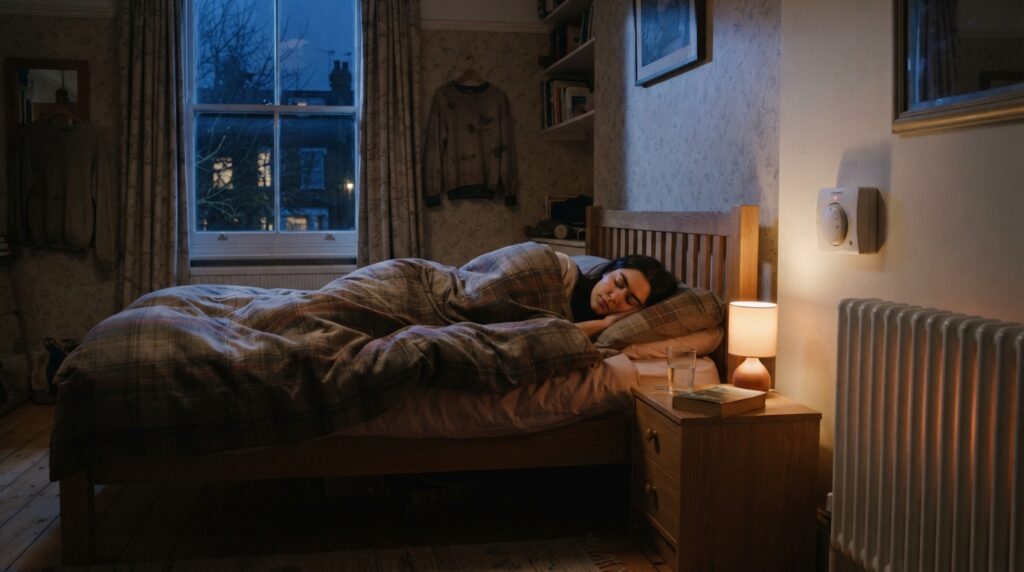
Turn it down, not off — that’s the answer for most households. A cooler bedroom is genuinely better for sleep, and there’s no efficiency argument for heating a house nobody’s awake in. But a setback of a few degrees beats switching off entirely, for three reasons: it protects against frozen pipes in a cold snap, it stops surfaces getting cold enough to condense on, and it means the house isn’t starting from scratch in the morning. The exception is households with older people or anyone unwell, where overnight warmth matters more.
This gets debated every winter with confident answers on both sides. The honest version has more nuance than either.
Why cooler at night is right
Two arguments point the same way.
Sleep. Body temperature naturally drops as you fall asleep, and a cooler room supports that. Sleep guidance generally points to a cool bedroom — cooler than you’d keep a living room. An overheated bedroom is a common and under-recognised cause of poor sleep, which is why our 3am waking guide covers temperature as a prime suspect.
Cost. Heating a house through the night when everyone’s asleep under a duvet is largely wasted. A setback overnight is one of the more straightforward savings available.
So the direction is clear. The question is how far.
Why “off” is the wrong setting
Three practical reasons.
1. Frozen pipes
The big one during a cold snap. Water expands as it freezes and splits pipes — and the flood usually comes on the thaw, when the ice melts and water pours out of the split.
Keeping a low background temperature overnight is the simplest protection there is, and it costs a fraction of an escape-of-water claim. Our frozen pipes guide covers the full picture.
2. Condensation and mould
A house that drops cold overnight has cold surfaces at 6am. Moisture from cooking, showering and simply breathing condenses on them.
Anyone who’s woken to streaming windows knows the effect. Repeated night after night, that’s how mould establishes — and damp and mould are a health issue, not just a decorating one. Our condensation guide covers the mechanism.
3. The morning recovery
A house that’s dropped several degrees takes a long time to come back up, and the fabric of the building — walls, floors, furniture — has cooled too. That’s why a house can read 20°C on the thermostat at 7:30am and still feel cold: the air has warmed but the surfaces haven’t. Our why 20°C feels cold guide explains why that matters more than people expect.
What to actually set
A workable approach for most households:
- A setback of a few degrees below your daytime setting overnight, rather than off.
- Bedrooms cooler than the rest of the house, using TRVs — that’s what per-room control is for.
- A frost protection setting if your system has one, as the absolute floor during a cold snap.
- Heating scheduled to come back on shortly before you get up, not the moment your alarm goes.
Our thermostat guide covers the daytime numbers, and our smart controls guide covers whether better scheduling hardware is worth buying — the short answer being that it depends heavily on what you have now.
When overnight heating matters more
Also worth flagging:
- Babies and young children. Different guidance applies — the Lullaby Trust points to around 16–20°C for a sleeping baby, and overheating carries its own risk. Our nursery guide covers it.
- Older relatives living alone. Worth checking what their heating actually does overnight rather than assuming — our elderly parents guide covers the seasonal conversation.
- A genuine cold snap. Raise the overnight floor when a hard frost is forecast. The pipe risk outweighs the saving.
The things that make a cool bedroom comfortable
If you want the sleep benefit without feeling cold, this is where to spend effort — and it’s mostly free.
- A warmer duvet rather than a warmer room. Far cheaper, and it keeps the air cool for breathing.
- Thermal or lined curtains, closed at dusk. A large cold window is a constant radiant drain on you all night.
- Draught-proof the bedroom door and window. A cold current across the bed is what actually wakes people, not the air temperature. Our draught-proofing guide covers it.
- A hot water bottle or an electric blanket on a timer — targeted warmth for a few pence rather than heating the whole house. Our running costs comparison covers which is cheapest.
- A rug beside the bed, so the first thing your feet touch isn’t a cold floor.
If you’re away, this changes
Leaving the heating off entirely while away for days in winter is a different and larger risk — and many insurance policies impose conditions, often requiring either a minimum temperature or a full drain-down beyond a set number of days unoccupied.
Our empty home checklist covers this, and it’s worth reading before Christmas rather than after.
Frequently asked questions
How many degrees should I set back overnight?
A few degrees below your daytime setting is the usual approach. Going deeper saves marginally more but increases the recovery time and the condensation risk. Experiment over a fortnight and see what your house does.
Does the boiler use more energy reheating in the morning than it saved?
No — this is a persistent myth. The house loses heat at a rate proportional to the temperature difference with outside, so a cooler house overnight loses less. Reheating costs energy, but less than was saved by not maintaining the higher temperature all night.
What about heat pumps — is the advice different?
Yes, somewhat. Heat pumps generally work best running steadily at lower output rather than in sharp cycles, so deep setbacks suit them less well than they suit gas boilers. If you have one, follow your installer’s guidance rather than boiler advice.
My bedroom is freezing but the living room is fine. Is that normal?
Common, and usually fixable — a seized TRV, a radiator needing bleeding, or thermostat placement. Our cold room guide works through the diagnosis.
Sources
- Energy Saving Trust — Thermostats and heating controls (scheduling, setbacks, TRVs)
- NHS — Keep warm, keep well
- NHS — Sleep and tiredness
- ONS / BBC — Heat and cold related deaths in England and Wales
- The Lullaby Trust — Room temperature
- Water UK — Frozen and burst pipes
- Citizens Advice — Grants and benefits to help pay energy bills
Related reading: our thermostat guide and 3am waking guide.
Related guides

Compare current prices, stock and reviews on portable air conditioners at Amazon UK. Prices and stock move fast in a heatwave, so it is worth checking before you commit.
Browse air conditioners →