Electric Blanket vs Heated Throw vs Hot Water Bottle: Running Costs
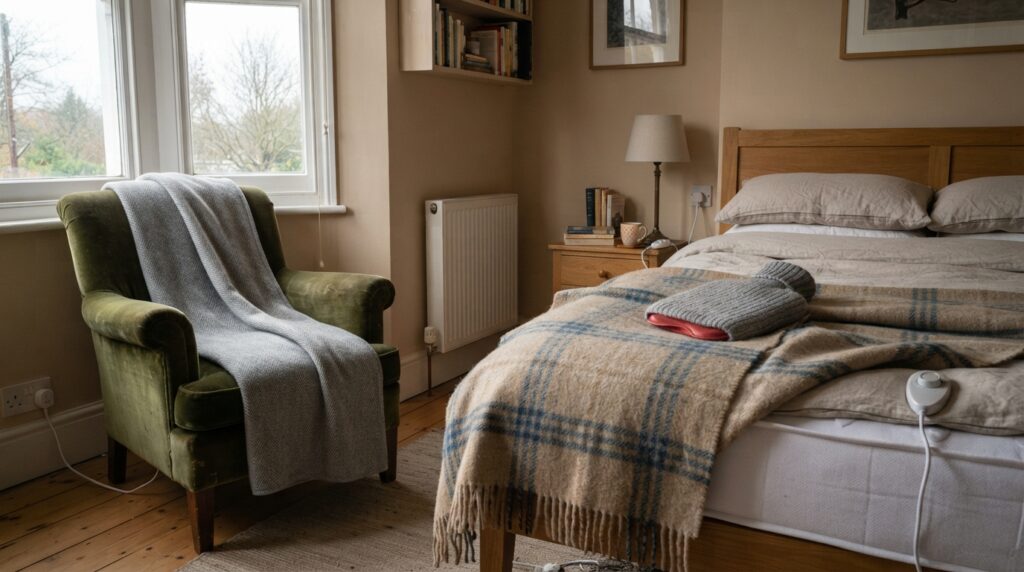
All three are dramatically cheaper than heating a whole room, which is the real point. Electric blankets and heated throws typically draw somewhere in the region of tens of watts, not hundreds — a fraction of a fan heater — so running one for an evening costs pennies. A hot water bottle costs whatever it costs to boil the kettle, and nothing after that. The honest comparison isn’t between the three; it’s between any of them and turning the central heating up, which is where the real money is.
These come up every autumn as the cost-of-living answer to a cold evening, and they genuinely work. Here’s how to think about them properly.
Why personal heating beats room heating
The principle underneath all of this: heating a person is vastly cheaper than heating the air, walls, floor and furniture around them.
Central heating warms an entire building’s worth of material, and the building loses that heat to outside continuously. A heated throw warms you directly, at a few tens of watts, and loses almost nothing.
That’s why these products are worth taking seriously rather than treating as a compromise — for a person sitting still in one place for an evening, they’re the efficient answer.
Working out what yours costs
Rather than quote figures that go stale with every price cap change, here’s the method — it takes thirty seconds and gives you an accurate answer for your own tariff.
- Find the wattage on the rating label or in the manual.
- Divide by 1,000 to get kilowatts.
- Multiply by your electricity unit rate in pence per kWh, from your bill or Ofgem’s current price cap figures.
- That’s your cost per hour at full draw.
Two things make the real cost lower than that number: most of these products have thermostats and cycle rather than drawing continuously, and most people use a lower setting than maximum.
Our running cost guide works through the same method for cooling, and our heating comparison covers why every resistive electric heater costs the same per watt.
The three options compared
Electric blanket (underblanket or overblanket)
Best for: bed, overnight or pre-warming.
An underblanket sits beneath the sheet and warms the bed before you get in. Many are designed to be switched off once you’re in — which means the running cost is only for the pre-warming period, often thirty minutes or so. That’s genuinely cheap.
An overblanket sits on top and is generally designed to be left on at a low setting, so it uses more over a night but keeps you warm continuously.
Check your model’s instructions on whether it’s rated for all-night use — this varies, and using one contrary to its instructions is not sensible.
This pairs well with the setback approach in our overnight heating guide: a cool bedroom is better for sleep, and a warm bed makes that comfortable rather than grim.
Heated throw
Best for: sitting on the sofa in the evening.
Essentially an overblanket for the living room. Typically similar power draw to an electric blanket, with a timer and multiple heat settings.
This is the one that most directly substitutes for turning the central heating up, because it targets exactly the situation — one or two people sitting still for a few hours — where whole-house heating is least efficient.
Worth noting for anyone working from home: it’s also a genuine alternative to heating a home office all day, covered in our home office guide.
Hot water bottle
Best for: targeted warmth, cheapest option, no electricity at the point of use.
Costs whatever it costs to boil the kettle — and if you’re boiling for tea anyway, the marginal cost approaches nothing. No standing power draw, works in a power cut if you have a gas hob, and it’s the cheapest of the three by a comfortable margin.
The trade-offs: it cools over a couple of hours, it warms a smaller area, and it needs refilling.
Electric blanket safety — the part that matters
• Age — replace roughly every ten years, or sooner if the manufacturer says so
• Scorch marks, fraying fabric, exposed elements or worn flex — stop using it
• Creasing or folding — store rolled or flat, never folded, as folds damage the internal wiring
• Never use one that’s wet, and never use with a hot water bottle
• Look for a recognised safety mark and buy from a reputable retailer — counterfeit electrical goods are a real problem online
Many fire services offer free electric blanket testing events. Worth searching for yours in autumn. If in doubt about an old blanket, replace it rather than risk it.
What to look for when buying
An electric blanket or heated throw
Pennies per evening
Timer + thermostat
Washable
What to look for: a stated wattage so you can calculate running cost, multiple heat settings and a thermostat so it cycles rather than drawing full power continuously, an auto-off timer, and confirmation of whether it’s rated for all-night use. Detachable controls and machine-washability matter more than they sound — an unwashable throw on a sofa doesn’t last. Check for a recognised safety mark and buy from a retailer you’d trust to honour a return.
Where these fit in a sensible winter plan
They’re a layer in a strategy, not the whole strategy:
- Fix the fabric first. Draught-proofing and loft insulation reduce demand permanently — our draught-proofing and loft insulation guides cover both.
- Control what you heat. TRVs turned down in unused rooms, doors closed — see our closed doors guide.
- Then use personal heating for the evening in one room, instead of raising the whole house.
Frequently asked questions
Which is genuinely cheapest?
A hot water bottle, especially if you’re boiling the kettle anyway. But the differences between all three are small compared with the difference between using any of them and turning the central heating up.
Can I leave an electric blanket on all night?
Only if the manufacturer’s instructions say so — this varies between underblankets and overblankets and between models. Many underblankets are designed for pre-warming only. Follow the manual rather than general advice.
Are heated throws safe for pets?
Claws and teeth damage the internal wiring, which is a genuine hazard. If you have pets that sit on the sofa, either keep the throw out of reach or accept it may need replacing sooner. Never use a damaged one.
What about heated clothing — gilets, socks, slippers?
Same principle and generally low power draw. Judge them the same way: check the wattage, look for a recognised safety mark, and buy from a reputable retailer. Our cold hands and feet guide covers the underlying issue, including when it’s worth mentioning to a GP.
Should I use one instead of putting the heating on at all?
As a supplement, yes. As a total replacement in a genuinely cold house, no — see the note above. Aim for a moderate room temperature plus personal heating, rather than a cold room plus a blanket.
Compare electric blankets, heated throws and hot water bottles at Amazon UK. Check the wattage on the listing so you can work out running cost before you buy.
Sources
- Energy Saving Trust — Home appliances and energy use
- Ofgem — Energy price cap (current unit rates)
- Electrical Safety First — Electric blanket safety
- National Fire Chiefs Council — Home fire safety
- NHS — Keep warm, keep well
- ONS / BBC — Heat and cold related deaths in England and Wales
- Citizens Advice — Grants and benefits to help pay energy bills
Related reading: our one-room heating guide and running costs comparison.