Best Portable Air Conditioners UK 2026: How to Choose, and What to Avoid
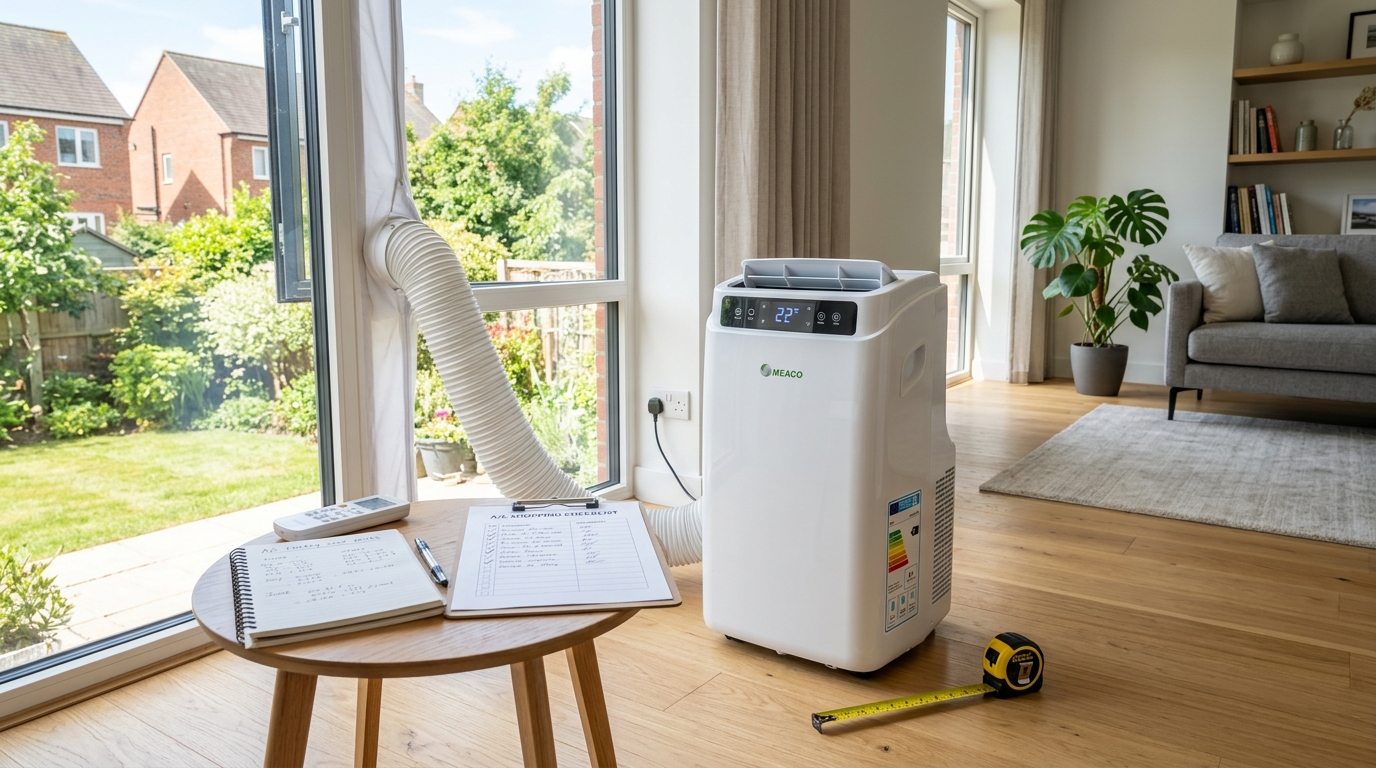
For most UK bedrooms and home offices, 7,000–9,000 BTU is the right size. The MeacoCool MC Series Pro 9000 is the unit we’d point most people at: a British brand, A-rated, published as 52 dB on low fan speed, and rated for rooms of 16–26m². Beyond that, the thing that most determines whether you’re happy with your purchase isn’t the model — it’s sizing the unit to the room and sealing the window kit properly. Both are covered below.
Get the size right — this matters more than the brand
Cooling capacity is measured in BTU per hour. The rule of thumb used across UK retail is roughly 500–600 BTU per square metre, adjusted upward for particular conditions.
Adjust up if the room has: large south or west-facing glazing, a high or vaulted ceiling, poor insulation, a loft directly above, or a lot of heat-generating equipment such as desktop computers or kitchen appliances.
Adjust down for a small, well-shaded, north-facing room.
- Up to 15m² — small bedroom, home office, box room: 7,000 BTU
- 16–26m² — standard double bedroom, small living room: 9,000 BTU
- 25–35m² — living room, open-plan area: 12,000 BTU
- 35m²+ — large open-plan kitchen-diner: 14,000 BTU or more, or two units
Oversizing is a real mistake, not just wasted money. An oversized unit cools the air quickly, satisfies its thermostat and shuts off before it has run long enough to remove much moisture. You end up with a room that’s cold but still clammy. Undersized, it runs continuously and never catches up.
Our BTU sizing guide works through the calculation properly, including how to account for glazing and aspect.
The picks
MeacoCool MC Series Pro 9000
Best all-round
16–26m²
52 dB low fan
A-rated
R290
Meaco is a British company that specialises in air treatment, and the documentation reflects it — published figures are specific and consistent across the manufacturer’s own site and major retailers, which is not universally true in this category. The Pro 9000 is rated for rooms of 16–26m², carries an A energy rating, uses R290 refrigerant, and comes with a two-year parts and labour warranty. App control via the Meaco app, with Alexa and Google Assistant support, and both fixed and flexible window kits are supplied — genuinely useful, since window kit fit is where most portable units disappoint.
Good for: standard double bedrooms and small living rooms; anyone who wants to pre-cool a room remotely before getting home; households with awkward window types.
Less good for: light sleepers who want silence. Trusted Reviews measured 58.5 dB in fan-only mode and described it as noticeably louder than an equivalent fan. Like all mono-block portables, the compressor sits inside the unit, so a fixed split system will always be quieter indoors.
MeacoCool MC Series 9000 (MC9000)
Simpler, no app
16–26m²
53 dB minimum
A-rated
The non-Pro version of the same size class. Same room coverage and A energy rating, published at a 53 dB minimum noise level, with two fan speeds, an oscillating louvre and a built-in dehumidify mode. No app control, which for a lot of households is not a loss — a plug-in timer achieves most of the same scheduling benefit.
Good for: anyone who wants the same cooling capacity and brand support without paying for smart features they won’t use.
Less good for: people who genuinely want remote control — pre-cooling a bedroom from your phone on the way home is the one smart feature that earns its keep in this category.
MeacoCool MC Series 7000
For small rooms
Small rooms
Meaco range entry
Meaco describe the 7000 BTU as the smallest and most budget-friendly model in their range, intended for small home and office spaces. If your room is genuinely under about 15m², this is the right size — and buying down rather than up is the correct instinct here, because a right-sized unit dehumidifies properly and costs less to run.
Good for: box rooms, small home offices, single bedrooms.
Less good for: anything approaching 20m², where it will run continuously without reaching temperature. Check the current published room-size range on Meaco’s own site before buying, since figures are revised between model years.
MeacoCool MC Series Pro 9000 CH
Cools and heats
8,000 BTU heating
16–26m²
53 dB low fan
The reverse-cycle version, which heats as well as cools. The MC Series manual gives 9,000 BTU cooling and 8,000 BTU heating, with R290 refrigerant and a 53 dB noise level at low fan speed. That heating capability changes the value calculation considerably — instead of sitting in a cupboard for eight months, it works through autumn and spring as an efficient one-room heater. Our heat pump guide explains how reverse-cycle operation works.
Good for: anyone who wants year-round use from one appliance, or who has a cold room in a house that’s otherwise adequately heated.
Less good for: deep winter. Heat pump output falls as outside temperatures drop, and units run periodic defrost cycles that briefly blow cool air. Treat it as a shoulder-season and mild-winter heater, not a replacement for central heating.
Meaco Cirro
Quietest in the range
Dual-wrapped compressor
Newest model
Meaco’s newer Cirro line is built around noise reduction: the manufacturer publishes a Super Quiet mode at 45 dB, describing it as roughly half the noise level of their previous portable air conditioners, achieved with a dual-wrapped compressor. If noise is your main objection to portable air conditioning — and for bedroom use it usually should be — this is the part of the range worth looking at first.
Good for: bedrooms, nurseries, home offices where you’re on calls, and anyone who has previously given up on a portable unit because of the noise.
Less good for: tight budgets. As the newest line it sits at the upper end of the range, and the quiet mode will run at reduced output — you’re trading some cooling speed for the silence. Check current specifications and sizing on Meaco’s site, as this line is newer and figures may be revised.
Other brands worth shortlisting
We’ve led with Meaco because their published specifications are consistent and verifiable across the manufacturer’s own site and major retailers, which makes recommendations defensible. That isn’t a claim that nothing else is good.
Other brands widely sold in the UK and worth comparing on the same criteria are Pro Breeze, Igenix, Electriq, De’Longhi, Olimpia Splendid, Honeywell and Duux. When you compare them, check these five things on the listing or the manufacturer’s page rather than trusting a headline:
- Stated room size range, not just BTU
- Noise level in dB, and at what fan speed — a figure quoted without the fan speed is close to meaningless
- Energy class
- Whether a flexible window kit is included, and whether it suits your window type
- Whether continuous drainage is supported, which matters more than self-evaporation claims — our drainage guide covers why
The two things that decide whether you’re happy
More than the model, honestly.
Seal the window kit properly. Most supplied kits fit approximately. Every gap lets hot air straight back in — and with a single-hose unit the room is under slight negative pressure, actively pulling outside air in through every gap you leave. Foam tape or draught strip costs very little and changes performance more than most upgrades to the unit itself. Our seal kits guide covers the options.
Keep the hose short and straight. That hose gets hot, and every metre of it inside your room is working against you. Kinks restrict exhaust flow and make the compressor work harder.
Our ten things that actually improve performance covers the rest, and almost all of it is free.
Single-hose or dual-hose?
A single-hose unit vents hot air outside but draws its intake air from inside the room, which means replacement air is pulled in from elsewhere in the house through every available gap. A dual-hose unit draws intake air from outside instead.
Dual-hose is more efficient in principle. In practice most units sold in the UK are single-hose, and a well-sealed single-hose unit in a closed room performs perfectly acceptably. Our full comparison covers when the difference is worth paying for.
Running costs
Rather than quote a figure that will be wrong by next quarter, here’s the calculation. Take the unit’s power consumption in watts from the rating plate or manual, divide by 1,000, and multiply by your electricity unit rate in pence per kWh. That gives cost per hour at full draw — and with a thermostat the unit cycles, so real cost is lower.
Ofgem publishes the current price cap unit rates. Our running cost guide works through the method and the habits that reduce it.
Buy out of season
Stock on popular units disappears during hot spells, and UK retailers reported air conditioner and fan supply running low during the June 2026 heatwave. Prices on what remains tend to firm up at exactly the moment demand peaks.
Autumn, winter and early spring are the sensible windows. Our buying timing guide covers the calendar, our Black Friday guide covers November, and our fake discount guide covers telling a real saving from a manufactured one.
Frequently asked questions
Is a portable air conditioner worth it for a UK summer?
For renters, or anyone who can’t install a fixed system, yes. UK heatwaves have gone from rare to reliably occupying several weeks a summer, and a decent unit lasts years. If you only get a handful of hot days, a good fan and closed curtains will usually do — and cost almost nothing.
Do I need planning permission?
Not for a genuine portable unit vented through an opening window — nothing is installed or altered. A fixed split system with an outdoor condenser is a different matter, and there are separate rules for leasehold flats and listed buildings and conservation areas.
Can I plug it into an extension lead?
Plug directly into a wall socket wherever possible. These draw high current for hours at a time, and an underrated or coiled extension is a genuine fire risk. Our electrical safety guide covers it.
What if the room has no window?
A portable unit must exhaust outside the room it’s cooling — run unvented it makes the room warmer, because the compressor’s own energy consumption becomes heat. There are workable alternatives, covered in our windowless room guide.
How noisy is too noisy for a bedroom?
There’s no single threshold, but the published figure is usually measured at the lowest fan speed, and units are considerably louder at full speed. If the manufacturer publishes a quiet mode figure, that’s the one that matters for sleeping. Check whether the compressor cycling — which is the intrusive part — is audible in reviews rather than only the steady fan noise.
Sources
- Meaco — MeacoCool portable air conditioners (Cirro Super Quiet 45 dB, dual-wrapped compressor)
- Meaco Dehumidifiers — MeacoCool MC9000 (53 dB minimum, 16–26m², A rating, airflow)
- Argos — MeacoCool MC Series Pro 9000 (room size, energy class, warranty, hose and duct dimensions)
- B&Q — MeacoCool MC Series Pro 9000 (52 dB low fan speed, 16–26m²)
- ManualsLib — MeacoCool MC Series instruction manual (9,000 BTU cooling / 8,000 BTU heating, R290, 53 dB)
- Trusted Reviews — MeacoCool MC Series Pro 9000 review (independent 58.5 dB fan-only measurement, dimensions, weight)
- Ofgem — Energy price cap
- Energy Saving Trust — Home appliances and energy use
Compare current prices, stock and specifications on portable air conditioners at Amazon UK. Check the stated room size and noise level against your room before you commit.