What Temperature Should I Set My Thermostat in Winter?
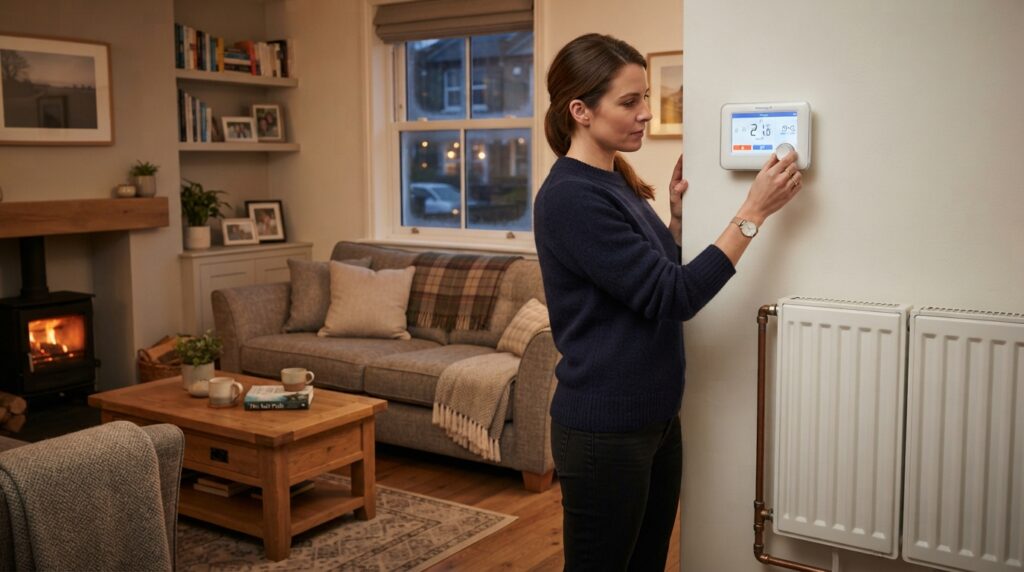
For most households, somewhere in the region of 18–21°C for occupied living rooms, with 18°C generally treated as a sensible minimum — particularly where anyone is older or has a health condition. Bedrooms can be cooler. The bigger savings usually come not from the number but from when the heating runs and which rooms it heats, which is what thermostatic radiator valves and a decent schedule are for.
This gets asked every autumn and answered with a single number, which isn’t quite right. Here’s the fuller picture.
The numbers, and where they come from
UK health guidance has long pointed to around 18°C as a sensible minimum for occupied rooms, with particular emphasis for older people and those with health conditions. Comfort guidance for living spaces generally sits around 18–21°C.
Beyond that, it’s genuinely a personal judgement — and a legitimate one. What matters more than hitting a specific figure is:
- Not being below roughly 18°C for extended periods in occupied rooms
- Not heating rooms nobody’s in to the same temperature as ones you’re using
- Not heating an empty house
Room by room
- Living room: 18–21°C when occupied. This is where most people spend evenings, so it’s the room worth getting right.
- Bedrooms: cooler is generally better for sleep — sleep guidance points to a cool room in the mid-to-high teens. But consistency matters as much as the number, as covered in our 3am waking guide.
- Hallways and landings: lower. You pass through them.
- Unused rooms: low, but not off. See below — this is the mistake that costs people money later.
- Bathroom: people often want this warmer for the short time it’s used, which is what a TRV and timing are for rather than raising the whole house.
- Nursery: different rules entirely — NHS and Lullaby Trust guidance points to around 16–20°C for a sleeping baby. Our nursery guide covers this.
Don’t switch unused rooms off entirely
This is the counterintuitive point worth taking seriously.
A completely unheated room develops cold surfaces, and moisture migrating from the rest of the house condenses on them. That’s why the unused spare room is so often the one with mould behind the wardrobe.
Keeping unused rooms at a low background temperature — rather than off — costs far less than remediating mould, which is a health issue as well as a decorating one. Our condensation guide covers the mechanism.
Does one degree really matter?
Yes, more than people expect. Heat loss from a house is roughly proportional to the difference between inside and outside temperature — so raising the indoor temperature by a degree increases that difference and therefore the rate of loss, across the whole heated envelope, for as long as the heating runs.
The Energy Saving Trust’s long-standing advice is that turning the thermostat down by one degree can produce a meaningful annual saving. Their current figures are on the page linked below, and worth checking rather than relying on a number quoted second-hand.
Practical version: try one degree lower for a fortnight before deciding it’s not tolerable. Many people find they don’t notice, particularly if they’ve also addressed the draughts and cold surfaces covered in our why 20°C feels cold guide.
The schedule matters more than the number
Heating an empty house is pure waste, and it’s where most households lose money.
- Set the heating to come on shortly before you need it, not hours before. Modern boilers heat a room reasonably quickly.
- Set it to go off before bed or before you leave, not at the moment you do — residual heat carries you for a while.
- Different schedules for weekdays and weekends if your routine differs.
- Don’t leave it on constant “for efficiency”. This is a persistent myth. A house loses heat continuously in proportion to how much warmer it is than outside, so keeping it warm for longer means losing more heat overall. The exception is the low background temperature for unused rooms above.
Our smart heating controls guide covers whether upgrading your controls is worth it — the short version being that it depends heavily on what you have now.
Use TRVs, and check they work
The single biggest control improvement for most households, and frequently free.
Thermostatic radiator valves let you turn down rooms you aren’t using, so the system runs longer for the rooms you are. That’s often the fix for the “one room is freezing while another is boiling” problem.
Before buying anything, check your existing ones aren’t seized. A valve left in one position all summer very frequently sticks. Pull off the plastic head and check the pin underneath moves freely — if it’s stuck down, gently free it. Our cold room guide covers the full diagnostic.
Where the thermostat is matters
Your thermostat controls the whole system based on one spot. If that spot is unrepresentative, everything else follows.
- Not near a radiator, lamp, TV or in direct sunlight — it’ll read high and shut the system down early.
- Not in a draught — it’ll read low and overheat everything else.
- Not in an unusually warm or cold room. A thermostat in a hall with a wood burner nearby satisfies before the rest of the house is warm.
If your living room has its own heat source and satisfies the thermostat early, turning down the TRVs in that room so the system runs longer is often the counterintuitive fix.
Boiler flow temperature: the setting people miss
Worth mentioning because it’s separate from the room thermostat and frequently overlooked.
Condensing boilers are most efficient when the water returning to them is cool enough for the flue gases to condense. Many are installed with the flow temperature set higher than necessary, which prevents that and reduces efficiency.
Lowering the flow temperature on a combi boiler serving radiators can improve efficiency — the Energy Saving Trust has current guidance on this, linked below. The trade-off is that radiators run cooler and rooms warm more slowly, so it suits a household that heats steadily rather than in short bursts. Check your boiler manual, and ask your engineer at the next service.
Frequently asked questions
Is it cheaper to leave the heating on low all day?
Generally no. A house loses heat continuously in proportion to the temperature difference with outside, so keeping it warmer for longer means losing more overall. Heat when you need it, with a schedule. The exception is keeping unused rooms at a low background temperature to prevent damp.
Does turning the thermostat up make the house heat faster?
No. The boiler and radiators output heat at their rate regardless of the target. Setting 25°C when you want 20°C just means it overshoots and runs longer. Same principle as the air conditioner version in our cooling temperature guide.
What if my household disagrees about the temperature?
Genuinely common, and thermal comfort varies legitimately between people. Per-room control via TRVs is the practical answer — different rooms at different temperatures beats arguing about one number. Layers and warm surfaces also do more than people expect.
Should I turn it down at night?
Most people do, and cooler is generally better for sleep. Don’t turn it off entirely in a cold snap though — a floor under the overnight temperature protects against both burst pipes and the condensation that follows a cold night. Our frozen pipes guide covers the freeze risk.
Sources
- Energy Saving Trust — Thermostats and heating controls (recommended settings, one-degree saving, TRVs)
- Energy Saving Trust — Boilers (flow temperature guidance)
- NHS — Keep warm, keep well
- ONS / BBC — Heat and cold related deaths in England and Wales
- The Lullaby Trust — Room temperature (nursery guidance)
- Citizens Advice — Grants and benefits to help pay energy bills
Related reading: our why 20°C feels cold guide and smart controls guide.
Related guides


Compare current prices, stock and reviews on portable air conditioners at Amazon UK. Prices and stock move fast in a heatwave, so it is worth checking before you commit.
Browse air conditioners →