Looking After Elderly Parents Through Winter and Summer: A Year-Round Plan
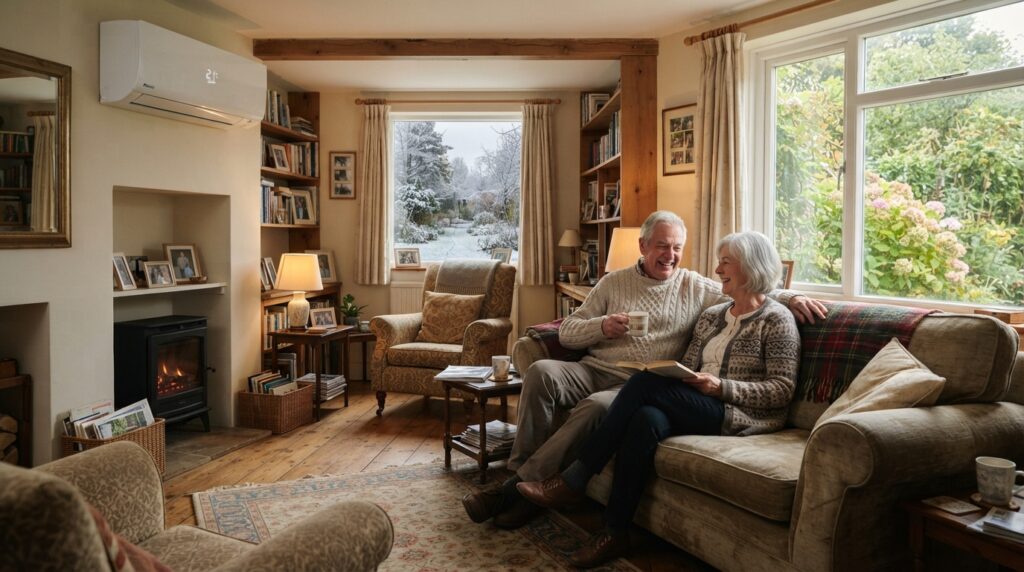
Most advice treats winter cold and summer heat as separate problems. They aren’t — they’re the same vulnerability expressed twice a year, and the same practical setup handles both. Aim for one room held at a stable, safe temperature, a simple appliance your parent can operate without help, and a check-in routine you actually keep. Cold remains the bigger killer overall in England and Wales, but heat mortality is rising fast and concentrates in the oldest age groups.
If you’re in your fifties, there’s a reasonable chance you’re the person who notices that your parents’ house is freezing in February and stifling in July. This is a single plan for both.
Why it’s the same problem twice
Thermoregulation becomes less effective with age. The body’s responses to both heat and cold — sweating, shivering, circulatory adjustment — become slower and less reliable. So does the perception of temperature, which is the part that catches families out: an older person may genuinely not feel that a room is dangerously cold or hot.
Add common factors — reduced mobility making it harder to adjust the environment, medications affecting temperature tolerance, cardiovascular and respiratory conditions, and living alone — and the same person is at elevated risk in January and July.
The numbers bear this out in both directions. UKHSA’s heat monitoring consistently finds the highest heat-associated mortality rates in the oldest age groups — in 2024, 521 per million for those aged 85 and over against 111 per million for 75–84. On the cold side, ONS analysis shows cold remains a larger cause of temperature-related mortality in England and Wales overall.
The setup that handles both
One room, held stable, with an appliance they can actually use.
Choose the bedroom. Overnight is when the risk concentrates in both seasons — the body needs a recovery period, and a bedroom that’s freezing at 4am or stifling all night removes it.
A reverse-cycle heat pump unit is the single most useful appliance for this specific situation, because it does both jobs from one set of controls. There’s no seasonal changeover, nothing to store, nothing to set up again in June. You fit it once and it holds a temperature year-round. Our heating mode guide covers how to check a unit genuinely has this.
Prioritise simplicity over features. Large physical buttons, a clear display showing an actual number, and a remote with few keys beat anything app-based. Our easiest units guide covers picks chosen on exactly this basis.
Set it and leave it. Fit it, set a sensible temperature, and show them one button. Write the target on a sticky note stuck to the unit. Don’t demonstrate every mode.
Target temperatures
Winter: general guidance for older people points to heating the rooms they use to around 18°C or above, and keeping bedrooms comfortably warm overnight. Below that, cardiovascular and respiratory risk rises.
Summer: keeping at least one room below 26°C, and ideally the bedroom cooler overnight. Our heatwave guide covers this in depth.
Both: stability matters as much as the number. Big swings are harder on an ageing cardiovascular system than a steady moderate temperature.
Fit a simple thermometer in the main room so both of you can see what’s actually happening rather than guessing — our thermometers guide covers cheap options. This also gives you something concrete to ask about on the phone.
The seasonal calendar
| When | What to do on a visit |
|---|---|
| Sept–Oct | Test the heating; bleed radiators; free stuck TRVs; book the boiler service; clear gutters; check the thermometer is working |
| Nov–Dec | Draught-proof; check for a working CO alarm; check they’re claiming everything they’re entitled to |
| Jan–Feb | Daily-ish contact during cold snaps; watch for the house being cold when you visit |
| Mar–Apr | Service or clean the cooling unit; test it works; check filters |
| May–Aug | Register for Heat-Health Alerts; check in during hot spells; make sure they’re actually switching it on |
The reluctance problem, in both seasons
The most common obstacle isn’t the equipment — it’s a generation that doesn’t want to waste money. Families report the same thing in winter and summer: the appliance is there, and it’s off.
What tends to work better than persuasion:
- Give them a concrete cost. “Running this overnight costs less than a pint of milk” is more effective than “don’t worry about the bill.” Our running cost guide has the figures.
- Frame it as a health measure, not a comfort one — the same category as a grab rail or a non-slip mat, rather than a luxury.
- Check they’re claiming what they’re entitled to. Pension Credit, Winter Fuel Payment, Cold Weather Payment, the Warm Home Discount and Attendance Allowance are all commonly under-claimed. Pension Credit in particular acts as a gateway to other support. Citizens Advice and Age UK can do a benefits check — links below.
- Set a timer or schedule so it runs without them deciding to switch it on.
Warning signs, both directions
Too cold: shivering, or notably not shivering while cold to the touch; drowsiness or confusion; slurred speech; cold skin on the chest or back, which is more telling than hands. Hypothermia can develop slowly indoors, and confusion is often the first thing a family notices.
Too hot: confusion or disorientation that’s a step change from normal; rapid breathing or pulse; unusual fatigue; very dark urine; skin that’s hot and dry rather than sweaty — because the sweating response may not be working.
Common to both: confusion is frequently the earliest sign, and it’s easy to misread as ordinary forgetfulness. If a parent seems unusually muddled during a cold snap or a heatwave, check the room temperature before assuming anything else.
In either case: move them to a safer room, call NHS 111 for advice, or 999 if they’re seriously unwell. Don’t wait to see if it passes.
The house itself
Fabric improvements help in both seasons and reduce running costs permanently:
- Loft insulation — keeps heat in during winter and out during summer. Building Regulations guidance points to around 270mm.
- Draught-proofing — cheap and effective. Our guide covers it, including what not to block.
- Thermal curtains — reduce winter heat loss through glass and block summer solar gain. Genuinely dual-purpose.
- Clear gutters — wet walls are cold walls, and damp is a respiratory risk. Our storm-proofing guide covers the autumn jobs.
Some households may qualify for help with insulation or heating improvements through government schemes — worth checking rather than assuming, and Citizens Advice can advise on current eligibility.
The conversation about the check-in routine
Agree something specific and sustainable rather than vague. A short call each morning during a cold snap or heatwave, at a set time, works better than “I’ll ring if I’m worried” — because you’ll both forget, and because a missed call becomes a signal.
If you’re not local, a neighbour who’ll knock is worth more than any technology. Some councils and charities run check-in schemes during severe weather — worth asking before you need it.
Frequently asked questions
My parent insists they’re fine. How hard do I push?
Focus on the measurable rather than the subjective — a thermometer reading is harder to argue with than “it feels cold in here.” Fitting equipment and leaving it set is often more effective than winning the argument.
Is one appliance really enough for both seasons?
A reverse-cycle heat pump unit genuinely does both, which is why we suggest it for this situation specifically. It won’t replace central heating for a whole house — it holds one room, which is the room that matters.
What if they live in sheltered housing or a care setting?
Speak to the scheme manager or provider — they’ll have policies on appliances and may already have provision. Providers also have obligations regarding safe temperatures.
Should I register them for anything in advance?
Yes, and it’s worth doing before you need it: their energy network operator’s Priority Services Register, Heat-Health Alerts from UKHSA and the Met Office, and a benefits check with Age UK or Citizens Advice. All free, all linked below.
Sources
- UKHSA / GOV.UK — Heat mortality monitoring report, England: 2024 (age-group mortality rates)
- UKHSA / GOV.UK — Hot weather and health: supporting vulnerable people
- UKHSA / GOV.UK — Cold weather and health guidance
- ONS / BBC — Heat and cold related deaths in England and Wales
- NHS — Keep warm, keep well
- NHS — Hypothermia (warning signs)
- Age UK — Benefits and entitlements
- Citizens Advice — Grants and benefits to help pay energy bills
- Met Office — Heat-Health Alerts
Related reading: our heatwave guide and easiest units guide.
Related guides



Compare current prices, stock and reviews on portable air conditioners at Amazon UK. Prices and stock move fast in a heatwave, so it is worth checking before you commit.
Browse air conditioners →