How to Maintain Your Portable Air Conditioner
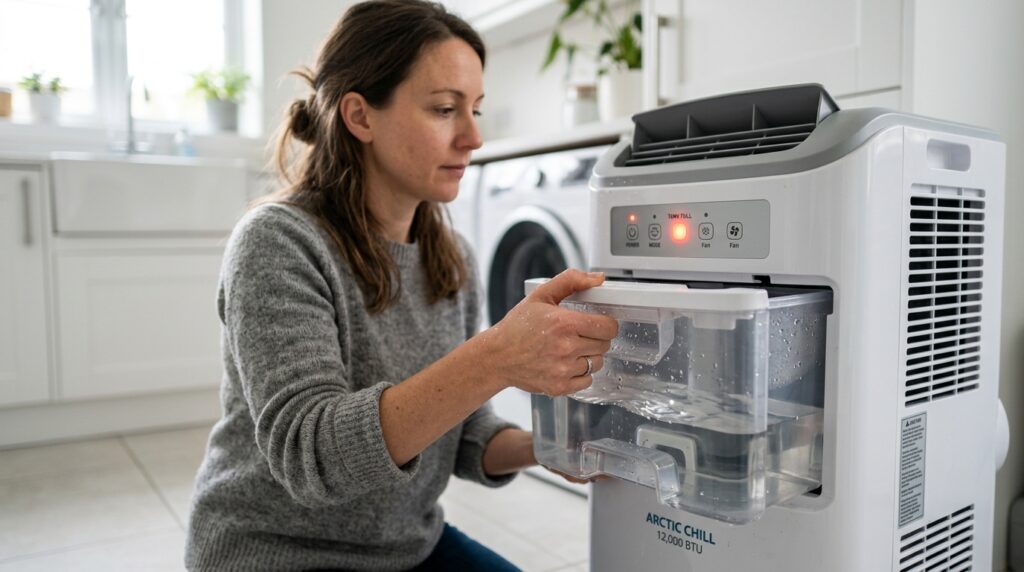
Four habits cover almost all of it: clean the filter every two weeks during use, keep the exhaust hose short and straight, seal the window kit properly, and dry the unit out before storing it. That last one is the most-skipped and causes the most complaints — a unit put away damp spends eight months as a sealed, dark, humid box, and the musty smell people meet the following June is the result.
A portable air conditioner is a simple machine. The habits around it make more difference than the model does, both to how well it cools and to what it costs to run.
During the season: every two weeks
Clean the filter
The single highest-value maintenance task, and the reason most units seem to weaken over a summer.
A clogged filter restricts airflow across the evaporator coil, so less heat is removed per minute, so the compressor runs longer for the same result. That shows up on your bill, and in severe cases the coil ices over and cooling stops entirely.
Most filters slide out and can be vacuumed or rinsed — check the manual, since some shouldn’t get wet. Let it dry completely before refitting, over hours rather than minutes. A damp filter is the main cause of the smell covered in our smell guide.
Weekly rather than fortnightly if you have a shedding pet — our pets guide covers why fur clogs filters so quickly.
Check the hose
Look for kinks, sagging and splits, particularly at the couplings where it meets the unit and the window kit. Keep it as short and straight as the room allows — the hose gets hot, and every extra metre inside your room radiates heat back into the space you’re cooling.
Re-check the window seal
Gaps open up as kits get knocked. With a single-hose unit the room sits under slight negative pressure, so it’s actively pulling warm outside air in through any gap — our hose comparison explains the mechanism, and our seal kits guide covers doing better than the supplied kit.
Check drainage
Empty the tank, or better, set up continuous drainage to a drain or sink so it never fills and never shuts off mid-night. Our drainage guide covers the setup, including why “self-evaporating” doesn’t mean “no water ever”.
Positioning
- Leave clearance around intake and exhaust as the manual specifies — commonly around 30cm.
- Flat and level. Most units rely on gravity for internal drainage, and an unlevel unit is a common cause of leaks.
- Out of direct sunlight where possible.
- Away from curtains and furniture, both for airflow and because fabric against a hot exhaust is a fire risk.
- As close to the window as the room allows, to keep the hose short.
End of season: the part that matters most
Do this properly and next summer’s unit works. Skip it and you’ll meet the smell.
- Run it on fan-only for two to four hours with no cooling, to dry the internal coils. This is the step people skip, and it’s the important one.
- Drain all remaining water from the tank and any drain port.
- Clean the filter and let it dry completely before refitting. Don’t store the unit with the filter out — the aperture collects dust.
- Disconnect the hose and coil it loosely. Folded tightly for eight months, the accordion material takes a permanent crease that restricts airflow forever after.
- Store it upright, somewhere dry and temperature-stable. A spare room or dry loft beats a garage that swings between wet and frozen.
- Keep the window kit with the unit — it’s the part that goes missing between seasons. Tape it to the unit or bag it together.
- Cover it loosely against dust, provided it went in dry. Never seal a damp unit under a cover.
Our winter storage guide covers this in more detail, and our winter running guide explains why you shouldn’t run a cooling-only unit periodically through winter — most have a minimum operating temperature, and running the compressor below it can ice the coil.
Bringing it back in spring
Do this in March or April, not in the first heatwave. Finding a fault in spring means you have options; finding it in July means competing with everyone else for stock.
- Stand it upright for a few hours before switching on, especially if it’s been moved.
- Check and clean the filter.
- Inspect the hose and couplings for creases and cracks.
- Check the plug and cable for damage before the first run.
- Run it for twenty minutes on a mild day. Confirm the compressor engages and the air is genuinely cold.
- Smell it. Musty means moisture got in over winter.
Our spring reset checklist covers the full changeover, and our winter check covers the mid-season look.
Troubleshooting: where to go next
- Not cooling properly → our troubleshooting guide
- Ice on the coils → our frozen coils guide
- Leaking water → our leaking water guide
- Musty smell → our smell guide
- Burning or electrical smell → stop using it, and see our safety guide
- Tripping the breaker → our electrical guide
- Taking too long to cool → our expectations guide
- Getting more from the unit you own → our ten things that actually help
What you shouldn’t do yourself
When to replace rather than repair
Worth being straight about, since maintenance can’t fix everything:
- Any electrical fault — a burning smell, a damaged cable, a melted plug. Not a category to gamble on.
- Refrigerant loss. A sealed system shouldn’t lose refrigerant; if it has, there’s a leak, and on an older portable the repair rarely justifies the cost.
- Repeated faults across successive seasons.
- Parts no longer available for a discontinued model.
- A unit that was always undersized. No amount of maintenance fixes a capacity problem — our sizing guide covers getting it right next time.
If you are replacing, buy outside summer. Our timing guide covers the calendar, and our second-hand guide covers the used route.
Frequently asked questions
How often should I clean the filter?
Every two weeks during regular use, weekly with pets or in a dusty room. It’s the most common cause of a unit that seems to have suddenly weakened, and it’s a five-minute job.
Can I run it all day?
Most are built for continuous running, but it’s rarely necessary. Pre-cooling in the late afternoon and letting the room coast costs less than running from cold at bedtime — our cooling times guide covers why.
Why is it leaking water?
Usually a full tank, a kinked or blocked drain hose, or an unlevel unit. If it persists on a self-evaporating model after checking those, the internal drainage needs a proper look.
Should I store it over winter?
Yes, unless it has a heating mode and you’ll use it. Dry the coils in fan mode first, drain fully, clean and dry the filter, and store upright somewhere dry. That routine is the difference between a unit that works next June and one that smells.
It smells odd on the first run of the season. Is that a fault?
A brief dusty smell that clears within an hour is normal after storage. Musty means trapped moisture — run fan mode with the window open. Anything acrid or like burning plastic means unplug it and read our safety guide.
Sources
- Electrical Safety First — Electrical safety around the home
- Electrical Safety First — Extension leads
- GOV.UK — Fluorinated gases (F-gases): rules
- Energy Saving Trust — Home appliances and energy use
- National Fire Chiefs Council — Home fire safety
If maintenance has run out of road — an electrical fault, refrigerant loss, or a unit that was always undersized — compare current specifications at Amazon UK. Buying outside summer means normal availability.