Winter Condensation, Damp and Mould: What Actually Works
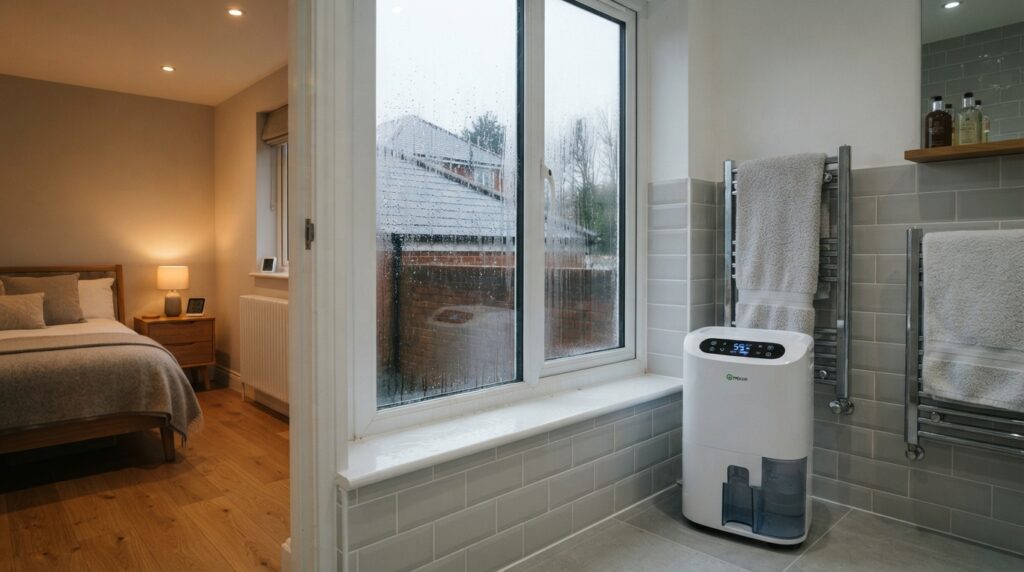
Condensation forms when moist air meets a surface cold enough to reach its dew point. So there are only three levers: make less moisture, remove more moisture, or make surfaces warmer. Most households only try the middle one. The highest-value fixes are covering pans while cooking, venting the tumble dryer properly, using extractor fans that actually work, and keeping unused rooms at a low background temperature rather than switching them off entirely. A dehumidifier helps genuinely, but it treats the symptom.
This is the defining winter housing problem in Britain, and it’s about to be a bigger one than usual: a wetter, stormier winter means more moisture in the fabric of buildings and fewer dry, breezy days to shift it. Worth getting ahead of in autumn.
The physics, briefly, because it makes everything obvious
Warm air holds more water vapour than cold air. As air cools, its capacity drops. At some point it reaches saturation — the dew point — and water condenses out onto whatever surface cooled it.
That’s why condensation appears on windows first: glass is the coldest surface in most rooms. It’s also why it appears in corners, behind wardrobes on external walls, and on cold spots where insulation is missing or bridged.
The key insight: condensation is a symptom of a mismatch between moisture level and surface temperature. You can fix it from either side.
Is it condensation, penetrating damp, or rising damp?
Worth diagnosing before spending money, because the fixes are entirely different.
Condensation appears on cold surfaces, is worst in winter, worst in the mornings, concentrated around windows, in corners, and in rooms generating moisture (kitchen, bathroom) or unheated bedrooms. Mould is typically black, in patches, on surfaces rather than in the wall.
Penetrating damp comes from outside — a defect letting water in. It’s often worse after rain, appears as a localised patch that may spread, and frequently has an external cause you can find: a blocked gutter, cracked render, failed pointing, a slipped tile. This is exactly why the gutter-clearing job in our storm-proofing guide matters so much.
Rising damp comes up from the ground through masonry, is confined to the lowest part of ground-floor walls, typically stops at a fairly consistent height, and often leaves a tide mark with salt deposits. It’s genuinely much rarer than the damp-proofing industry suggests, and frequently misdiagnosed condensation or penetrating damp.
Lever one: make less moisture
Ordinary household activity produces a surprising amount of water vapour. Reducing it at source is free and effective.
- Cover pans when cooking. Genuinely one of the highest-value habits on this list — an uncovered pan of boiling water releases a great deal of vapour.
- Vent the tumble dryer properly outside, or use a condenser or heat pump model. A vented dryer exhausting into the room is one of the largest indoor moisture sources there is.
- Don’t dry washing on radiators if you can avoid it. All the water in that laundry ends up in your air. If you must dry indoors, do it in one room with the door closed and a window slightly open or a dehumidifier running.
- Close the bathroom door when showering, and keep the extractor running for fifteen minutes afterwards.
- Put lids on aquariums and be aware that a lot of houseplants add measurable humidity.
Lever two: remove more moisture
Extractor fans, working properly. Check yours actually extracts — hold a sheet of tissue to it; if it doesn’t hold, the fan or the duct is failing. Blocked external grilles are extremely common. This is the single most-neglected item in most homes.
Trickle vents. Modern windows have them, and people close them to stop draughts. Leaving them open costs a little heat and prevents a lot of moisture accumulation.
Purge ventilation. Opening windows wide for five to ten minutes exchanges the air without significantly cooling the walls and furniture, which hold most of the room’s heat. Far better than leaving a window on the latch all day.
A dehumidifier genuinely works and is the right tool when the moisture load is high — drying laundry indoors, a persistently damp room, or after storm-related water ingress. Our dehumidifiers guide covers choosing one.
Worth knowing: an air conditioner dehumidifies inherently as part of cooling, which is useful in summer but not applicable to winter damp — in cold weather you want a dedicated dehumidifier, not an air conditioner. Our AC vs dehumidifier guide covers where each belongs.
Lever three: make surfaces warmer — the one people skip
This is where the real long-term fix usually sits, and it’s counterintuitive if you’re trying to save money on heating.
Don’t switch unused rooms off entirely. A completely unheated room develops cold surfaces, and moisture migrating in from the rest of the house condenses there. This is why the spare bedroom is so often the mouldy one. A low background temperature costs far less than remediating mould.
Move furniture off external walls. A wardrobe flat against a cold external wall creates an unventilated cold pocket behind it — a classic mould location. Leave a gap of a few centimetres.
Insulate. Loft insulation, cavity wall insulation and improved glazing all raise internal surface temperatures, which raises the dew point threshold you’d have to cross. Building Regulations guidance points to around 270mm of loft insulation. This is the durable fix.
Address cold bridges — lintels, window reveals, wall-floor junctions. These are localised cold spots where mould appears in an otherwise fine room.
Dealing with mould that’s already there
- Find and fix the cause first. Cleaning mould without addressing why it grew guarantees it returns.
- Ventilate the room while you work and wear gloves and a mask — disturbing mould releases spores.
- Clean it off with an appropriate product, following the instructions. Don’t dry-brush it, which disperses spores.
- Don’t just paint over it. Mould-resistant paint helps as part of a fix; it isn’t a fix on its own.
- If it keeps returning, or covers a large area, get it properly assessed — recurring mould indicates a building defect, not a cleaning problem.
The storm connection
Worth flagging given this winter’s outlook. Wind-driven rain and saturated masonry raise the moisture load in the fabric of a building, and wet walls are colder walls — waterlogged masonry conducts heat out far faster than dry masonry.
So a stormy winter produces colder internal surfaces and more moisture at once, which is exactly the combination that generates condensation. The autumn jobs in our storm-proofing guide — gutters, downpipes, pointing, roof — are damp-prevention jobs as much as storm-damage jobs.
Measure it rather than guessing
A cheap hygrometer tells you what’s actually happening. Indoor relative humidity is generally considered comfortable somewhere around 40–60%; persistently above that in winter indicates a moisture problem worth acting on. Our thermometers and hygrometers guide covers the options.
Put one in the room that has the problem, not the warmest room in the house.
Frequently asked questions
Will a dehumidifier fix my mould problem?
It will reduce the moisture that feeds it, which genuinely helps and may be enough in a mildly damp room. It won’t fix a building defect, a broken extractor fan, or a cold-bridged wall. Treat it as a useful tool alongside diagnosis, not instead of it.
Should I open windows in winter?
Yes — short, sharp purge ventilation of five to ten minutes exchanges air without letting the fabric of the room cool significantly. That’s much more effective and much cheaper than leaving a window ajar all day.
Is condensation my fault for not heating enough?
Government guidance is explicit that damp and mould should not be attributed to occupant lifestyle — it’s usually a combination of building performance, ventilation provision and moisture load. If you’re renting, your landlord has obligations regardless of how you use the property.
What humidity level should I aim for?
Around 40–60% relative humidity is the usual comfortable and healthy range indoors. Persistently above 60% in winter suggests a moisture problem; well below 40% can feel dry and uncomfortable.
I rent and my landlord says it’s my lifestyle. What now?
Report it in writing and keep records. Landlords have legal obligations regarding damp and mould, strengthened in recent years. Citizens Advice and Shelter both have current guidance on the process — linked below.
Compare current prices, stock and reviews on dehumidifiers at Amazon UK.
Sources
- GOV.UK — Damp and mould: understanding and addressing the health risks (health risks; guidance against attributing damp to lifestyle)
- NHS — Can damp and mould affect my health?
- Energy Saving Trust — Roof and loft insulation
- GOV.UK — Approved Document L (insulation standards)
- Citizens Advice — Repairs: your landlord’s responsibilities
- Shelter — Damp and mould in rented homes
Related reading: our dehumidifiers guide and storm-proofing guide.