Air Con That Heats Too: Portable Heat Pump Guide for UK Homes
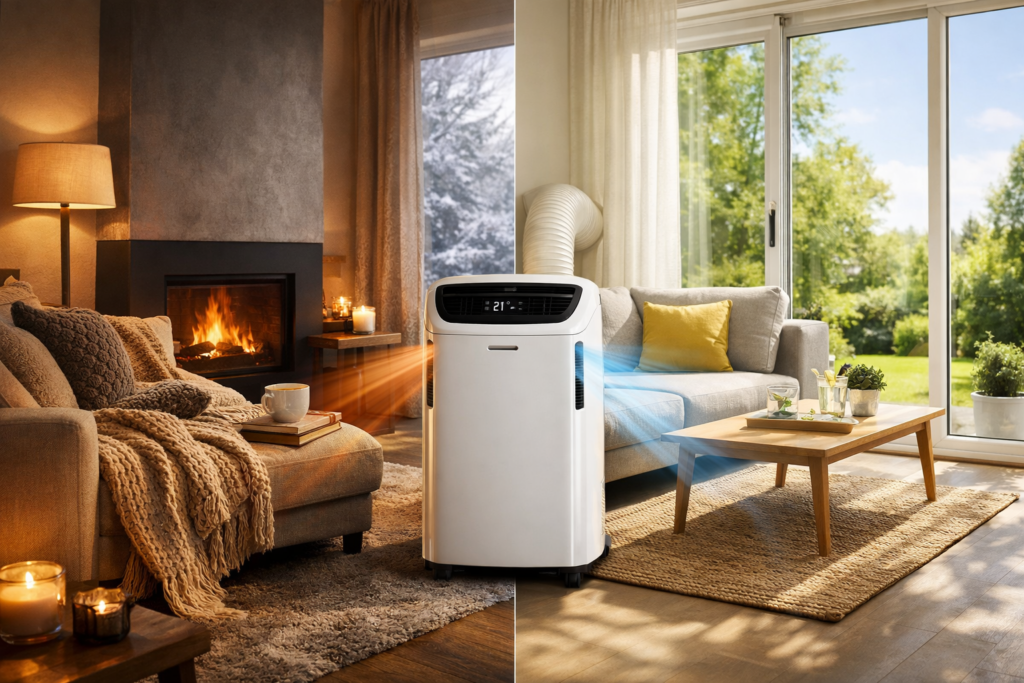
Most portable air conditioners only cool. A smaller group — labelled heat pump, reverse cycle, or with CH in the model name — genuinely does both, using the same principle as your fridge but reversed. It is not the same thing as the “heat pump” that attracts a government grant; that’s a professionally installed system replacing your boiler. Both are covered below, kept clearly apart, because conflating them is the most common mistake in this area.
How one unit manages both
Inside a reverse-cycle unit is a reversing valve. In cooling mode it works like any portable air conditioner: pulling heat out of the room and expelling it through the exhaust hose. Switch to heating and the valve reverses the refrigerant flow, so the unit pulls heat from the outside air and delivers it indoors.
Because it moves existing heat rather than generating it from electrical resistance, a heat pump delivers more heat energy than the electricity it consumes. That is the one genuine exception to the rule that every plug-in electric heater costs the same to run at the same wattage — our running costs comparison covers why that rule holds for everything else.
The pick
MeacoCool MC Series 9000 CH
Published heating output
8,000 BTU heating
16–26m²
53 dB low fan
R290
The reason this is the pick rather than something cheaper: Meaco publish the heating capacity separately in the instruction manual — 9,000 BTU cooling and 8,000 BTU heating — along with refrigerant type, maximum input power and noise level. That’s the information you need to judge whether a unit will actually heat your room, and a surprising number of listings in this category don’t provide it. Argos list the same unit at an A energy rating with a two-year guarantee and both fixed and flexible window kits.
Good for: a room that’s uncomfortable in both seasons — a conservatory, a loft conversion, a home office over a garage. Year-round use changes the value calculation completely compared with a unit that sits in a cupboard for eight months.
Less good for: deep winter, and light sleepers. Heating output falls as outside temperature drops, and the compressor sits inside the unit, so it’s audible. Note also that heating capacity is lower than cooling capacity on this model — size on the heating figure if winter is your main reason for buying.
MeacoCool MC Series Pro 9000 CH
With app control
16–26m²
A-rated
Meaco app
The Pro version of the same size class, adding app and voice control. For a heating application that’s more useful than it sounds — being able to warm a home office or conservatory for half an hour before you walk into it, from your phone, is exactly the use case a schedule serves well.
Good for: rooms you use predictably — a home office you start at nine, a conservatory you sit in each evening.
Less good for: anyone who won’t set up the app. If the scheduling goes unused you’ve paid for a feature you don’t have; a plug-in timer does most of it. Verify the current published heating output before ordering, as specifications are revised between model years.
Other manufacturers selling reverse-cycle portables in the UK include Electriq, Igenix, De’Longhi and Olimpia Splendid. Compare them on the same basis: a separately stated heating output, a published room size range, noise level with the fan speed specified, and energy class.
Running one properly in winter
- The window kit stays fitted. Heating mode still exchanges air with outside, so a poorly sealed kit undermines heating exactly as it undermines cooling.
- Clean the filter more often, not less. It’s working continuously through the cold months rather than in summer bursts.
- It still produces condensate, sometimes from a different part of the unit. Check the manual for the drainage arrangement in heating mode.
- Size on the heating figure. Where heating output is lower than cooling output, a unit that’s right-sized for summer may be undersized for winter.
- Expect defrost cycles. In cold, humid conditions the outdoor-facing coil ices up and the unit briefly reverses to clear it, blowing cool air for a minute or two. Designed behaviour, not a fault.
Our guide to heating mode covers this in more detail, and our autumn changeover checklist covers the seasonal switch.
The limits, honestly
- Output falls as it gets colder. There’s less ambient heat to extract, so the unit does least exactly when you want most.
- It’s a one-room appliance. An efficient top-up for the room you’re in, not a heating system. Our one-room heating guide covers the alternatives.
- Noise is more noticeable in winter. Compressor noise that goes unremarked on a summer night is intrusive in a still room in January.
- It won’t fix a cold room caused by something else. If the real problem is a seized thermostatic radiator valve or a radiator needing bleeding, fix that first — both are free. Our cold room guide covers the diagnosis.
Not the same as a “government grant heat pump”
Worth setting out clearly, because the terminology genuinely overlaps.
- Air-to-air heat pump — what this page covers. Heats and cools individual rooms via a reversing valve. A portable plug-in unit is the smallest version.
- Air-to-water heat pump — a boiler replacement. A large outdoor unit heating your whole home’s radiators, underfloor heating and hot water cylinder, installed by an MCS-certified engineer.
Frequently asked questions
Can a portable air conditioner heat a room in winter?
Only with a reversing valve — described as heat pump, reverse cycle, or CH in the model name. A cooling-only unit physically cannot generate heat.
Does the Boiler Upgrade Scheme apply?
No. That scheme covers professionally installed air-to-water heat pumps replacing a boiler. A plug-in portable is a different category entirely.
How much of a room can it heat?
One room, and best in mild to moderate cold. Size on the stated heating output rather than the cooling output, since the two often differ.
Is it cheaper to run than a plug-in electric heater?
Yes, and that’s the point of a heat pump — it moves heat rather than generating it. How much cheaper depends on outside temperature, since efficiency falls as it gets colder.
Does it need running in winter to stay healthy?
If it heats, you’re using it anyway. For cooling-only portables the answer is no — storage matters far more than periodic running, and running the compressor in a cold room can ice the coil. Our winter running guide covers where that advice came from.
Related reading: our best portable air conditioners guide and maintenance guide.
Sources
- ManualsLib — MeacoCool MC Series instruction manual (9,000 BTU cooling / 8,000 BTU heating, R290, 53 dB low fan, maximum input power)
- Argos — MeacoCool MC Series Pro 9000 (room size, energy class, warranty, window kits)
- Meaco — MeacoCool range
- GOV.UK — Boiler Upgrade Scheme
- Energy Saving Trust — Air source heat pumps
- MCS — Find a certified installer
- GOV.UK — Fluorinated gases (F-gases): rules
Compare reverse-cycle portable units at Amazon UK. Check the listing states a heating output separately from the cooling figure — many “4-in-1” units have no heating function at all.