Is It Safe to Leave Christmas Lights On Overnight? (UK)
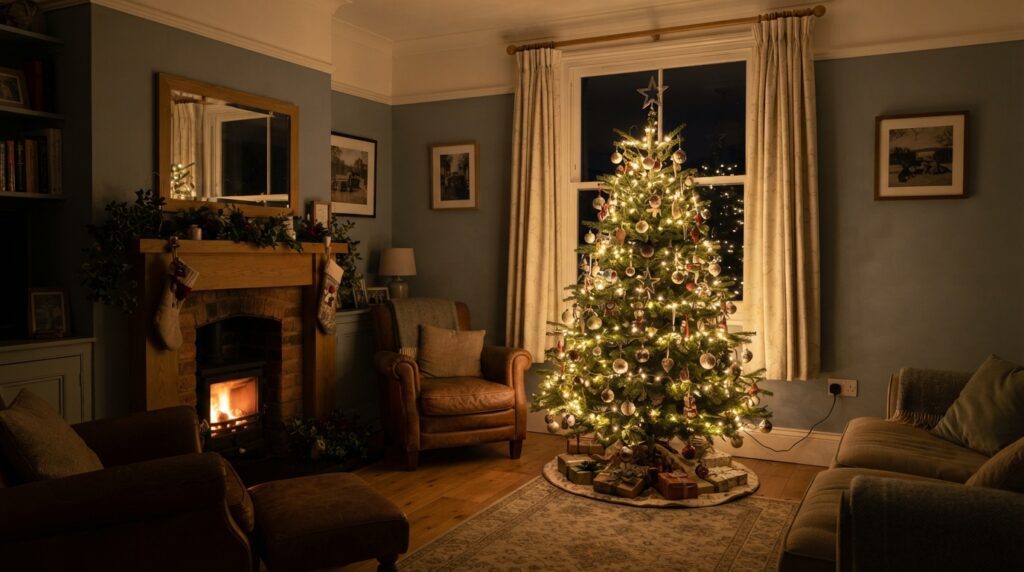
No — switch them off and unplug them at bedtime. Every UK safety body we checked says the same thing. Electrical Safety First’s advice is: “Switch the lights off and unplug them before you go to bed or if you go out.” Hertfordshire Fire and Rescue Service and the Scottish Fire and Rescue Service say the same. Modern LED sets are lower risk than old filament bulbs, because most run at extra-low voltage and give off less heat, but the advice doesn’t make an exception for them. Cost isn’t the reason: by our sums, an LED chain left on all night costs about 1p. The point is not to have anything running with nobody awake to notice a fault. A timer plug or smart plug is a useful back-up that switches them off if you forget, but it doesn’t unplug them, so unplug when you can.
Lights on the tree, a string round the window, a display out the front: by mid-December, it’s easy to end up with far more plugged in than usual. It’s tempting to leave the lot twinkling all night, especially the lights outside. Here’s what the UK’s electrical and fire safety bodies actually say, what leaving lights on really costs, and how to set up a back-up so they go off even if you forget.
What UK safety bodies say
The advice is consistent and short:
- Electrical Safety First, the UK electrical safety charity: “Switch the lights off and unplug them before you go to bed or if you go out.”
- Hertfordshire Fire and Rescue Service: “Always switch off Christmas lights and unplug them before you go out or to bed.”
- Scottish Fire and Rescue Service: “Unplug fairy lights and other electrical decorations when you leave the house or go to bed.”
- London Fire Brigade, in its 2019 Christmas safety tips: “Check your Christmas tree lights conform with safety standards and always switch them off before going to bed.”
None of them makes an exception for LED lights or outdoor displays.
Are LED lights safer to leave on?
Safer than old filament sets, yes. Risk-free, no. Electrical Safety First explains that Christmas lights run either at mains voltage (230 volts) or at extra-low voltage, typically 12 to 24 volts, through a safety transformer. Most LED Christmas lights work at extra-low voltage, which it says “significantly reduces the risk of electric shock, uses much less power, and generates less heat.” LEDs also have no filament and no glass lamps to break, and the charity says they can use 80–90% less electricity than filament lamps and typically last up to 60 times longer.
Old filament sets are the ones to watch. Electrical Safety First says to replace failed lamps before using the lights, to prevent overheating, and points out that lights you’ve used for years may not be designed to cope with damp winter weather. Whatever the type, the Scottish Fire and Rescue Service warns that fairy-light bulbs “can get very hot” and shouldn’t touch paper or fabric. If you’re still putting up a set from decades ago, it’s probably time it retired.
What does leaving them on all night cost?
Less than you’d think, which is exactly why cost isn’t the argument. When Which? tested LED chains, the steady “on” setting averaged 0.13p an hour per chain at its 27.35p/kWh test rate. That works out at roughly 4.75 watts. The twinkling settings were cheaper still. For old filament lights, EDF says incandescent sets often average around 40 watts per 100 lights.
At the October to December 2026 price cap rate of 26.32p per kWh:
| Lights | Approx. power | 8 hours overnight | 31 nights in December |
|---|---|---|---|
| LED chain (Which? test average) | About 4.75W | About 1p | About 31p |
| 100-bulb filament set (EDF average) | About 40W | About 8.4p | About £2.61 |
So switching off at night saves you pennies. It’s still worth doing, because the risk is a fault developing while everyone’s asleep, not the bill. If you want to trim the cost of the evenings too, our winter energy myths guide covers where the real money goes.
The checks that matter more than the hours
A faulty set is dangerous whether it’s on for one hour or eight. Before the lights go up, run through Electrical Safety First’s and the fire services’ checklist:
- Check for damage. Look for broken lamps, damaged wires and loose connections. Don’t use a set with damaged wires or a damaged plug.
- Check the plug and socket while they’re in use. Electrical Safety First says to look for burn marks, listen for “arcing” (buzzing or crackling), and feel whether the plug is too hot to touch.
- Buy from a reputable retailer. Electrical Safety First says to buy from a reputable retailer “rather than a third-party seller online”. Hertfordshire Fire and Rescue says to only use lights that carry a recognised safety mark such as UKCA or CE.
- Don’t overload sockets or chain extension leads. Electrical Safety First says it’s best not to rely on extension leads or adaptors if you can avoid it. West Sussex Fire and Rescue is blunter: “never plug one extension lead into another.” Our guide to extension leads and tripping fuses explains why leads overheat.
- Keep decorations off the lights. London Fire Brigade warns: “Don’t attach decorations to lights or heaters – they can overheat and catch fire.”
Outdoor lights need extra care
Outdoor displays face rain, frost and damp, so Electrical Safety First has extra rules for them:
- Only use lights outdoors if they’re specifically designed for it. They should be marked with a water drop symbol or an IP code. The last digit of the IP code shows protection against water, and the charity says it should be three or higher for outdoor use, so IP44 qualifies but IP20 doesn’t.
- Any lights plugged in outdoors must be connected via a 30mA RCD-protected socket. If you don’t have RCD protection, use an RCD plug on the socket the lights are plugged into.
- Keep the plugs and transformers indoors, even if the lights themselves are outdoor-rated.
Not sure what an RCD does? Our explainer on fuses and RCD trips covers the basics.
Battery lights and button batteries
Battery fairy lights avoid mains voltage altogether, but they bring a different risk if you have small children. The Child Accident Prevention Trust warns that a swallowed button battery can kill a child, and advises spotting any toys or “light-up novelties that have easy-to-access button batteries” and removing them. Great Ormond Street Hospital lists LED lights among the things that can be powered by button batteries, and says that if a child swallows one, you should “take them to your nearest Accident and Emergency (A&E) department as quickly as possible”, and not to delay even if you can’t see what they’ve swallowed. It also says not to give them anything to eat or drink, or try to make them sick.
If your battery lights have a built-in timer, use it, and switch them off at bedtime like any other decoration.
Timers and smart plugs: a useful back-up
Unplugging at bedtime is the advice, but on a busy night it’s easy to forget. A timer plug or smart plug is a good back-up: it switches the lights off at a set time even if you’ve gone to bed without thinking about them. Two things to know:
- It switches them off, but it doesn’t unplug them. TP-Link’s safety notes for its Tapo smart plug say the built-in switch is “only intended for functional purpose”, and that the plug only de-energises “when the plug is pulled out”. So unplug when you can, and treat the timer as the safety net.
- Set the “on” time for when you’re home. The fire services say to switch off and unplug before you go out, so don’t use a timer to run the lights while nobody’s in.
Tapo P100 smart plug
Best for: different times on different days
Up to 13A, no hub
2.4GHz Wi-Fi only, indoor use
TP-Link says the Tapo P100 lets you create weekly schedules and countdown timers from your phone, works with Alexa and Google Assistant, and doesn’t need a hub. Set the tree lights to go off at 11pm on weeknights and later at weekends, as a back-up in case you forget to unplug them. TP-Link says it’s mini-sized so it doesn’t block the neighbouring socket on a double. It also has an Away Mode that switches devices on and off while you’re out, but don’t use that for Christmas lights: the advice is to unplug them before you go out.
Good for: tree and window lights indoors; weekly schedules; switching off from your phone if you forget.
Less good for: 5GHz-only Wi-Fi networks; outdoor sockets and unheated garages, because TP-Link says it’s for indoor use at room temperature; plugging into an RCD adaptor or another plug-in device, which TP-Link’s safety notes say not to do.
Timeguard TS800N plug-in timer
Best for: no app, no Wi-Fi
15-minute steps, 30-minute minimum
LED lighting up to 60W
A simple mechanical 24-hour timer. Fit an ON pin in the inner ring for when you want the lights on and an OFF pin in the outer ring for bedtime, plug it in, and it repeats the same pattern every day. Its specification allows up to 60W of LED lighting, which is far more than a typical LED chain uses, and it has a manual override that cancels itself at the next programmed change.
Good for: anyone who doesn’t want another app; a fixed evening schedule; giving to a relative who just wants it to work.
Less good for: different times on different days, because it repeats the same 24-hour pattern; on or off periods shorter than 30 minutes; larger lighting loads, so check the wattage on your lights’ box or transformer.
Masterplug ARCDKG RCD adaptor
Best for: outdoor lights without RCD sockets
Plug-in single socket
Non-latching: test and reset each use
Electrical Safety First says outdoor lights must be on a 30mA RCD-protected socket, and recommends an RCD plug if you don’t have that protection. Masterplug says this adaptor has a 30mA trip rating and “cuts off the power within 40 milliseconds if an earth current fault is detected”. Its manual says to test it before each use: press TEST, then RESET.
Good for: outdoor displays and older homes without RCD protection on the sockets; garden tools the rest of the year.
Less good for: use with timers or smart plugs: as a non-latching adaptor it must go straight into the wall socket, and it needs resetting whenever its supply is interrupted (see the box above). Masterplug’s safety warnings also say not to use it in wet or humid conditions, so it stays indoors.
And check your smoke alarms
Christmas is a good reminder to test them. Hertfordshire Fire and Rescue Service advises fitting smoke alarms on every level of your home, ideally in hallways and landings, testing them at least once a month by pressing the test button, and replacing alarms every 10 years.
FireAngel ST-622T smoke alarm
Best for: no battery changes for ten years
BS EN 14604
Standalone
FireAngel says the ST-622T combines optical smoke sensing with thermal enhancement (its “Thermoptek” technology), runs on a sealed 10-year lithium battery, and meets BS EN 14604. It suggests fitting it in hallways, landings, living rooms, dining rooms and bedrooms.
Good for: replacing old alarms on every level; homes where nobody wants to climb a ladder to change batteries.
Less good for: kitchens, where FireAngel says a smoke alarm isn’t recommended and suggests a heat alarm instead; homes in Scotland, where the Scottish Government says every home must have interlinked fire alarms, or anyone who wants alarms that sound together, as this one is standalone.
Frequently asked questions
Can you leave LED Christmas lights on all night?
UK safety advice says no. Electrical Safety First and the fire services say to switch Christmas lights off and unplug them before you go to bed. LEDs are lower risk than filament bulbs because most run at extra-low voltage and give off less heat, but the advice doesn’t make an exception for them.
Is it OK to leave Christmas lights on when I go out?
No. Hertfordshire Fire and Rescue Service says to switch them off and unplug them before you go out, and the Scottish Fire and Rescue Service says to unplug them when you leave the house. Don’t use a timer or a smart plug’s away mode to run Christmas lights while nobody’s home.
How much does it cost to leave Christmas lights on overnight?
Very little. Based on Which?’s tests, an LED chain uses just under 5 watts, so eight hours costs about 1p at the October to December 2026 price cap rate of 26.32p/kWh. A 100-bulb filament set at around 40 watts costs about 8.4p a night.
Should outdoor Christmas lights be switched off at night?
Yes, the same advice applies. Outdoor lights must also be designed for outdoor use and plugged into a 30mA RCD-protected socket, or an RCD plug, with the plugs and transformers kept indoors.
Can I plug Christmas lights into a timer?
Yes, as a back-up that switches them off if you forget. It doesn’t unplug them, though, so unplug when you can. Check the timer’s rating for LED lighting (the Timeguard TS800N allows up to 60W, for example), keep it indoors, set the “on” time for when you’re home, and avoid stacking it with an RCD adaptor or other plug-in devices.
Sources
- Electrical Safety First — Electrical safety advice for Christmas lights
- Hertfordshire Fire and Rescue Service — Fire safety at Christmas
- Scottish Fire and Rescue Service — Festive safety
- London Fire Brigade — Have yourself a fire-free merry Christmas
- West Sussex Fire and Rescue Service — Electrical safety
- Which? — Which setting on your Christmas lights is cheapest to run
- EDF — How much electricity do Christmas lights use?
- Ofgem — Energy price cap unit rates and standing charges
- Child Accident Prevention Trust — 6 simple safety tips to keep children safe this Christmas
- Great Ormond Street Hospital — Button batteries
- TP-Link — Tapo P100
- TP-Link — Tapo P100 setup guide and safety information
- TLC Direct — Timeguard TS800N specification
- Masterplug, via ManualsLib — ARCDKG quick manual
- FireAngel — ST-622T standalone smoke alarm
- Scottish Government — Fire and smoke alarms in Scottish homes
Related reading: our smart plugs and scheduling guide, storm-proofing your home and 10 ways to lower your heating bill.
Compare the Tapo P100 smart plug at Amazon UK.