Waking Up at 3am in Your 50s: Is Your Bedroom Temperature the Problem?
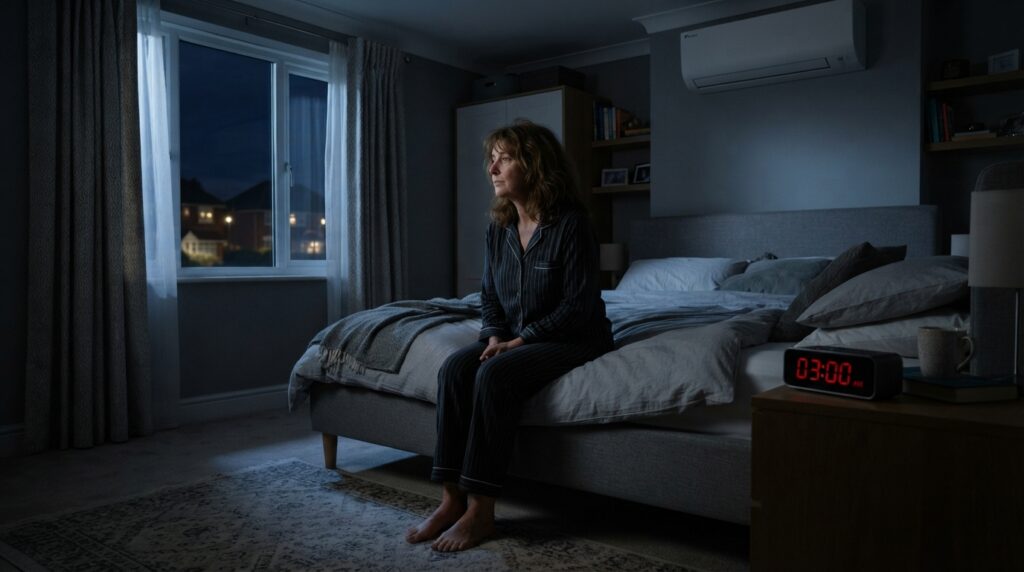
Sometimes, yes — and it’s the cause people check last. Your core temperature reaches its lowest point in the small hours, sleep gets naturally lighter in the second half of the night, and a room that’s drifted too cold or too warm is far more likely to tip a light phase into a full wake-up. Temperature won’t explain every 3am waking, but it’s cheap to test and cheap to fix, which makes it worth ruling out before assuming it’s stress or age.
Waking in the small hours becomes more common from middle age onward, and most advice jumps straight to stress, alcohol or screens. Those matter. But the physical state of the room is measurable, controllable, and frequently overlooked.
Why 3am specifically
Three things converge in the small hours.
Your core temperature bottoms out. Body temperature follows a daily rhythm, falling through the night to a minimum in the middle-to-later part, then rising as a wake signal. At that low point you’re most sensitive to a room that’s too cold.
Sleep is lighter in the second half of the night. Deep sleep is concentrated in the early hours after falling asleep; later sleep contains proportionally more light sleep and REM. Anything that would have been slept through at midnight can wake you at 3am.
Sleep architecture changes with age. From middle age, most people experience less deep sleep and more fragmented sleep. That’s normal, not a disorder — but it lowers the threshold at which a cold draught or an overheated duvet becomes a full wake-up.
The two temperature failure modes
Too cold, usually in winter
Classic pattern: heating goes off at 11pm, the room drops steadily for six hours, and by 3am it’s bottomed out at the same moment your body temperature has. You surface, feel cold, and struggle to settle.
Tell-tale signs: cold hands, nose or shoulders on waking; wanting more covers; worse in a room with a lot of external wall or glazing. Our cold room guide covers diagnosing why one room runs colder than the rest.
Too warm, and often too humid
The mirror image: heating fires at 5am, or a thick duvet traps heat, or a room stays warm because the door’s been closed all evening. You wake damp and restless.
Common in summer, and increasingly on the mild, muggy nights that a stormier winter brings. Also strongly associated with menopausal night sweats — covered in our night sweats guide.
Measure it before you change anything
The whole point of this article. Put a cheap thermometer-hygrometer beside the bed — ideally one that logs a minimum and maximum — and read it for a week.
You’re looking for the overnight low and high, not the temperature when you go to bed. A room that reads 19°C at 11pm may be at 12°C by 4am, and you’d never know.
Our thermometers and hygrometers guide covers options. The humidity reading matters too — persistently high humidity makes a warm room feel worse and a cold room feel damp.
Aim for stable, not just cool
Sleep guidance generally points to a cool bedroom, somewhere in the mid-to-high teens Celsius, as most conducive to good sleep. But for 3am waking specifically, stability matters as much as the number. A room held steadily at 17°C usually produces fewer wake-ups than one swinging between 21°C and 12°C.
Practical ways to flatten the curve:
- Turn the bedroom radiator down rather than off. A low TRV setting puts a floor under the overnight drop. Off gives you the biggest swing and invites condensation.
- Check when your heating fires in the morning. If it’s 5am and you’re waking at 5:15am, that’s not coincidence.
- Draught-proof. Draughts create cold spots and uneven temperature — our draught-proofing guide covers it.
- Close curtains at dusk. Glass is the biggest heat-loss route in most bedrooms.
- Layer bedding so you can adjust without getting up. Two thinner layers beat one thick duvet.
The things that aren’t temperature
Being straight about this: temperature is one cause among several, and it’s worth knowing what else commonly wakes people in the small hours.
- Alcohol. Helps you fall asleep and reliably disrupts the second half of the night. One of the most common causes of 3am waking, and one of the most reversible.
- Needing the toilet, which becomes more common with age.
- Noise — a boiler firing, a neighbour, traffic. Easier to sleep through in deep sleep than at 3am.
- Light, including from streetlights and standby LEDs.
- Anxiety and rumination, which is often the result of waking rather than the cause, and then keeps you awake.
- Snoring or breathing interruptions — worth taking seriously rather than dismissing.
A practical week-long test
- Nights 1–3: change nothing. Log the overnight minimum and maximum temperature and humidity, and note what time you woke and how you felt — cold, hot, clammy, or neither.
- Look for the pattern. Waking cold at the overnight low points at temperature. Waking hot and damp points at bedding or humidity. Waking neither hot nor cold points elsewhere.
- Change one thing — TRV setting, bedding weight, heating schedule — and log another three nights.
- Keep what works.
The value of measuring is that it either confirms temperature is the issue or rules it out, so you stop guessing.
If you wake anyway
Standard sleep-hygiene advice, and it’s genuinely useful: if you’re awake for more than about twenty minutes, get up, go to another room, do something quiet and dull in low light, and go back when you feel sleepy. Lying there getting frustrated trains your brain to associate the bed with being awake.
Which is a practical reason to keep the rest of the house from being freezing at 3am too — if getting up means stepping into an ice-cold hallway, you won’t do it.
Frequently asked questions
What temperature should my bedroom actually be?
General sleep guidance points to a cool room in the mid-to-high teens Celsius. For 3am waking specifically, consistency through the night matters as much as the absolute figure — measure your overnight low before deciding anything.
Is waking at 3am just a normal part of getting older?
Lighter, more fragmented sleep in the second half of the night is a normal age-related change. That doesn’t mean nothing can be improved — it means the threshold for disruption is lower, so environmental factors matter more than they did at thirty.
Would a fan help or make it worse in winter?
Depends which failure mode you have. If you wake hot and clammy, gentle air movement helps evaporation and can genuinely improve things even in winter. If you wake cold, a fan will make it worse.
Does a smart thermostat help with this?
It can, mainly by letting you hold a low overnight floor rather than switching off entirely, and by shifting the morning firing time away from when you’re waking. Smart TRVs give per-room control, which is useful if the bedroom and the rest of the house disagree.
Sources
- NHS — Sleep and tiredness (sleep hygiene; when to seek help)
- NHS — Insomnia (including the get-up-if-awake advice)
- NHS — Sleep apnoea (symptoms and when to see a GP)
- Energy Saving Trust — Thermostats and heating controls
- Energy Saving Trust — Draught-proofing
Related reading: our cold bedroom guide and night sweats guide.
Related guides

Compare current prices, stock and reviews on portable air conditioners at Amazon UK. Prices and stock move fast in a heatwave, so it is worth checking before you commit.
Browse air conditioners →