Why Is My Bedroom Freezing When the Living Room Is Warm?
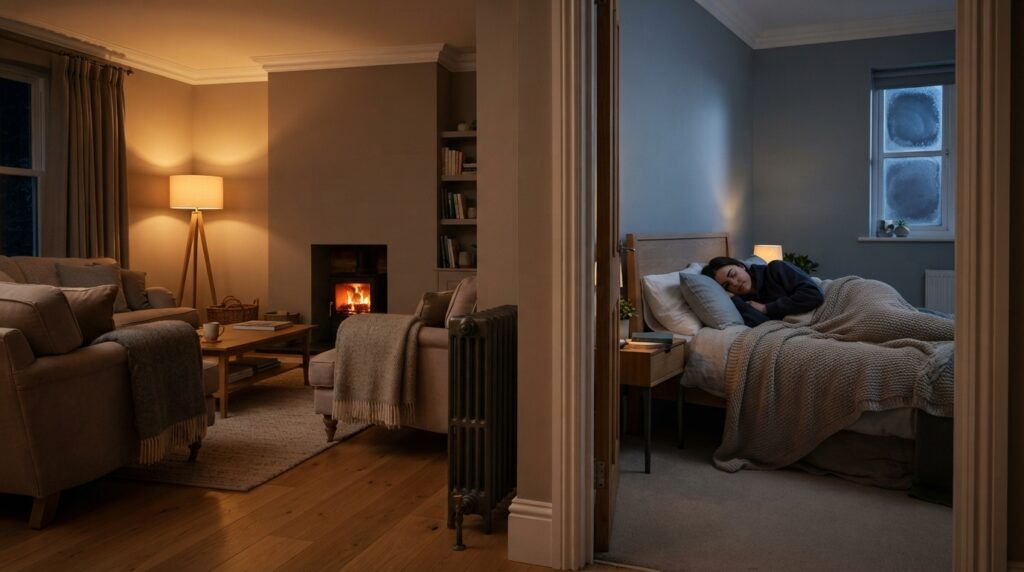
Almost always one of five things: the radiator isn’t actually working properly (trapped air, a stuck TRV pin, or sludge), the room has more exposed surface than the ones that stay warm, the thermostat is in a different room and switching the system off before this one warms up, air leakage, or insulation that’s missing or bridged in that specific spot. Work through them in that order — the first two cost nothing to check and fix a large share of cases.
This is one of the most common winter household complaints, and it’s genuinely diagnosable. Work through it methodically rather than buying a heater, because in a meaningful proportion of cases the fix is free.
Cause 1: The radiator isn’t working properly
Check this first, because it’s the most common and the cheapest to fix.
Cold at the top, warm at the bottom means trapped air. Bleed it with a radiator key, with the heating off, catching drips in a cloth. Check system pressure afterwards on a combi boiler and top up if it’s dropped.
Cold at the bottom, warm at the top means sludge — a build-up of corrosion debris settling in the bottom of the radiator. Bleeding won’t help. This needs a power flush or radiator removal and cleaning, which is a job for a heating engineer.
Completely cold while others are hot often means a seized thermostatic radiator valve. TRVs stick, especially after a summer in the fully-open position. Pull off the plastic head and look at the pin underneath — it should move freely. If it’s stuck down, gently free it with pliers, or tap it. This single fix resolves a surprising number of cold rooms.
All the upstairs radiators are cooler than downstairs suggests a system balancing problem — flow is favouring the path of least resistance. Balancing involves adjusting lockshield valves and is worth a heating engineer if you’re not confident.
Cause 2: The room has more exposed surface
Not every room in a house is thermally equal, and floor area doesn’t tell you much.
Count exposed surfaces. A mid-terrace’s internal box room might have one external wall. A corner bedroom above an unheated garage or a passageway can have two external walls, an exposed floor and part of the roof — four surfaces losing heat, against one.
Common cold-room profiles:
- Above a garage, passage or open porch — an exposed floor, frequently uninsulated.
- Corner rooms — two external walls.
- Rooms under a flat roof or a dormer — often thinner insulation than a standard loft.
- Loft conversions — rafter-depth insulation is inherently thinner than a floored loft’s 270mm. Our loft conversion guide covers why they run hot in summer and cold in winter for the same reason.
- Rooms with large or single glazing — glass is the weakest thermal element in most rooms.
If the cold room has a radiator sized like every other room but twice the heat loss, it will never keep up. That’s a sizing problem, not a fault.
Cause 3: The thermostat is somewhere else
Genuinely underappreciated. A single room thermostat — typically in a hall or living room — controls the whole system. When that room reaches temperature, the boiler stops, regardless of what your bedroom is doing.
So if your living room has a wood burner, gets afternoon sun, or is simply warmer, it satisfies the thermostat early and the cold room never catches up.
Options: turn down TRVs in the warm rooms so the system runs longer, move the thermostat if practical, or fit smart TRVs enabling per-room control. Turning down radiators in rooms that are already warm feels counterintuitive but is often the effective free fix.
Cause 4: Air leakage
A room that feels draughty as well as cold has an air problem, not only a fabric one — and this matters more in a windy winter, since wind pressure drives higher air-change rates through the same gaps.
Usual suspects in bedrooms: gaps around window frames, an unused chimney, floorboard gaps, a poorly sealed loft hatch on the landing outside, and service penetrations. Our draught-proofing guide covers the whole job — it’s cheap and the highest-return fix after the radiator checks.
Cause 5: Insulation that’s missing or bridged
If the room is sealed and the radiator works, look at the fabric.
Loft insulation is frequently thinner over one part of a house — pushed aside for storage, disturbed by cabling work, or simply never topped up in one corner. Look directly above the cold room. Current Building Regulations guidance points to around 270mm of mineral wool.
Cavity wall insulation can be absent or have slumped. A room that’s cold on one particular wall is worth investigating.
Cold bridges — lintels, window reveals, wall-floor junctions — create localised cold spots. These are often where mould appears first, which is a useful diagnostic clue in itself; our condensation guide covers the connection.
Wet walls are cold walls. Saturated masonry conducts heat out far faster than dry masonry, so penetrating damp from a blocked gutter or failed pointing shows up as a cold room. This is a real and common cause, and it’s why the autumn jobs in our storm-proofing guide matter thermally as well.
Measure before you spend
Put a cheap thermometer-hygrometer in the cold room and one in a warm room, and compare over a few days. You’ll learn whether the room never warms up, or warms up and loses it fast — which are different problems.
- Never gets warm: heat input problem — radiator, TRV, balancing, or undersized emitter.
- Warms up then drops rapidly: heat loss problem — air leakage or insulation.
Our thermometers guide covers cheap options. The humidity reading is a bonus: a cold room with high humidity is a mould risk.
Why a cold bedroom is worth fixing properly
Beyond comfort, two reasons.
Cold rooms develop damp and mould, because moisture migrating from the rest of the house condenses on their cold surfaces. The unheated spare room is so often the mouldy one for exactly this reason.
And cold homes carry genuine health consequences — cold remains a larger cause of temperature-related mortality in England and Wales than heat, driven by poorly heated homes rather than record low temperatures. If cost is forcing you to under-heat, it’s worth checking what support exists rather than simply enduring it; Citizens Advice maintains current information on grants and payments.
The order to work through it
- Free, five minutes: check the radiator is hot all over; free a stuck TRV pin; bleed if cold at the top.
- Free, one evening: turn down TRVs in rooms that are already too warm.
- Cheap: draught-proof the room; close curtains at dusk; move furniture off the radiator.
- Modest cost: top up loft insulation above the room; secondary glazing film.
- Professional: system balancing, power flush, larger radiator, or investigating damp and insulation defects.
- Only then: consider supplementary heating — our one-room heating guide covers the options.
Frequently asked questions
Should I just close the door and heat it separately?
Closing the door helps if the room has its own heat source, but a closed door to an unheated room makes it colder and raises damp risk. Fix the input first; use supplementary heat as a last step rather than a first one.
My radiator is warm but the room still isn’t. Why?
Usually an undersized radiator for that room’s heat loss, or the boiler switching off on the hall thermostat before the room catches up. Both are fixable — a larger emitter, or better per-room control.
Is it bad to sleep in a cold bedroom?
A cool bedroom is generally good for sleep, but genuinely cold is a different matter, particularly for older adults, young children and anyone with a respiratory or cardiovascular condition. If a room is persistently very cold, treat it as a problem to fix rather than tolerate.
Would a smart thermostat help?
Smart TRVs enabling per-room control genuinely help with the hall-thermostat problem, letting you run the system longer without overheating the rest of the house. They don’t fix a sludged radiator, missing insulation or a leaky window — diagnose first.
Sources
- Energy Saving Trust — Thermostats and heating controls (room thermostats, TRVs, per-room control)
- Energy Saving Trust — Draught-proofing
- Energy Saving Trust — Roof and loft insulation
- GOV.UK — Approved Document L (insulation standards)
- GOV.UK — Damp and mould: health risks
- ONS / BBC — Heat and cold related deaths in England and Wales
- Citizens Advice — Grants and benefits to help pay energy bills
Related reading: our draught-proofing guide and condensation guide.
Related guides


Compare current prices, stock and reviews on portable air conditioners at Amazon UK. Prices and stock move fast in a heatwave, so it is worth checking before you commit.
Browse air conditioners →