10 Things Making Your House Colder That You Haven’t Thought Of
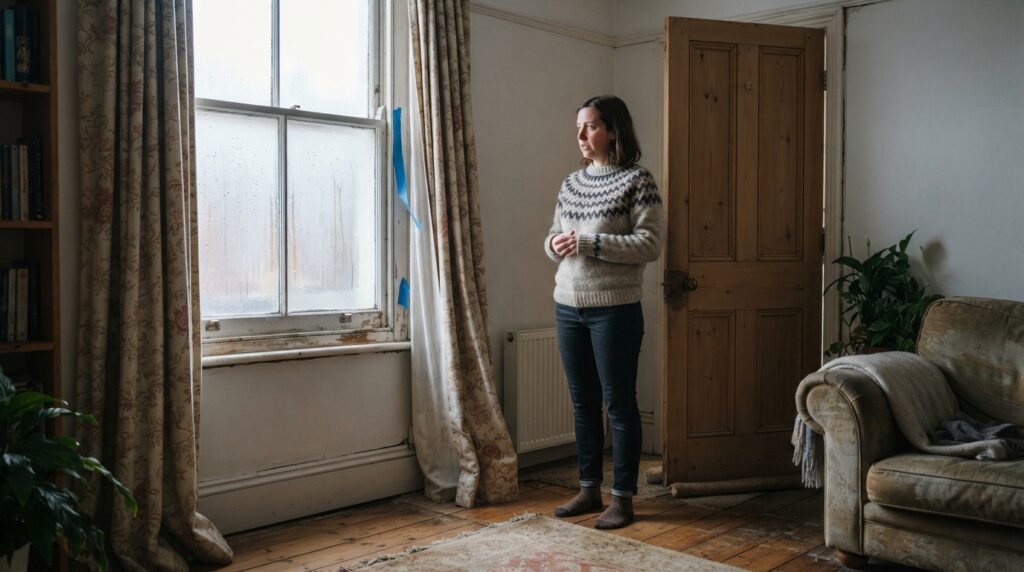
Everyone knows about draughty doors and thin loft insulation. These are the ten less obvious ones — the sofa parked in front of the radiator, the seized valve nobody’s touched in five years, the extractor fan with no flap, the curtain hanging over the radiator sending heat straight up the window. Most cost nothing to fix and take under an hour. Work down the list before you turn the thermostat up.
If your house feels colder than it should for what you’re spending, one of these is usually involved.
1. A seized thermostatic radiator valve
The single most common cause of a room that won’t heat, and it’s free to fix.
A TRV left in one position for months — often years — seizes. The pin underneath the plastic head sticks down, holding the valve closed no matter what the dial says. You turn it up, nothing happens, you conclude the radiator is broken.
The check: pull off the plastic head. Underneath is a small spring-loaded pin. Press it — it should move freely and spring back. If it’s stuck down, gently free it, working it up and down. A dab of releasing fluid helps if it’s stubborn.
Do this on every radiator each autumn as part of the test run in our boiler prep guide.
2. Furniture in front of radiators
A sofa across a radiator absorbs the heat and blocks the convection current that should be circulating warm air around the room. The sofa gets lovely and warm; you don’t.
Move it forward even ten centimetres and you’ll notice. Same applies to beds, bookcases and anything else parked against one.
3. Curtains hanging over the radiator
Enormously common in UK homes, where radiators sit under windows.
A full-length curtain hanging in front of a radiator traps the rising warm air between the curtain and the glass — the coldest surface in the room — and sends it straight up and out through the window. You’re heating your window.
Fix: tuck curtains behind the radiator, or fit a shelf above it to deflect the rising air into the room. Sill-length curtains that stop above the radiator work better than floor-length ones here, though floor-length is better where there’s no radiator.
4. Radiators that need bleeding
Air rises to the top of a radiator and displaces water, so the top stays cold while the bottom heats. Very common after a summer of no use.
Cold at the top means air, and bleeding fixes it. Cold at the bottom is a different problem — sludge — and needs an engineer. Our bleeding guide covers the method and the order to do them in, which matters more than people expect.
5. An extractor fan with no backdraught flap
A bathroom or kitchen extractor without a working flap is a permanently open hole in your external wall. On a windy night, cold air pours in through it.
Hold a tissue up to it when it’s off. If it’s being pushed into the room, the flap is missing, stuck open or broken. Replacements are inexpensive, and it’s a fifteen-minute job.
Don’t block the fan itself — you need that ventilation for moisture, as covered in our condensation guide. Fix the flap instead.
6. The gap under the floorboards
If you have suspended timber floors, there’s a ventilated void underneath at close to outside temperature. Gaps between boards and at the skirting let that cold air straight into the room, and it pools at floor level — which is why your feet are cold while your head is fine.
Filling floorboard gaps with a flexible filler or fitting a good underlay and carpet makes a substantial difference. Our cold feet guide covers the effect.
Never block the airbricks ventilating that void. They’re preventing rot.
7. The letterbox and keyhole
Small, and disproportionately effective at making a hallway cold — because on an exposed front door they’re a direct opening with wind pressure behind them.
A letterbox brush-and-flap insert and a keyhole escutcheon cover cost very little between them. Our draught-proofing guide covers the full door.
8. An unused chimney
An open flue is a purpose-built device for extracting air from a room. If you have a fireplace you never use, it’s pulling warm air out continuously and drawing cold air in through every other gap to replace it.
A chimney balloon or a sheep-style draught excluder addresses it for very little money, and both are removable.
9. Damp walls
Underrated as a thermal problem rather than just a decorating one.
Wet masonry conducts heat away considerably faster than dry masonry. A wall saturated by a blocked gutter, failed pointing or a leaking downpipe makes that room genuinely colder — and no amount of heating fixes it while the water keeps arriving.
Which is why the autumn jobs in our storm-proofing guide are thermal jobs as much as maintenance ones. Clear the gutters.
10. The thermostat is in the wrong place
Your whole heating system takes its instructions from one spot on one wall. If that spot is unrepresentative, everything downstream is wrong.
- Near a radiator, lamp, TV or in sunlight — reads high, shuts the boiler down early, rest of house stays cold.
- In a draught — reads low, overheats everything else.
- In a hall with a wood burner nearby — satisfies long before the rooms you’re in.
Put an independent thermometer next to it and compare. Cheap thermostats also drift with age. Our cold room guide covers the diagnosis and our smart controls guide covers whether relocating or upgrading is worth it.
The bonus eleventh: it isn’t actually cold
Worth ending on, because it explains a lot of complaints.
Your thermostat measures air temperature. Your body also loses heat by radiating it to cold surfaces and by convection from moving air. A room at 20°C with a large cold window and a draught across the floor feels genuinely colder than a room at 20°C with warm, dry, well-insulated surfaces.
That’s not a perception error — it’s physics, and it’s why our why 20°C feels cold guide is worth reading before you conclude the heating is broken.
The order to work through them
- Free, today: check TRVs for seizing; move furniture off radiators; tuck curtains behind them; check the extractor flap.
- Free, this weekend: bleed the radiators; check gutters are clear.
- Under £30: letterbox brush, keyhole cover, door brush strip, chimney balloon.
- Under £100: floorboard gap filling, thermal curtain linings, radiator reflectors on external walls.
- Bigger: loft insulation top-up, which outperforms everything above — see our loft guide.
Frequently asked questions
Which of these is most common?
Seized TRVs, by a distance. It’s the one that most often explains a single cold room, and it’s free to fix.
Should I put foil behind all my radiators?
Only on uninsulated external walls. On an internal wall it does essentially nothing, since that heat ends up in another room of your house anyway. Use proper foil-faced panels rather than kitchen foil, which crumples.
Is it worth getting a thermal camera survey?
It can be genuinely revealing on an older property, showing exactly where heat escapes. Work through the free items on this list first though — a survey that tells you your curtains are over the radiator is an expensive way to learn that.
Sources
- Energy Saving Trust — Draught-proofing
- Energy Saving Trust — Thermostats and heating controls
- Energy Saving Trust — Roof and loft insulation
- GOV.UK — Approved Document F: Ventilation
- Gas Safe Register — Carbon monoxide safety
- GOV.UK — Damp and mould: health risks
Related reading: our cheap upgrades guide and radiator bleeding guide.
Related guides



Compare current prices, stock and reviews on portable air conditioners at Amazon UK. Prices and stock move fast in a heatwave, so it is worth checking before you commit.
Browse air conditioners →