How to Sleep in a Heatwave: A Practical UK Guide
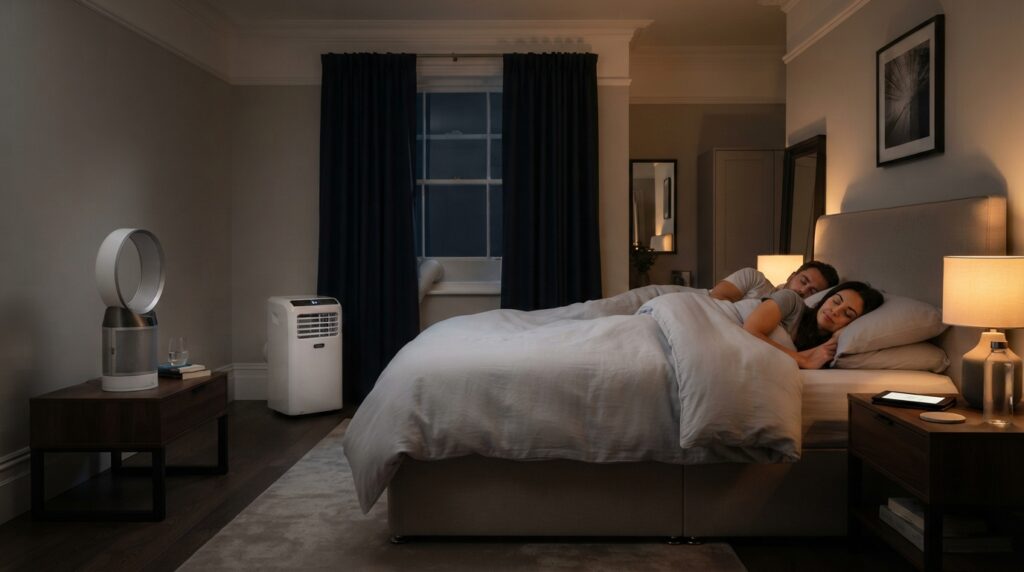
Sleep fails in the heat for a specific physiological reason: your core body temperature has to drop for sleep to start and stay stable, and a hot bedroom stops that happening. So everything that works is aimed at one of two targets — making the room cooler, or helping your body shed heat. The single most effective approach is pre-cool, seal and coast: shade the bedroom all day, flush it with cooler air in the evening, shut it up, and let a sealed room hold its temperature overnight. Then help your body: a lukewarm (not ice-cold) shower before bed, light breathable bedding, air movement across the room, and damp skin at the pulse points. The counter-intuitive one worth knowing: a cold shower feels right and works less well than a warm one.
British bedrooms are badly suited to hot nights — upstairs, under a hot roof, built to retain heat. Here’s what actually works, in the order that matters.
Why heat wrecks sleep (the mechanism)
Falling asleep isn’t just about feeling relaxed. Your body initiates sleep partly by dropping its core temperature, shedding heat through the skin — particularly the hands and feet, where blood vessels dilate to dump warmth. That drop is a signal your body uses to begin and maintain sleep.
In a hot room, there’s nowhere for that heat to go. The temperature gradient between your skin and the air is too small, so your body can’t offload heat efficiently, the core temperature stays up, and sleep is harder to enter and easier to break — which is why heatwave sleep is typically shallow, restless and punctuated by waking at 3am. Our night-waking guide covers that pattern specifically.
It also explains why humidity makes it so much worse. Sweating only cools you if the sweat evaporates, and in muggy air it doesn’t — so you’re hot, damp and unable to shed heat. The Met Office’s tropical nights — where the temperature never drops below 20°C — are the hardest version of this, and they’re becoming more common.
The room: pre-cool, seal, coast
This is where most of the benefit lies, and it starts long before bedtime.
- Shade the bedroom all day. Close curtains or blinds before the sun reaches that window — not once the room is already hot. For an east-facing bedroom that means overnight; for west-facing, before mid-afternoon. External shading does far more than internal, as our shading guide explains.
- Keep the door and windows shut through the hot part of the day, so the room isn’t taking on warm air from outside or from the rest of the house.
- Flush it in the evening. Once it’s cooler outside than in, open up and get air moving through — ideally a through-draught, with a fan in the window doing the work. Our window timing guide covers finding that crossover point, and the box-fan window trick speeds it up enormously.
- Then let it coast. A shaded, sealed bedroom holds its temperature for hours. If you’re running an air conditioner, this is the argument for pre-cooling before bed and switching it off rather than running it all night — quieter, cheaper, and covered in our quiet bedrooms guide.
- Sleep in the coolest room. Obvious but underused — a north-facing or downstairs room is often several degrees cooler than an upstairs bedroom. Moving downstairs for a few nights is free.
The bed: stop trapping your own heat
- Swap to a low-tog summer duvet — roughly 2.5–4.5 tog. People change their sheets and keep a 13.5 tog winter duvet, then wonder why they’re roasting. On the worst nights, a duvet cover with no filling, or just a sheet, is plenty.
- Breathable natural fibres. Linen, percale cotton and Tencel/lyocell breathe and wick; polyester and microfibre trap heat and leave you clammy. Our cooling bedding guide covers the materials.
- Check what’s under you. A dense memory foam mattress or topper hugs you and holds heat — often the hidden reason a bed sleeps hot. Our mattress toppers guide covers the breathable alternatives.
- Cool the pillow. The cool side of the pillow is real physics; a breathable pillow helps more than a gel layer that warms once you’re on it.
- A hot water bottle filled with cold water (or a frozen one, wrapped) at the feet is a genuinely effective old trick — the feet are one of the body’s main heat-dumping sites.
- The damp sheet trick, with a caveat. A lightly damp sheet cools by evaporation, and it works — but it adds humidity to the room and can leave you clammy as it warms. Better in dry heat than muggy, and best used as a last resort.
The body: help it shed heat
- Take a lukewarm shower, not a cold one. This surprises people. A very cold shower feels wonderful but causes the blood vessels near your skin to constrict, which reduces your ability to shed heat afterwards — and the body may respond by generating warmth. A warm or lukewarm shower keeps those vessels open and leaves your skin slightly damp, so you carry on losing heat by evaporation as you cool down and settle.
- Damp skin at the pulse points. Neck, wrists, temples, behind the knees — where blood runs close to the surface. A damp flannel or a cooling towel does the job.
- Cool your feet. A bowl of cool water for the feet before bed is genuinely effective for the same reason as the cold water bottle.
- Air movement across you — but angle the fan near rather than directly at your face all night, which dries the throat and airways.
- Loose, light nightwear in natural fibres — or none. Counter-intuitively, a thin layer of breathable cotton can help by wicking sweat away from the skin.
- Hydrate through the evening, with cool rather than ice-cold drinks, but not so much that you’re up all night.
- Go easy on alcohol and heavy late meals. Alcohol fragments sleep and affects temperature regulation; digesting a big meal generates heat. Both make a hot night worse.
When you can’t sleep anyway
Some disruption in a heatwave is normal, and fighting it tends to make it worse. If you’ve been lying awake a while, get up, keep the lights low, avoid screens, do something dull in a cooler room, and go back when you feel sleepy. Accept that a few poor nights during a hot spell is a normal response rather than a sign something is wrong, and try to keep your usual wake time so the pattern re-establishes itself. The Sleep Charity and NHS both have solid general guidance, linked below.
If cooling is the answer
On the most humid tropical nights, passive measures genuinely run out — there’s little cool air to bring in, and a fan helps less because sweat won’t evaporate. That’s the point at which a unit that removes both heat and moisture earns its cost. If you go that way, size it to the room, pre-cool and switch off rather than running it all night if noise wakes you, and remember no portable unit is silent — our quiet bedrooms guide and fan vs air conditioner guide cover where the line sits.
Frequently asked questions
Should I have a cold shower before bed in a heatwave?
A lukewarm or warm one is better. Very cold water constricts the blood vessels near your skin, which reduces heat loss afterwards. A warm shower keeps them dilated and leaves skin slightly damp, so you carry on cooling by evaporation.
Is it better to leave the fan on all night?
It helps if the airflow is across the room rather than blasting your face, which dries the throat. A fan cools you, not the room, so it only helps while you’re there — and pre-cooling the room then sleeping in silence suits light sleepers better.
Why do I keep waking at 3am when it’s hot?
Because your body can’t shed enough heat to keep core temperature low, so sleep stays shallow and breaks easily — and bedrooms often peak in warmth overnight as heat stored in the building releases. Cooling the room before bed and sealing it helps most.
Does the damp sheet trick work?
It does cool by evaporation, but it adds humidity to the room and can feel clammy as it warms. It works better in dry heat than on a muggy night — worth trying, but not the first thing to reach for.
Is it safe to sleep with the windows open?
With sensible precautions, yes — but fit window restrictors if you have young children, since falls from upstairs windows are a real risk, and think about security at ground level. Restrictors on fire-escape windows must be releasable quickly from inside.
Sources
- NHS — Sleep and tiredness
- NHS — Heat exhaustion and heatstroke
- The Sleep Charity — Sleep advice for adults
- Met Office — Tropical nights and their impact
- The Lullaby Trust — Safer sleep advice
Related reading: our cooling bedding guide and quiet bedrooms guide.
A low-tog duvet and breathable sheets are the cheapest fix for a hot bed. Compare current options at Amazon UK.