What Do the Numbers on a Radiator Valve Mean? (UK)
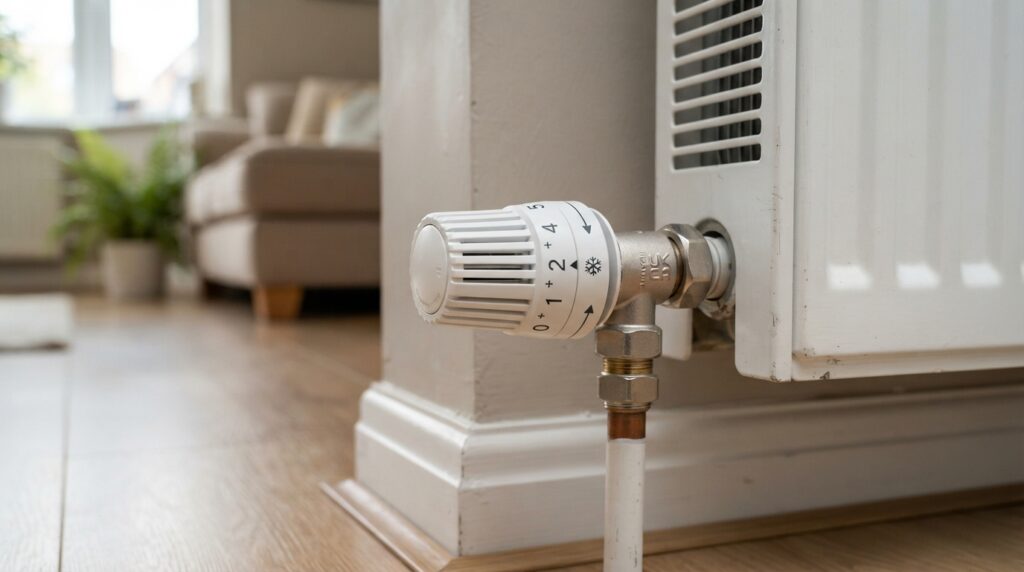
The numbers on a thermostatic radiator valve (TRV) are target room temperatures, not how hot the radiator gets. On most valves with a 1–5 scale, 3 is about 20°C. Beyond that, brands differ: depending on the model, 1 is roughly 12–13°C, 2 about 16–17°C, 4 about 23–24°C and 5 about 26°C on most models. The snowflake or star is frost protection, usually 5–8°C. Some valves use a different scale, so check yours. Turning a valve to 5 won’t heat a room any faster; it just means the radiator keeps going until the room is hotter. The Energy Saving Trust’s advice is simple: set each TRV to the lowest setting that keeps the room comfortable, starting from a middle setting.
Most British radiators have a valve with numbers on one end, and most of us have turned one to 5 on a cold evening expecting the room to warm up faster. It doesn’t work like that. Here’s what those numbers actually do, what temperature each one roughly means, and how to set them so you’re not paying to overheat rooms you’re not sitting in.
What a TRV actually does
A TRV is a small thermostat for one radiator. The Energy Saving Trust explains that the valve “senses the temperature of the air around it and automatically adjusts the flow of hot water” into the radiator. Inside the head is a sensor, usually filled with wax or liquid, which expands as the room warms and gradually closes the valve. Danfoss says its UK domestic range uses liquid-filled sensors, which respond in around 15 to 22 minutes, while wax sensors are the slowest at around 40 minutes.
So the number you choose isn’t how hot the radiator gets. It’s the room temperature at which the valve starts to shut the radiator off. When the room cools, the valve opens again.
TRV numbers and temperatures
Here’s what two manufacturers say each setting means. All these figures are approximate: Honeywell, for example, says its settings are for guidance only and can vary by 1 to 2°C depending on where the valve is fitted.
| Setting | Stelrad (TRV guide) | Danfoss (user guide) | Typical meaning |
|---|---|---|---|
| Snowflake / * | 8°C | About 7–8°C | Frost protection only |
| 1 | 12°C | 13°C | Unused rooms, hallways |
| 2 | 16°C (bedroom) | 17°C | Bedrooms |
| 3 | 20°C (living room) | 20°C | Living rooms |
| 4 | 24°C (bathroom) | 23°C | Bathrooms |
| 5 | — | 26°C | Rarely needed |
Stelrad’s printed guide uses four marks rather than five, while its blog puts 5 at around 30°C (and also describes 5 as fully open). Viessmann also says setting 3 should give about 20°C, and that the snowflake is “usually set to 5°C”. Not every valve uses a 1–5 scale: Honeywell’s Valencia heads run from 1 to 6, with 20°C nearer 4. Drayton’s TRV4 runs from 1 to 5 and then MAX, with frost protection below about 8°C; its datasheet gives a range of 10°C to 30°C, while its fitting instructions say 10°C to 27°C. The Energy Saving Trust sums it up: “The numbers don’t correspond to the same temperature on every model.”
Why turning it to 5 doesn’t heat the room faster
Drayton and Danfoss both make the same point in their user guides: “Turning a TRV to a higher setting will not make the room heat up any faster.” While the room is well below the target, the valve is fully open whether it’s set to 3 or 5. The only difference is that on 5 it doesn’t start closing until the room is far warmer, so you end up paying to overheat it. If a room is slow to warm up, the cause is usually elsewhere: a radiator that needs bleeding, a sofa in front of it, or a boiler flow temperature that’s set low. Our guides to bleeding a radiator and things that make your house colder cover those.
What setting should each room be on?
The Energy Saving Trust’s advice is to “set each TRV to the lowest setting that keeps the room comfortable”, and if you’re unsure, to “try setting the TRV to a middle setting” first. As a starting point, based on the manufacturers’ tables:
- Living room: 3 (about 20°C).
- Bedrooms: 2 to 3. Stelrad marks setting II (about 16°C) as the bedroom setting.
- Bathroom: 3 to 4, so it’s warm when you get out of the shower.
- Hallway and landing: 2.
- Spare room you’re not using: 1 or the snowflake. Don’t switch it fully off if the room is cold and damp, as that’s where condensation and mould tend to start; our winter condensation guide explains why.
If anyone in your home is older or has a health condition, keep the rooms they use at a healthy temperature. Our guide to setting your thermostat in winter covers the recommended levels.
The room with the main thermostat
This catches out a lot of homes. Your wall thermostat decides when the boiler fires. If the radiator in that same room also has a TRV that shuts it off first, the thermostat never reaches its target and the boiler keeps running to heat the rest of the house. Drayton says the radiator in the room with the room thermostat “should not normally have a TRV”, and that if it does, it should be kept on maximum. Honeywell says UK Building Regulations recommend a TRV in every room “except the one with the Room Thermostat”. Viessmann’s way of putting it is that the two will “compete”.
Common mistakes
- Covering the valve. Drayton and Danfoss both say TRVs “must not be covered by curtains or blocked by furniture”. A valve under a curtain senses trapped warm air and shuts off early, leaving the room cold.
- Radiator covers. The Energy Saving Trust says it generally doesn’t recommend them, because they can trap warm air around the valve, so the TRV switches the radiator off before the room is warm.
- Turning everything to 5 when you’re cold. As above, it doesn’t speed things up and wastes gas.
- A valve that won’t respond after summer. Stelrad says the most common reason a TRV seizes is “simple lack of use”. With the head unscrewed, you’ll see a small pin; Stelrad suggests gently easing it “up and down a few millimetres”, and warns that forcing it “risks snapping it or cracking the valve body”. To stop it happening again, it suggests leaving TRVs fully open over the summer. If it won’t free up, call a heating engineer.
What it saves
The Energy Saving Trust says installing and using heating controls effectively could save around £100 a year in Great Britain and £110 in Northern Ireland. If you already have a programmer and thermostat, it estimates adding TRVs to all your radiators costs around £370. If you already have TRVs, the saving comes from actually using them: turning down rooms you’re not in rather than heating the whole house to living-room temperature. At the October to December 2026 gas price cap of 7.97p per kWh, every kilowatt hour of gas you don’t burn saves about 8p.
Do you have to have TRVs?
In England, if you replace your boiler, the Building Regulations expect it. Approved Document L says that when a boiler is replaced in an existing home, “each room should be provided with thermostatic room controls”, which in practice usually means TRVs. In some cases zone control is allowed instead, such as single-storey open-plan homes where the living area is more than 70% of the floor area, or two adjacent rooms with a similar use, like a kitchen and utility room. Your installer should sort this out as part of the job.
Drayton TRV4 thermostatic radiator valve
Best for: replacing an old or missing valve
Liquid-filled sensor head
Frost protection below about 8°C
Drayton’s datasheet describes the TRV4 as having “setting numbers 1 to 5 then ‘MAX'”, a liquid-filled head and frost protection below 8°C. It gives the range as 10°C to 30°C, though the fitting instructions sold with it say 10°C to 27°C, and say the valve comes factory-set on 4. If you have radiators with plain manual valves, or a TRV head that’s cracked or no longer works, a valve like this lets you set each room separately. Drayton’s user guide carries the same advice as above: don’t cover it, and turning it higher won’t heat the room faster.
Good for: adding room-by-room control; replacing worn or broken TRV heads.
Less good for: DIY if you’re not confident: fitting a new valve body usually means draining the system or using a specialist kit, which is a job for a plumber or heating engineer. Not for the radiator in the room with your wall thermostat.
TP49 room thermometer and hygrometer
Best for: checking what your TRV setting really gives you
Shows humidity too
1 × AAA
Because TRV numbers vary by brand, the only way to know what setting 3 means in your room is to measure it. Its maker, now trading as TempPro (formerly ThermoPro), quotes temperature accuracy of ±0.5°C between 0°C and 60°C. Put it at seated height, away from the radiator, and adjust the TRV a step at a time until the room sits where you want it. Our room thermometer guide compares other options.
Good for: finding the right TRV setting for each room; spotting rooms that run too hot or too cold.
Less good for: alerts or history, which it doesn’t have; you have to look at it.
Frequently asked questions
What temperature is number 3 on a radiator valve?
About 20°C on most valves with a 1–5 scale. Stelrad, Danfoss and Viessmann all put setting 3 at roughly 20°C, though the exact figure can vary by a degree or two depending on where the valve is fitted. Some valves, such as Honeywell’s Valencia heads, use a 1–6 scale, where 20°C is nearer 4.
What does the snowflake on a radiator valve mean?
It’s frost protection. The valve stays shut unless the room falls to around 5–8°C, depending on the brand, to stop pipes freezing in an unheated room.
Does turning a radiator valve to 5 heat the room faster?
No. Drayton and Danfoss both say a higher setting won’t make the room heat up any faster. It just means the radiator keeps running until the room is warmer, which uses more energy.
Should there be a TRV on the radiator in the room with the thermostat?
Usually not. Drayton says that radiator should not normally have a TRV, and if it does, it should be set to maximum, so the valve and the wall thermostat don’t work against each other.
Is it OK to turn radiators off in rooms I don’t use?
Turning them right down saves energy, but in a cold, damp home a completely unheated room can attract condensation and mould. The snowflake or 1 setting keeps a little background warmth without heating the room properly.
Sources
- Energy Saving Trust — Thermostats and heating controls
- Stelrad — Thermostatic radiator valves and lockshield valves FAQs
- Stelrad — Radiator valve numbers explained
- Stelrad — How to fix a stuck radiator valve
- Honeywell, via Sparesbase — VT15 thermostatic radiator valve instructions
- Danfoss — Set and forget: radiator thermostat user guide
- Honeywell, via Sparesbase — Valencia TRV homeowner guide
- Danfoss — Radiator thermostats overview
- Danfoss — RAS-D2 user guide
- Viessmann — Radiator valves explained
- Drayton — TRV4 datasheet
- Drayton — What is a TRV?
- Drayton, via Wickes — TRV4 fitting instructions
- GOV.UK — Approved Document L, Volume 1: Dwellings
- Ofgem — Energy price cap unit rates and standing charges
- TempPro — TP49 indoor thermometer and hygrometer
- PR Newswire — ThermoPro becomes TempPro
Related reading: our winter thermostat guide, how to bleed a radiator and does closing internal doors save heating?
Compare the Drayton TRV4 at Amazon UK.