The Box Fan Window Trick: Pulling a Cooling Draught Through Your Home
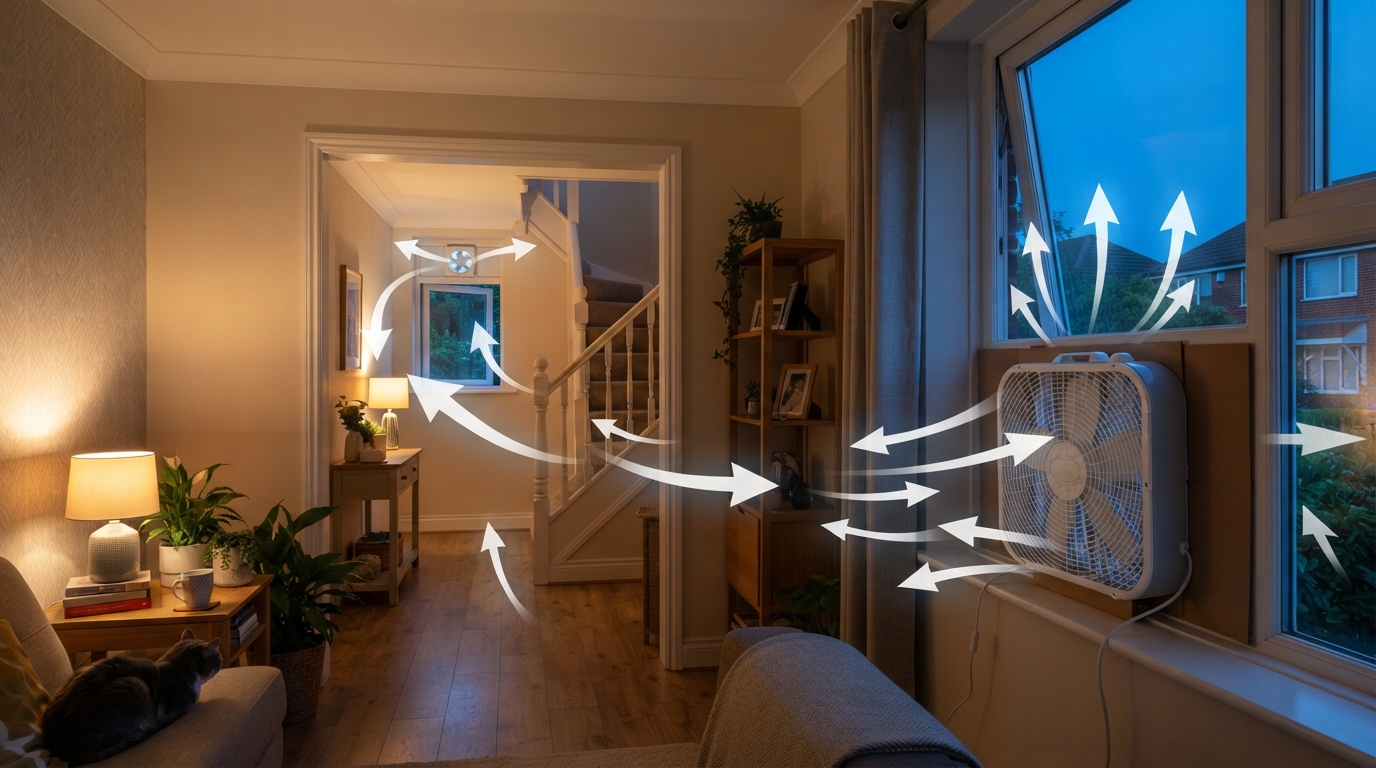
Put a fan in an open window facing outwards so it blows the warm indoor air out, and open a window on the opposite side of the home to let cooler air be drawn in. Done at the right time — when the air outside is cooler than the air inside, usually late evening into early morning — this flushes the day’s heat out far faster than an open window alone. The whole trick rests on one condition: it only works when it’s cooler outside than in. Run it in the heat of the day and you’re just pumping hot air through the house. A fan moves air; it doesn’t chill it.
It’s the cheapest cooling technique there is, and it genuinely works — as long as you understand the one rule that makes or breaks it.
The one rule: only when it’s cooler outside
A fan doesn’t lower the temperature of the air — it just moves it. So this trick only cools your home when the air you’re pulling in is cooler than the air you’re pushing out. That means:
- Do it in the late evening, overnight, and early morning, once the outside temperature has dropped below your indoor temperature.
- Don’t do it in the afternoon heat — you’d be actively drawing hot air in. At that point, close up and shade instead. Our window timing guide covers the daily rhythm.
Which way should the fan face?
There are two valid setups, and the best one depends on your home:
- Exhaust setup (usually best): fan in a window on the warm side of the house, facing outwards, blowing hot indoor air out. Open a window on the cooler, shadier side and cool air is drawn in to replace it. Because hot air rises, an upstairs window is a good exhaust point.
- Intake setup: fan facing inwards on the cool, shady side, pushing cooler outside air in, with another window open elsewhere to let warm air escape.
The principle behind both: you want air to travel across the space — in one side, out the other — not just swirl by one window. A single fan blowing into a room with no exit achieves far less.
Getting the most from it
- Create a cross-flow. Openings on opposite sides of the home pull air through; two windows on the same wall barely do.
- Exhaust the hottest air. Upstairs, and near the ceiling, is where the warmest air collects — a good place to blow it out from.
- Use the temperature drop. Start as soon as it’s cooler outside and run it through the coolest part of the night.
- Close up before the heat returns. In the morning, shut windows and shading to hold the cool you’ve gathered — our draught-proofing guide covers keeping it in.
- Mind security and rain. An open downstairs window overnight is a security thought; a window fan needs to be safe from a sudden shower.
The pick
A box fan (or any flat fan that sits in a window)
The cheapest cooling there is
Pennies per night
Moves a lot of air
A box fan’s flat shape is what makes the trick work — it sits squarely in a window opening and moves a large volume of air for very little electricity. Any fan can help, but a boxy one seals the opening better than a round pedestal head.
Good for: flushing the day’s heat at night; homes with windows on opposite sides for cross-flow; anyone wanting the cheapest possible cooling.
Less good for: daytime heat, when the outside air is warmer than inside — then it works against you. It also won’t dehumidify or hit a set temperature, and on a still, muggy tropical night when it barely cools below 20°C outside, there’s little cool air to pull in. Our fan vs air conditioner guide covers that limit.
Choosing between a box fan and the other types — pedestal, tower, desk, ceiling — is covered in our fan types guide.
Frequently asked questions
Should the fan face in or out?
Either works if you create a cross-flow. Facing out on the warm side (exhausting hot air) is usually most effective, with a window open elsewhere to draw cool air in. The key is air travelling across the space, not past one window.
Why isn’t it cooling during the day?
Because the outside air is hotter than inside, so you’re pulling heat in. This trick only cools when it’s cooler outside — evening, night and early morning. In the day, close up and shade.
Do I need two fans?
No — one fan plus an open window on the opposite side usually creates the through-draught. A second fan at the intake can speed it up, but the open window is what lets the air move.
Is a box fan better than a pedestal fan for this?
For the window trick, yes — its flat shape fills the opening better. For cooling you directly by day, a pedestal or tower fan is easier to aim. Our fan types guide covers the choice.
Sources
- Energy Saving Trust — Keeping your home cool in summer
- Met Office — Heat-health advice
- NHS — Heat exhaustion and heatstroke (keeping cool safely)
Related reading: our window timing guide and fan types guide.
A box or window fan is a few pounds and moves a lot of air. Compare current options at Amazon UK.