Storage Heater Settings for Winter: Input and Output Explained (UK)
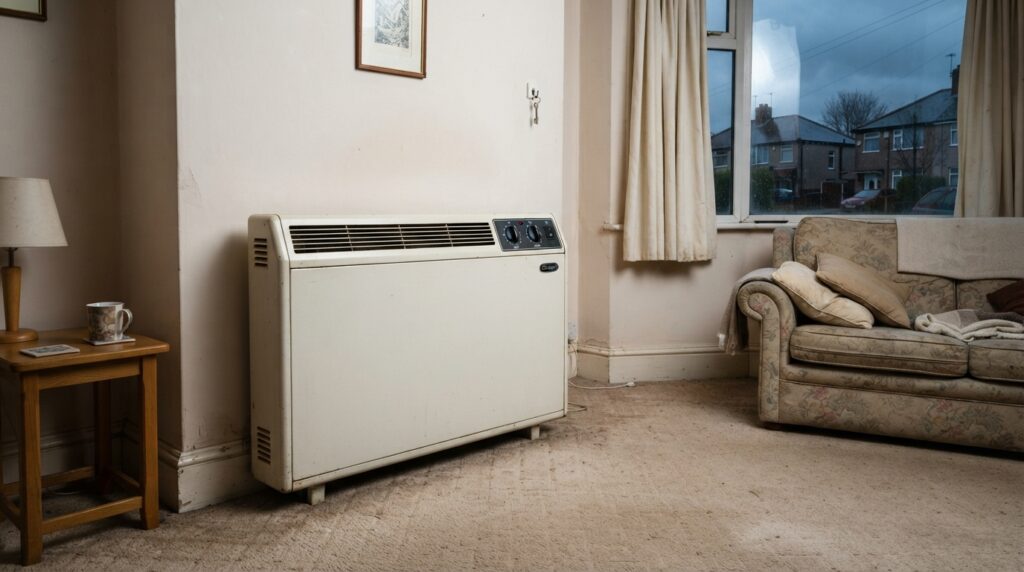
Think of a storage heater as a battery for heat. The input dial decides how much heat it stores overnight on cheaper off-peak electricity; the output dial decides how fast it releases that heat the next day. Citizens Advice suggests setting the input to 5 or 6 in winter (1 to 3 in spring and autumn), and the output to about 3 in the morning, 2 during the day, 1 if you’re out and 5 in the evening — then turning the output to its lowest setting at bedtime, so you’re not releasing heat while you sleep. The most common mistake is setting the output too high during the day, so the heater has run out by the evening. And go easy on the boost button: it runs on full-price daytime electricity.
If you’ve moved into a flat or house with storage heaters, the two dials on the top can be baffling, and the instruction leaflet is usually long gone. Get them wrong and you get the classic storage heater experience: a roasting living room at 9am and a cold one at 7pm. Here’s how they work and the settings that fix it.
How a storage heater works
Inside a storage heater are heavy bricks that are heated up overnight, when electricity on an off-peak tariff such as Economy 7 is cheaper. During the day, that stored heat seeps out into the room. Ofgem explains that on multi-rate tariffs like Economy 7, you pay one unit rate during peak hours and a different rate during off-peak hours. The whole system is designed to buy its heat at the cheaper rate.
The catch is that the bricks are always losing some heat. EDF points out that even the lowest output setting releases heat slowly over time. A storage heater isn’t a tap you can turn fully off; it’s more like a hot-water bottle that you can wrap more or less tightly.
The input dial: how much to charge
Citizens Advice explains that the input dial controls how much heat is stored during off-peak hours. A higher number means more heat stored overnight, ready for the next day. Its suggested settings by season are:
| Season | Input setting |
|---|---|
| Winter | 5 or 6 |
| Autumn | 1 to 3 |
| Spring | 1 to 3 |
| Summer | 1 |
Changeworks, the Scottish energy charity, gives a day-by-day version: medium to high (between 3 and 5) on a cold day, and low to medium (between 1 and 3) on a mild one. The thing to remember is timing. Home Energy Scotland notes that any change you make to the input won’t take effect until the next day, because the heater only charges overnight. So check the forecast in the evening and set the input for tomorrow’s weather, not today’s.
The output dial: how fast to release it
Citizens Advice describes the output dial as controlling how much of the stored heat is released. Its suggested pattern for colder months is:
| Time of day | Output setting |
|---|---|
| Morning | 3 |
| Daytime | 2 |
| When you’re not at home | 1 |
| Evening | 5 |
| Overnight | Lowest setting |
The overnight setting is the one people forget. Citizens Advice says to set the output dial to the lowest number at night, which stops heat being used while you’re asleep. Changeworks says the same: remember to turn the output down again before going to bed.
Why your storage heater is cold by the evening
The fix is to keep the output low through the day — Changeworks suggests a low setting — and turn it up in the late afternoon or early evening. If you’re out at work, output on 1 — Citizens Advice’s setting for when you’re not at home — keeps more of the heat in reserve for when you get back.
Why it’s too hot in the morning
If rooms are stuffy first thing but you still run out later, the input is probably too high for the weather and the output too high overnight. Turn the output to its lowest setting at bedtime, and on milder days drop the input a couple of numbers. Because input changes only take effect from the next charge, give any adjustment a day or two before judging it.
The boost button: use it sparingly
Many storage heaters have a boost or convector function for extra heat on demand. Citizens Advice explains that this extra heat uses electricity during peak times, which is more expensive on a time-of-use tariff, and suggests turning the auto boost off on digital models. Changeworks says the boost uses electricity priced at the daytime rate, not the cheaper overnight rate, and the Energy Saving Trust advises not relying on these too often. A heated throw on the sofa is usually a much cheaper way to bridge a cold evening than running the boost.
Check your off-peak hours
Storage heaters only work cheaply if they charge during your actual off-peak hours. Citizens Advice notes that the exact times depend on your supplier, your tariff and where you live, and that your off-peak times might change when the clocks change. If your heaters seem to be charging at the wrong time, or your bills look high, ask your supplier to confirm your off-peak hours and check that the heater timer or meter is set to match. Our guide to Economy 7 and time-of-use tariffs explains how these tariffs work in more detail.
Old heaters versus modern ones
Citizens Advice says older storage heaters with manual controls can be less efficient and cost more to run. The Energy Saving Trust explains that high heat retention storage heaters retain more heat than older models, are well insulated and have automated controls, and that storage heaters made after 2018 must meet stricter efficiency standards and come with better controls. If you own your home and your heaters are old, upgrading can make your home more comfortable and cut bills. If you rent, it’s worth asking your landlord.
A room thermometer with min/max memory
The easiest way to tune your settings
Records the day’s highs and lows
Battery powered
Storage heaters are slow to respond, so it’s hard to judge your settings by feel. A thermometer with min/max memory shows you how warm the room got in the morning and how cold it dropped by the evening, which tells you straight away whether to change the input or the output. Put it at seated height, away from the heater itself. Our thermometer and hygrometer guide covers what to look for.
Good for: tuning input and output settings; spotting a heater that’s running out by evening; checking a room stays warm enough.
Less good for: changing anything itself — it measures, you adjust. Cheap models can be a degree or so out.
An electric heated throw
Cheaper than the boost button on cold evenings
Several heat settings
Auto shut-off on most models
When the storage heater runs low late in the evening, the temptation is to press boost, which runs on peak-rate electricity. A heated throw on the sofa uses far less power because it warms you rather than the whole room. Look for an automatic shut-off, several heat settings and a washable cover, and check the wattage on the listing. Our heated throw comparison goes through the options.
Good for: the last hour or two of the evening; avoiding peak-rate boost heating; anyone sitting still for long periods.
Less good for: keeping the room itself warm, which still matters for damp and for health. Not for use while asleep unless the manufacturer says so.
Frequently asked questions
What should I set my storage heater input to in winter?
Citizens Advice suggests 5 or 6 in winter. Changeworks suggests between 3 and 5 on a cold day and between 1 and 3 on a mild one. Remember that changes only take effect after the next overnight charge.
Should the output be on or off overnight?
Set it to the lowest number. Citizens Advice says this stops heat being used overnight, and Changeworks advises turning the output down before going to bed.
Why is my storage heater cold in the evening?
Usually because the output has been set too high during the day, so the stored heat has been used up. The Energy Saving Trust warns that a high output can make the heater run out before the end of the day. Keep the output low until late afternoon.
Is it expensive to use the boost button?
It can be. Citizens Advice and Changeworks both explain that boost heating uses electricity at the peak or daytime rate rather than the cheaper overnight rate, and the Energy Saving Trust advises not to rely on it too often.
Sources
- Citizens Advice — Using storage heaters and immersion heaters
- Energy Saving Trust — Electric storage heaters
- Changeworks — Traditional storage heaters
- EDF — Storage heaters explained
- Home Energy Scotland — How to save energy with electric storage heaters
- Ofgem — Energy price cap unit rates and standing charges
Related reading: our Economy 7 and time-of-use tariffs guide, heat pump versus electric heater running costs and cheapest way to heat one room.
Compare current room thermometers with min/max memory at Amazon UK.