Air Conditioner vs Fan: When Is a Fan Actually Enough?
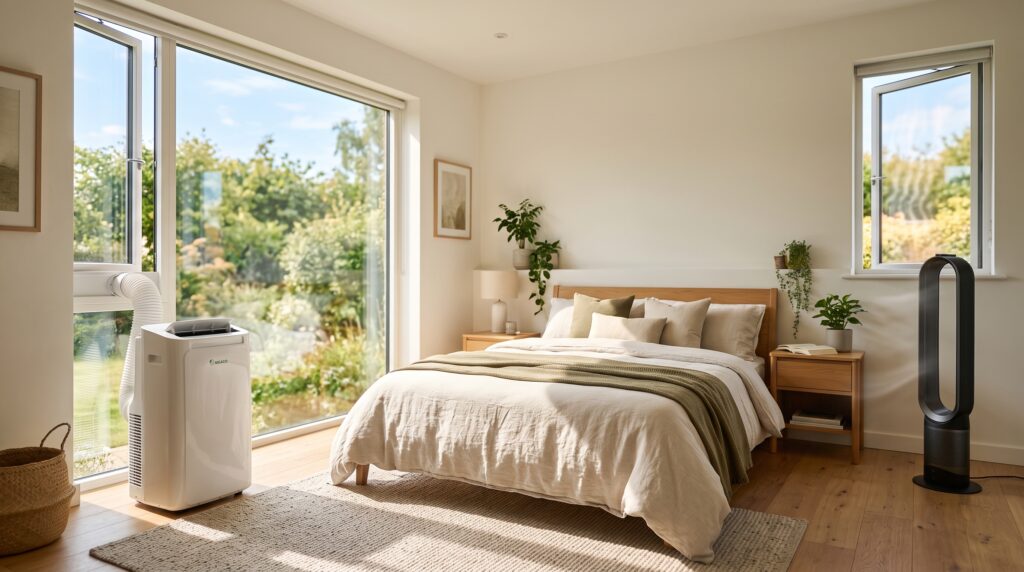
They do fundamentally different things, and the distinction decides which you need. A fan doesn’t cool a room at all — it moves air, which increases evaporation from your skin, so you feel cooler while the room temperature stays the same or rises slightly. An air conditioner removes heat from the room and dumps it outside. For most British summers, in most rooms, a fan plus proper shading is genuinely enough — and costs pennies a night against tens of pounds a month. You need cooling when the room itself is too hot for evaporation to keep up, which in the UK means tropical nights, west-facing rooms, loft conversions and conservatories.
The honest version of this comparison, including when we’d tell you not to buy the more expensive thing.
What each one actually does
A fan moves air
It adds no cooling to the room. In fact a fan motor adds a small amount of heat.
What it does is increase the rate at which sweat evaporates from your skin, and evaporation takes heat with it. That’s why a fan feels good pointed at you and does nothing pointed at an empty room — and why turning one off makes a room feel hotter than before, even though the temperature hasn’t changed. Our fan explainer covers that sensation.
The practical rule: point it at people, not at the room.
An air conditioner moves heat
It takes heat out of the room air and expels it outside through the hose. The room genuinely gets cooler, and it gets drier too, since moisture condenses out of the air as it passes the cold coil — which is where the tank water comes from.
That dehumidification matters more than people realise, because humidity is much of what makes heat unbearable. Our “feels like” guide covers it.
Running cost: the gap is large
A fan typically draws tens of watts. A portable air conditioner typically draws somewhere in the region of 0.8 to 1.4 kW — a difference of roughly twenty to fifty times.
To work out your own figures: wattage divided by 1,000, multiplied by your unit rate in pence per kWh, gives cost per hour at full draw. Our running cost guide works through it, and Ofgem publishes current price cap rates.
Over a British summer — which is a few weeks of genuine heat in most years — that gap is the single strongest argument for trying a fan first.
When a fan is enough
- Moderate heat. A room in the low-to-mid twenties with air moving across you is comfortable for most people.
- You’re in the room. A fan works on people, so it’s fine when you’re sitting or sleeping in one place.
- The air is dry. Evaporative cooling works better when the air can absorb more moisture.
- The room isn’t gaining heat continuously. A north-facing bedroom that’s warm rather than baking.
- You’ve done the free things. Shading from mid-morning and overnight purge ventilation change the picture enormously — a shaded, ventilated room plus a fan beats an unshaded room plus an air conditioner more often than you’d think.
- You move around — a fan you can carry between rooms suits a household that doesn’t sit still.
- Noise through shared walls matters, or you rent short-term.
When you need cooling
- Tropical nights, where the temperature doesn’t drop below 20°C overnight and there’s no cooler outside air to bring in. These are becoming more common in the UK — our tropical nights guide covers the trend.
- High humidity, where evaporation from your skin is already hampered. This is where a fan stops helping and cooling earns its cost.
- Rooms that gain heat continuously — west-facing rooms in the evening, loft conversions, conservatories, rooms above garages, flat-roof extensions.
- You need the room cool before you arrive. A fan can’t pre-cool; an air conditioner on a timer can.
- Equipment or people generating heat — a home office with a desktop, a home gym.
- Someone in the household is at higher risk in heat — older people, pregnant women, anyone with a heart or respiratory condition. Our elderly heatwave guide covers that.
The middle options
A ceiling fan is more efficient than a portable one, doesn’t take floor space, and runs in reverse in winter to push warm air down. It needs fixed electrical work, which is notifiable under Part P. Our ceiling fans guide covers the constraints.
An evaporative cooler sits between the two and suits fewer UK situations than its marketing suggests — it adds humidity, which on a muggy British night makes things feel worse. Genuinely useful in a ventilated garage or workshop. Our comparison covers where it works.
A dehumidifier is the right answer if your complaint is clamminess rather than temperature. It doesn’t cool the air — it emits a little heat — but a less humid room feels considerably more comfortable.
The picks
A pedestal or tower fan
Try this first
No venting
Portable between rooms
For most UK households in most summers, this plus closed curtains from mid-morning is genuinely enough. Look for a remote if it’ll be used overnight, a timer, and a stable base. Oscillation is useful in a shared room; a fixed fan aimed at one person is more effective for one.
Good for: moderate heat, short tenancies, tight budgets, awkward windows, and overnight use where a compressor would disturb a shared wall.
Less good for: tropical nights and humid conditions, where the air itself is too warm for evaporation to help much. It also can’t pre-cool a room, can’t reduce humidity, and does nothing for a room that’s gaining heat faster than you can tolerate.
MeacoCool MC Series 9000 (MC9000)
When a fan isn’t enough
16–26m²
53 dB minimum
A-rated
Meaco publish 16–26m², an A energy rating and a 53 dB minimum noise figure — a sensible standard-bedroom or living-room capacity with documented specifications rather than a marketplace claim. The A rating matters if you’re going to run it: the difference between efficiency classes shows up on the bill over a hot fortnight.
Good for: a room that genuinely gains heat faster than shading and ventilation can handle; pre-cooling on a timer; humid nights where a fan has stopped helping.
Less good for: anyone who hasn’t tried shading and ventilation first — a unit fighting an unshaded west-facing window may not win regardless of capacity. It’s also 20-plus kilos to move and store, needs the hose vented through a window, and costs many times a fan to run. If you get four genuinely uncomfortable nights a year, it’s hard to justify.
Do these before buying either
- Shade sun-facing windows from mid-morning, before the room heats. Free, and it beats both machines. Our blinds guide covers what to look for.
- Purge ventilate once outside is genuinely cooler than inside, then shut up in the morning. Most households get this backwards by hours — our timing guide covers judging it.
- Close internal doors to the room you want cool.
- Switch off electronics generating heat.
- Measure the room with a thermometer for a few nights, so you know what problem you’re solving.
Frequently asked questions
Does a fan make a room hotter?
Marginally — the motor adds a small amount of heat. But it makes you feel cooler, which is what matters when you’re in the room. Leaving one running in an empty room is pure waste.
Can I use both?
Yes, and it’s a good combination. A fan circulating cooled air lets you set the air conditioner a degree or two higher for the same comfort, which reduces running cost.
Is a fan safe to leave on all night?
Generally yes, on a wall socket with a sound cable. Some people find direct airflow overnight causes a dry throat or stiffness — angling it to circulate rather than blow directly at you usually solves that. Our dryness guide covers the related complaints.
How many hot nights justify an air conditioner?
Only you can answer that, but it’s the right question. For a handful of nights a year, a fan and good shading is the sensible answer. If you’re losing sleep for two or three weeks every summer, or someone in the house is at higher risk in heat, the calculation changes.
Sources
- NHS — Heatwave: how to cope in hot weather
- UKHSA — Adverse Weather and Health Plan
- Met Office — Tropical nights and their impact
- Ofgem — Energy price cap
- Energy Saving Trust — Home appliances and energy use
- Meaco Dehumidifiers — MeacoCool MC9000 specifications
Related reading: our fan explainer and running cost guide.
Compare both at Amazon UK. If you’re undecided, a fan costs a fraction of an air conditioner and tells you within a fortnight whether you need more.