Window Restrictors: How to Ventilate Safely at Night (UK)
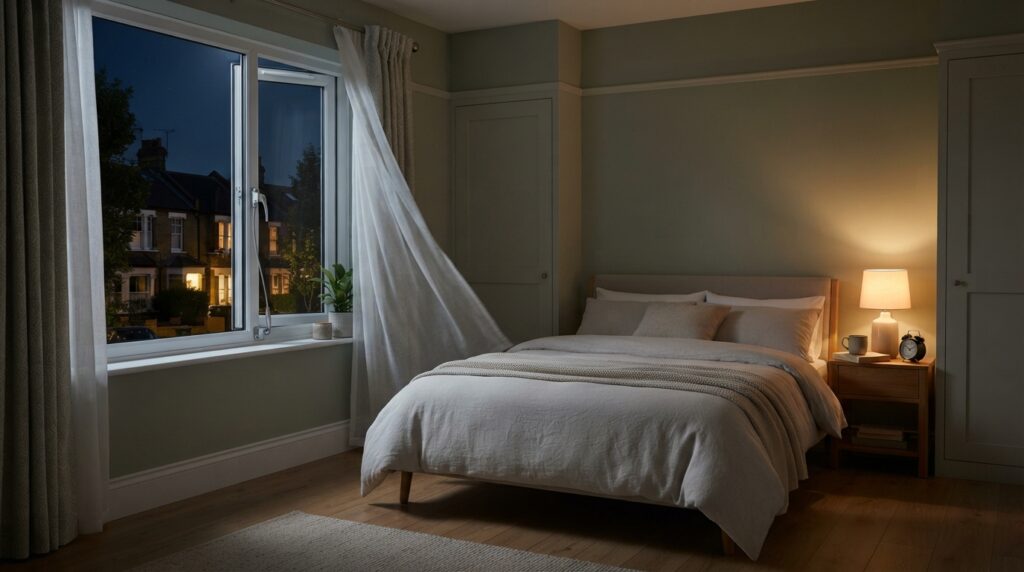
Night ventilation is the backbone of cooling a British home without air conditioning — but leaving windows wide open overnight creates two genuine risks: children falling and break-ins. A window restrictor resolves the tension by holding the window open a limited amount — commonly around 100mm, the figure usually specified where children may be present — which still moves a useful amount of air. The crucial detail most people miss: on any window that is a means of escape in a fire, the restrictor must be releasable from inside without hunting for a key, and everyone in the house needs to know how. Fit restrictors on upper-floor and children’s rooms, keep furniture away from windows, and you can ventilate through the night with far less risk.
Every guide to cooling a UK home — including ours — tells you to open the windows at night. Very few mention what that means if you have small children or a vulnerable ground-floor window. This one does.
Why night ventilation matters in the first place
Almost all passive cooling in the UK depends on one thing: outdoor air overnight is usually cooler than the air trapped inside your house. Opening up when it’s cooler outside flushes out the day’s accumulated heat, and closing up in the morning holds that coolness in. It’s the single most effective free cooling measure there is — our no-AC cooling guide and window timing guide cover the routine.
Which means “just don’t open the windows” isn’t a satisfactory answer to the safety problem — it costs you the main tool you have. Restricting the opening is the compromise that keeps most of the benefit.
The child safety problem
Young children are at risk from open windows for reasons that are easy to underestimate:
- They climb. A bed, cot, chest of drawers, radiator, toy box or windowsill seat next to a window is a ladder. Most falls involve furniture near a window.
- Low sills. Many older homes, and many upper-floor rooms, have sills low enough for a small child to get over.
- It’s fast and silent. Falls happen in the seconds an adult is out of the room.
- Insect screens are not barriers. A flyscreen will not hold a child’s weight — this is a dangerous and common assumption.
The practical measures: fit restrictors to upper-floor windows and any window in a child’s room; move climbable furniture away from windows; don’t rely on a child “knowing not to”; and keep window keys where an adult can find them instantly but a young child cannot reach them.
The fire escape problem — read this before you fit anything
The security problem
An open window overnight is an opportunity, particularly at ground level, on flat roofs, or anywhere reachable from a bin store, garage roof or garden furniture. In hot weather, opportunistic entry through open windows and doors genuinely rises.
Usefully, restrictors help here too — a window held to a narrow opening is far harder to exploit than one swung wide. Combine with:
- Prioritise upstairs for overnight ventilation where it’s harder to reach, and keep ground-floor windows closed or minimally restricted when you’re asleep.
- Check what’s climbable outside — don’t leave ladders, bins or garden furniture where they give access to an upper window.
- Lockable restrictors and key-locking handles, which let you set a secure night-vent position.
- Don’t advertise it — an obviously open, unlit ground-floor window at 2am is an invitation.
In summer, home security is mostly about open windows rather than dark evenings, so a lockable night-vent position is the part to get right.
The types of restrictor
- Cable restrictors. A short steel cable between frame and sash limiting how far it opens, usually with a release button or key. Versatile, work on most casement windows, and the common choice for child safety.
- Sash stops / sash restrictors. For vertical sliding sash windows — a stop screwed into the frame that limits travel, often with a keyed bolt so it can be released. Well suited to period homes.
- Hinge / arm restrictors. Built into or fitted to the window’s friction hinge or stay, limiting the arc of opening.
- Restricted-position handles. Many modern uPVC and aluminium windows have handles with an intermediate “night vent” or locked-ajar position, holding the window slightly open but latched. If your windows already have this, you may need nothing else.
- Tilt-and-turn windows. The tilt position is inherently a restricted opening — secure, hard for a child to get through, and good for ventilation. One of the better designs for this problem.
When buying, look for restrictors made to the relevant British Standard for the purpose, check they suit your window type and material, and make sure the fixings are into something solid rather than a thin plastic profile.
Ventilating without opening the window much at all
Sometimes the best answer is to get airflow another way:
- Trickle vents — the small controllable vents in the window frame or head. Modest airflow, but secure and safe to leave open permanently, and they help with condensation year-round.
- The tilt position on tilt-and-turn windows, as above.
- Ventilate the rooms you can secure — open a restricted upstairs window and an internal door to draw air through, rather than opening a vulnerable ground-floor window.
- Use a fan to make a small opening work harder. A fan in or near a restricted window moves far more air than the opening would passively — our box-fan window guide explains the principle, and it’s particularly useful when the opening is limited.
- Cool the room before bed and seal it, so you need less overnight opening — our draught-proofing guide covers holding the cool in.
If you rent
Ask your landlord or letting agent about window restrictors — in properties let to families, and particularly in houses in multiple occupation, window safety is something responsible landlords are expected to consider as part of keeping the property safe. Many restrictors can also be fitted with minimal, making-good-able fixings; agree it in writing first. Our renter’s guide covers cooling a rented home without permanent changes, and our flats and HMOs guide covers shared housing.
A sensible household setup
- Fit restrictors to upper-floor windows and all children’s rooms — releasable types on escape windows.
- Move furniture away from windows so there’s nothing to climb.
- Agree where the keys live — consistent, adult-reachable, near the window, out of children’s reach — and make sure everyone knows.
- Use upstairs restricted openings plus internal doors to get a through-draught overnight.
- Close and shade in the morning to hold the coolness you gathered.
- Include window release in your fire plan and check it works, occasionally, when it isn’t an emergency.
Frequently asked questions
How far should a window open where children are present?
Guidance commonly specifies restricting the opening to around 100mm — small enough that a child cannot get through, while still allowing useful ventilation. Check the product you buy states what opening it restricts to.
Will a restrictor stop me escaping in a fire?
It must not. On any window that’s a means of escape, use a releasable restrictor — quick-release or keyed with the key kept consistently within adult reach nearby — and make sure everyone in the household knows how to release it. Never fit a permanently fixed restrictor to an escape window.
Is a flyscreen enough to stop a child falling?
No, absolutely not. Insect screens are not designed to bear weight and will not hold a child. Never treat a screen as a safety barrier.
Is it safe to leave windows open overnight for cooling?
With restrictors on upper-floor and children’s windows, furniture kept clear, and ground-floor windows secured, it’s far safer — and restricted openings still ventilate well, especially with a fan helping. Weigh security too: upstairs openings are generally the better bet overnight.
Do trickle vents actually do anything?
They provide modest background ventilation — not enough to flush a hot room on their own, but useful, secure, safe to leave open, and helpful against condensation year-round. Use them alongside restricted window openings rather than instead of them.
Sources
- RoSPA — Child safety in the home
- Child Accident Prevention Trust — Preventing falls
- GOV.UK — Approved Document B: Fire safety (means of escape)
- GOV.UK — Approved Document F: Ventilation
- Secured by Design — Home security guidance
Related reading: our window timing guide and no-AC cooling guide.
Restrictors let you open windows overnight with far less risk — choose releasable types on escape windows. Compare current options at Amazon UK.