Best Quiet Air Conditioner for Bedrooms
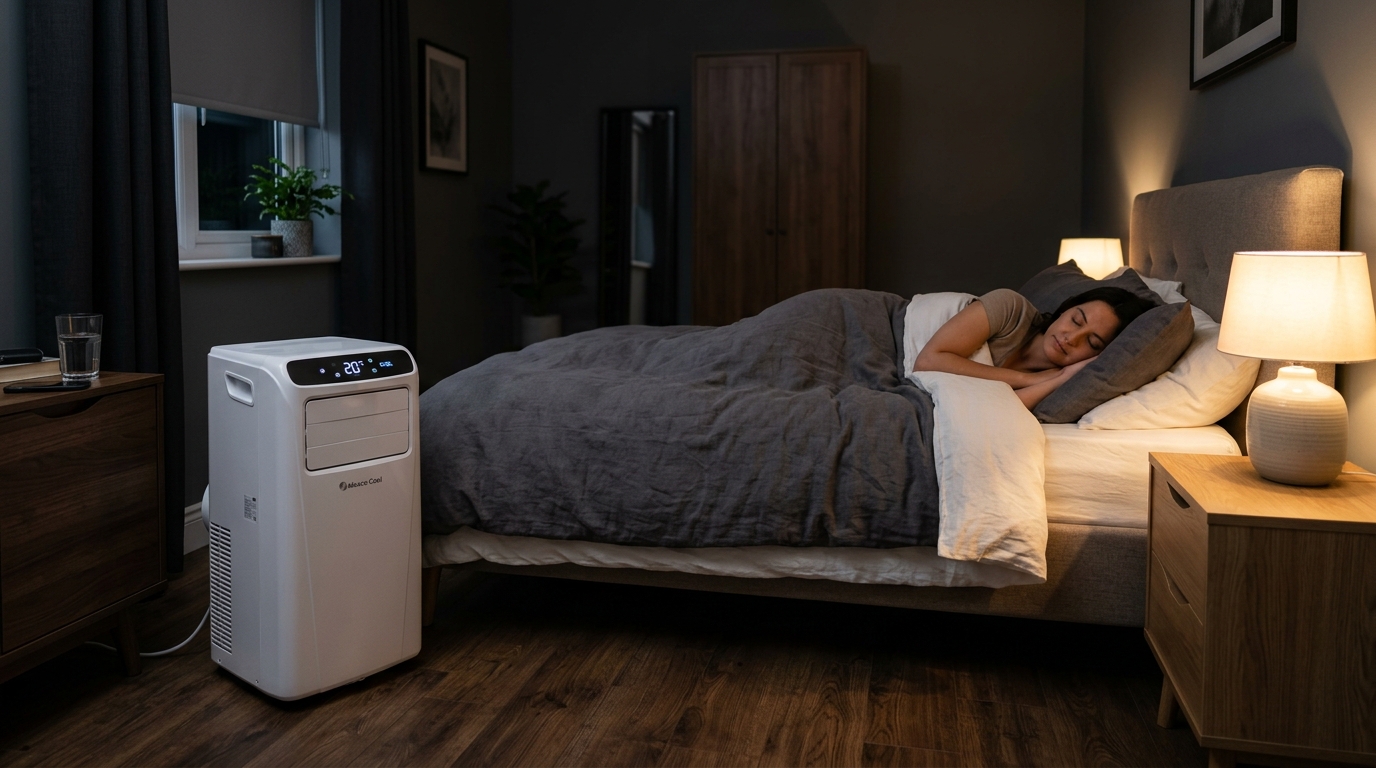
Setting expectations first, because this is where disappointment comes from: no portable air conditioner is quiet. They’re mono-block units with the compressor inside the box, in your room. The quietest are audible; the loudest are intrusive. What you’re choosing between is degrees of noise, and the figure that matters is the published level at the lowest fan speed — a decibel number quoted without a fan speed tells you nothing. The other half of the answer isn’t a product at all: pre-cool the room and switch it off. A sealed, shaded bedroom coasts for hours, and a unit that isn’t running is silent.
If sleep is the reason you’re buying, read the strategy section before the product section.
Why they’re all audible
A portable unit is a mono-block: the entire refrigeration circuit, including the compressor, sits in one box inside your bedroom.
A fixed split system puts the compressor outside, which is why those are dramatically quieter indoors. That’s a structural difference, not a quality difference — no portable unit can engineer its way around having a compressor in the room.
So the realistic goal is “quiet enough to sleep through”, not silence.
Reading the noise figure properly
The single most useful skill for this purchase.
- Check which fan speed it refers to. Units are considerably louder at full speed than at their advertised minimum. A figure quoted with no fan speed attached is close to meaningless.
- Look for a named quiet or night mode figure. Where a manufacturer publishes one, that’s the number relevant to sleeping.
- Treat the published figure as a floor, not a ceiling. Independent measurement can differ — Trusted Reviews measured 58.5 dB fan-only on the Meaco Pro 9000 against a published 52 dB low-fan figure. Test conditions vary; it’s not a scandal, but it’s worth knowing.
- Small decibel differences are bigger than they look. The scale is logarithmic, so a few dB is a meaningful change in perceived loudness, not a rounding error.
The thing that actually wakes you
Not the steady hum. The compressor cycling on and off.
A constant sound fades into the background — many people sleep better with it. A sound that starts and stops every few minutes does the opposite, because each transition is a change your brain registers.
Which means correct sizing matters for noise, not just performance. An oversized unit reaches temperature fast, shuts off, drifts, and restarts — cycling constantly. A correctly sized unit runs longer and steadier. Our sizing guide covers it, and our short cycling guide covers diagnosing it.
The strategy that beats any product choice
Pre-cool, then switch off.
A bedroom that’s been shaded from mid-morning and is properly sealed will hold its temperature for hours once cooled. Run the unit for an hour or two before bed, switch it off, and sleep in a cool, silent room.
This works better than any amount of shopping for quiet units, and it costs less to run. A timer or app control makes it automatic — check the load rating first if you’re using a smart plug, as our smart plugs guide explains.
What makes it work:
- Shade the window from mid-morning — our blinds guide covers what to look for
- Seal the window kit properly — our seal kits guide covers it
- Close the door
- Purge ventilate earlier in the evening if outside is cooler
Other things that matter at night
- Display brightness. A bright LED display in a dark bedroom is its own problem. Look for a dimmable display or a night mode that turns it off — or be prepared to tape over it.
- Beeps on button presses. Some units can’t be silenced. Check the manual.
- Placement. Not in a corner — two adjacent hard surfaces reflect and amplify. Not on bare laminate, which transmits vibration; a rigid board with thin anti-vibration pads underneath helps. Not a folded towel, which compresses unevenly and can block underside vents.
- Shared walls. In a flat, terrace or shared house, a compressor running overnight carries. Worth mentioning to a neighbour before it becomes a complaint — our flats and HMOs guide covers that.
- Airflow direction. Angle louvres away from the bed. Direct air on you all night causes its own problems — our dryness guide covers them.
The picks
MeacoCool MC Series Pro 9000
Lowest published low-fan figure
16–26m²
52 dB low fan
App control, 2yr warranty
Meaco publish 52 dB on the low fan setting — a specific figure at a specific speed, which is more than many listings give you — along with a 16–26m² room range, an A rating and a two-year warranty. The app control is the feature that matters most for a bedroom, because it makes pre-cooling automatic.
Good for: a standard double bedroom; anyone who’ll pre-cool and switch off; buyers who want documented specifications and UK warranty support.
Less good for: anyone expecting to sleep through it running. Trusted Reviews measured 58.5 dB fan-only — above the published low-fan figure — and the compressor cycling is more disruptive than the steady noise. It’s also a mono-block, so a fixed split system will always beat it if that’s an option for you.
MeacoCool MC Series 7000
For a small bedroom
Small rooms
Lower draw
UK support
Meaco’s smallest model, for small home and office spaces. Worth considering for a box room or single bedroom specifically because right-sizing reduces cycling — and cycling is what wakes people. A smaller unit running steadily can be less disruptive than a larger one clicking on and off.
Good for: genuinely small bedrooms; lower power draw on a loaded circuit; lighter to move and store.
Less good for: anything approaching 20m², where it’ll run continuously without catching up — and a unit that never reaches temperature never gets quiet. Check Meaco’s current published room range against your room before buying.
A quiet bedside fan
Worth trying first
Pennies per night
Steady sound
Said honestly: for a lot of British bedrooms on a lot of British nights, this is enough — and it has no compressor to cycle. The steady sound also masks intermittent noise from outside, which some people find helps more than silence. Look for a remote so you don’t have to get up.
Good for: moderate heat, light sleepers who’d be woken by cycling, shared walls, and anyone unsure whether they need cooling at all.
Less good for: tropical nights and humid conditions, where the air is too warm for evaporation from your skin to help much. It also can’t pre-cool or reduce humidity — our fan comparison covers where that limit sits.
Frequently asked questions
What decibel level is quiet enough to sleep through?
Highly individual. Some people sleep through a steady 55 dB and are woken by a 45 dB unit cycling. The pattern matters more than the number — steady beats intermittent.
Is a split system much quieter?
Substantially, because the compressor is outside. It costs considerably more and needs a certified installer — our installation law guide covers what’s involved, and in a flat you’ll likely need freeholder consent.
Does a bigger unit run quieter because it works less hard?
The opposite, usually. Oversizing causes short cycling, and the clicking on and off is what wakes people. Size to the room.
Can I put it in the next room and open the door?
You’d move the noise but lose most of the cooling — an open door means attempting the landing too. Pre-cooling and switching off is the better answer.
Sources
- Meaco Dehumidifiers — MeacoCool MC Series Pro 9000 specifications
- Trusted Reviews — MeacoCool MC Series Pro 9000 review (independent noise measurement)
- NHS — Sleep and tiredness
- Met Office — Tropical nights and their impact
- Energy Saving Trust — Home appliances and energy use
Related reading: our night waking guide and quiet operation for video calls, which covers the different question of call intelligibility.
Compare options at Amazon UK. Check the decibel figure and the fan speed it refers to — and size to the room, since cycling wakes people more than steady noise does.