Is It Cheaper to Leave Air Con On All Day or Turn It On and Off?
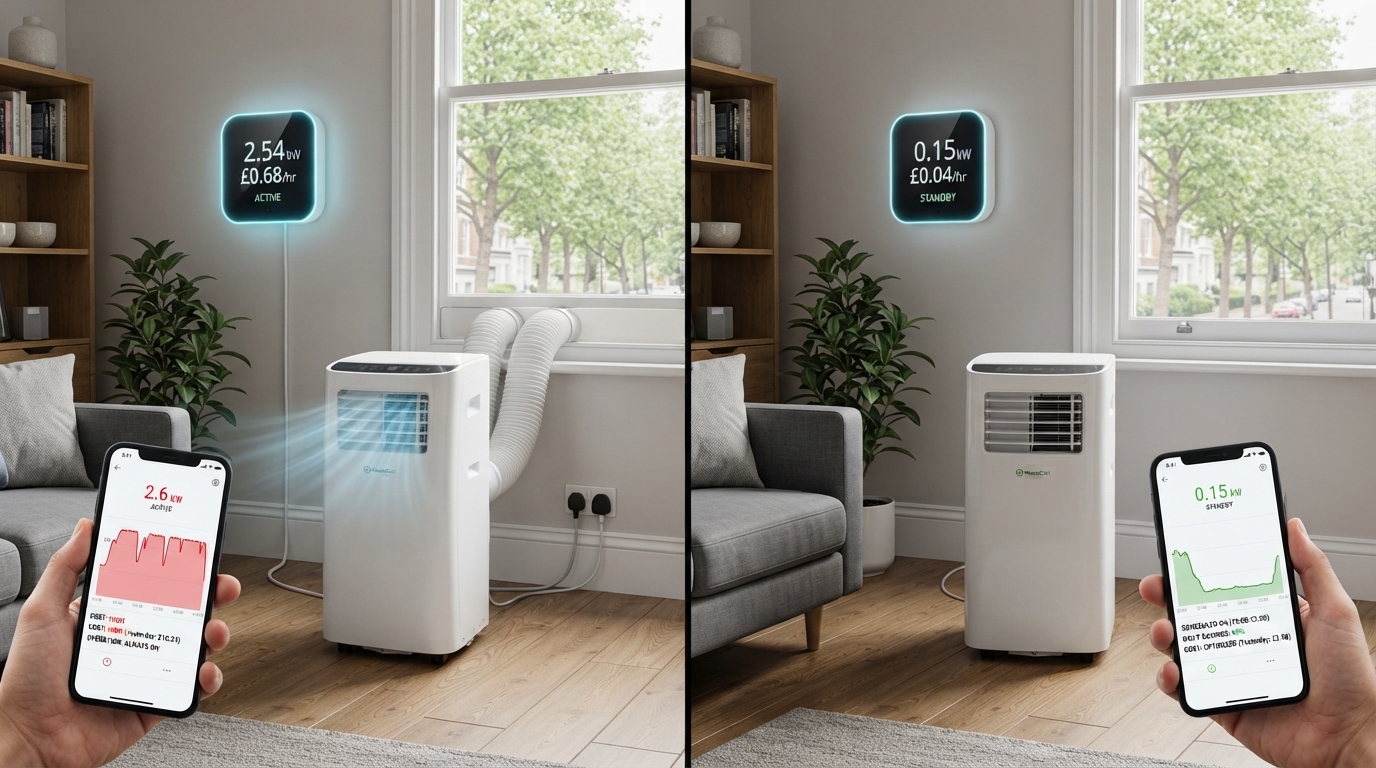
For a portable air conditioner cooling one room in a typical UK home, turning it off when you don’t need it is cheaper — usually clearly so. The reason is a single piece of physics: heat leaks into a room in proportion to the temperature difference between inside and out. Keeping a room cold all day while nobody’s in it means maintaining that big gap all day, and every degree of gap is heat continuously flowing in that you’re continuously paying to remove. Let the room drift up while you’re out and the gap shrinks, so less heat gets in overall. The “leave it on low” advice isn’t nonsense — it has real merit for heavy, high-thermal-mass buildings, commercial systems and winter heat pump heating — but those conditions don’t describe a portable unit in a British bedroom. The best strategy beats both: pre-cool, seal, and coast.
This is the most persistent argument in home cooling, and it’s usually conducted with confident assertions on both sides and no mechanism. Here’s the actual physics, the strongest version of the opposing case, and what to do in practice.
The physics that settles it
Heat moves from hot to cold, and the rate at which it moves depends on the size of the temperature difference. Double the gap between indoors and outdoors and you roughly double the rate heat flows in through the walls, roof, windows and every gap.
Now compare two days with the same hot weather outside, say 30°C, and nobody home from 9am to 6pm:
- Leave it on at 21°C all day: you hold a 9°C gradient for nine hours. Heat pours in at the maximum rate the whole time, and the unit runs (or cycles) continuously to remove exactly that heat. You pay for every joule.
- Switch it off at 9am: the room warms towards outdoor temperature. As it does, the gradient shrinks — and so does the rate heat enters. By mid-afternoon the room might sit at 27°C, with only a 3°C gradient, so very little further heat is arriving. Far less total heat has entered the room over the day.
When you come home and switch on, you pay to remove the heat that accumulated — but that total is smaller than the total you’d have been removing continuously. Less heat got in, so there’s less to take out. That’s the whole argument, and it’s why the same logic applies to heating in reverse (a cold house loses less heat than a warm one).
The counter-argument, taken seriously
The case for leaving it on rests on the pull-down or recovery load: when you switch on a hot room, the unit has to remove all the accumulated heat plus the ongoing gain, working hard for a sustained period. People assume that burst outweighs the savings.
For a portable air conditioner cooling a single, modestly-massed British room, it generally doesn’t. The recovery is a relatively short period of full-power running, and the energy it uses is essentially the heat that entered — which we’ve just established was less. There’s no hidden penalty that makes removing heat later more expensive than removing it continuously as it arrives.
Two real caveats, though:
- Recovery takes time. If your unit is undersized for the room, a hot room may take a long while to pull down — which is a comfort problem, not a cost one, and the fix is a timer rather than running all day. Our sizing guide covers getting capacity right.
- Humidity rises while it’s off. An air conditioner dehumidifies as it cools; with it off, moisture builds back up, and the first part of the recovery goes into removing that moisture rather than lowering the temperature. It’s a genuine effect, and the reason a room can feel muggy for the first ten minutes after switching on.
Where “leave it on” genuinely has merit
The advice isn’t imported from nowhere — it’s correct in contexts that just don’t match a portable unit in a UK home:
- Heavy, high-thermal-mass buildings. A thick-walled masonry or concrete building takes many hours to cool down and warm up. Letting it swing means a long, expensive recovery, and steadier operation can win. Most British homes, and certainly single rooms, don’t behave like this.
- Commercial and always-on systems conditioning large spaces to tight tolerances, where the plant is designed for steady-state operation and recovery loads strain it.
- Winter heating with a heat pump. This is where the “leave it on low” advice is genuinely well-founded and where most people first hear it — heat pumps are most efficient running gently and continuously at a low flow temperature, and buildings take a long time to reheat. That’s a real effect, and it does not transfer to summer cooling of one room. Our heat pump guide covers winter operation.
- Inverter compressors at part load. An inverter unit modulates its output rather than slamming on and off, so it runs efficiently maintaining a set point — which narrows the gap between the two strategies considerably. It makes “set it and leave it” a reasonable approach while you’re there. It still doesn’t make cooling an empty room for nine hours cheaper than not cooling it.
The strategy that beats both: pre-cool, seal, coast
- Shade and seal the room during the day so less heat gets in while you’re out — this is the bit that does the heavy lifting, and it’s free. Our shading guide and draught-proofing guide cover it.
- Pre-cool before you need the room — an hour or two before bed, or before you get home, using the unit’s timer.
- Then let it coast. A sealed, shaded room holds its temperature for hours, so you get the comfort without the running time. Switch off and sleep in silence.
A well-sealed, shaded room makes every strategy cheaper, because the whole argument is about how fast heat gets in. Our quiet bedrooms guide covers pre-cooling for sleep, and a timer or a suitably rated smart plug can automate it — with the important safety caveats in our smart plugs guide, since many units don’t resume after a power interruption.
The exceptions where you shouldn’t just switch off
- Pets at home. This is a welfare question, not a cost one. Don’t let a room a pet can’t leave become dangerously hot to save a few pence — use a higher set point rather than off, ensure shade, ventilation and water, and see our pets guide.
- Vulnerable people at home — older or unwell household members, or a baby’s room. Comfort and safety come before optimisation; our elderly heatwave guide covers this.
- Humidity or damp problems, where letting a room swing may cause issues — though a dehumidifier is the right tool there, as our AC vs dehumidifier guide explains.
- Equipment that needs stable conditions — but note we’d never recommend a portable unit as unattended critical cooling.
What actually moves the bill more than this question
Honestly, the on/off debate is a second-order optimisation. These matter more:
- The set point. Every degree lower means a bigger gradient and more heat to remove, all day. Setting 24°C instead of 20°C saves far more than any scheduling trick.
- Sealing the room — especially with a single-hose unit, which puts the room under slight negative pressure and actively draws warm air in through gaps. Our seal kits guide covers it.
- Shading the windows — stopping solar gain means less heat to remove in the first place.
- Correct sizing — oversized units short-cycle and dehumidify poorly; undersized ones run flat out.
- The unit’s efficiency rating — our efficiency ratings guide explains how to compare, and our running cost guide shows how to work out your actual cost with current unit rates rather than a figure from an article.
Frequently asked questions
Does it use more electricity to restart an air conditioner than to leave it running?
No. There’s a brief inrush of current when a compressor starts, but it lasts seconds and the energy involved is trivial next to hours of running. It doesn’t come close to offsetting the savings from not cooling an empty room.
So should I turn it off whenever I leave the room?
For long absences, yes — if you’re out for hours, switching off saves money. For brief absences it makes little difference and constant switching is a nuisance. Use the timer to have it cool the room before you return instead.
What about the “leave a heat pump on low” advice?
That’s about winter heating, where heat pumps run most efficiently gently and continuously and buildings take a long time to reheat. It’s sound advice in that context and doesn’t transfer to cooling a single room in summer.
Does an inverter unit change the answer?
It narrows the gap — an inverter modulates and runs efficiently holding a set point, so leaving it maintaining a temperature while you’re there is reasonable. It still doesn’t make cooling an empty room for hours cheaper than not cooling it.
Is a higher set point while out better than switching off?
It’s a sensible middle ground, and the right choice if pets or vulnerable people are home, or if you want to limit humidity. Purely on cost, off is cheaper than any set point you’d actually hold.
Why does the room feel muggy when I first switch it on?
Because humidity built up while it was off, and the unit removes moisture as well as heat — so the first stretch of running goes into dehumidifying before you feel the temperature drop. It passes.
Sources
- Energy Saving Trust — Home appliances and energy use
- Energy Saving Trust — Keeping your home cool in summer
- Ofgem — Energy price cap (current unit rates for your own calculation)
- GOV.UK — Energy labelling of products
Related reading: our running cost guide and overnight running guide.
A unit with a decent timer makes the cheapest strategy automatic. Compare current options at Amazon UK.