What Temperature Should a House Be in Summer? (UK)
There’s no single legally correct indoor summer temperature for a home — but there are useful reference points. Most people are comfortable somewhere around 18–24°C in living spaces, and cooler for sleeping, with sleep guidance commonly suggesting a bedroom somewhere around 16–19°C. The number that carries most weight is the overheating threshold used in building regulations guidance: a bedroom above roughly 26°C at night is treated as overheating. If you’re setting an air conditioner, aim for around 24°C rather than 18°C — every degree lower costs meaningfully more to hold and you rarely need it. And note the distinction that matters most: comfortable and safe are different questions, and heat becomes a health risk for vulnerable people long before a healthy adult feels troubled.
People ask this expecting a single number, and the honest answer is that it depends — but not in a hand-waving way. Here are the reference points that are genuinely useful, why the number moves, and what to actually do with it.
Why there isn’t one correct number
How warm a room feels is not determined by air temperature alone. The same 25°C can be pleasant or oppressive depending on several other factors — the same six that underpin workplace thermal comfort, covered in our workplace temperature guide:
- Humidity. Muggy air stops sweat evaporating, so a humid 24°C feels far worse than a dry 27°C. This is the single biggest reason people’s experience differs from the thermometer.
- Radiant heat. Sun streaming through glass, or a hot ceiling under a baking roof, makes a room feel hotter than the air reading suggests.
- Air movement. A gentle breeze from a fan can make a warm room feel several degrees cooler without changing the temperature at all.
- Clothing and activity. Obvious, but it’s why the same room suits one person and not another.
- Acclimatisation. British bodies and British houses are both adapted for cold. The same 28°C that’s unremarkable in southern Europe is genuinely difficult here, partly because our homes are built to retain heat — as our homes and heat guide explains.
The reference points worth knowing
General living comfort: roughly 18–24°C
For living rooms, kitchens and everyday spaces, most people settle somewhere in this band, with individual preference shifting it a couple of degrees either way. It’s a comfort range, not a rule — nobody is doing anything wrong at 25°C.
The overheating threshold: about 26°C in a bedroom at night
This is the most authoritative figure in the whole discussion. Approved Document O, the building regulations guidance on overheating in new homes in England, works to a night-time bedroom criterion of around 26°C — above that, a bedroom is considered to be overheating. It exists because sustained hot nights are where heat does real harm, not because 26°C is intolerable in itself.
If your bedroom is regularly above that on summer nights, you have a genuine overheating problem worth addressing rather than a preference issue.
Sleeping: cooler again, commonly cited around 16–19°C
Sleep guidance generally points to a cooler bedroom than your daytime comfort range. The reason is physiological: your core body temperature needs to fall to initiate and maintain sleep, and a warm room works against that. That’s the mechanism behind most heatwave insomnia, and our sleeping in a heatwave guide covers what to do about it.
Babies and nurseries
Guidance for infant sleep environments is more specific and more cautious than general advice, and it’s not something to take from a cooling website. Check current guidance from the Lullaby Trust and the NHS, which set out recommended room temperatures and safer-sleep practice. Our nursery guide covers the cooling equipment side, but the temperature guidance itself should come from those sources.
Comfortable is not the same as safe
What to actually set an air conditioner to
This is where the question usually comes from, and the practical answer is clear: around 24°C is a sensible set point for most people, and dramatically cheaper than chasing 18°C.
The reason is the same physics that governs the whole subject: heat flows into your room in proportion to the difference between inside and outside. Hold 18°C when it’s 30°C outside and you’re maintaining a 12°C gap — and paying to remove heat pouring in at that rate, continuously. Hold 24°C and the gap is halved, so far less heat arrives and far less energy is needed to remove it. Our leave-it-on vs turn-it-off guide works through that in full, and our running cost guide shows how to price it with current rates.
There’s also a comfort argument. Stepping from 30°C outside into an 18°C room is an unpleasant shock, and over-cooled rooms cause their own problems — dry throats, stiffness, and that clammy feeling when you go back out. A moderate set point plus air movement from a fan feels better than a cold room and costs a fraction as much.
Measure it — people are bad at guessing
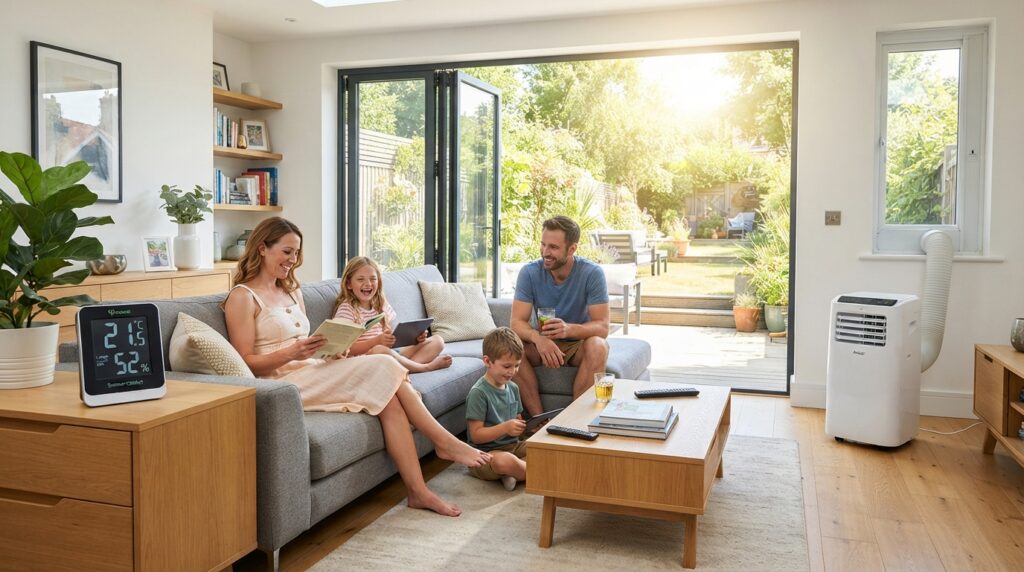
Almost everyone misjudges their indoor temperature, usually by several degrees, because humidity and radiant heat skew perception. A cheap thermo-hygrometer removes the guesswork and tells you two useful things at once: the actual temperature, and the humidity that explains why it feels worse than the number. Our thermometers and hygrometers guide covers choosing one.
Worth measuring in the right place, too — at seated or bed height in the room you actually use, not in a hallway or up near a ceiling where it reads warmer.
Humidity: the other half of the number
As a rough comfort guide, indoor relative humidity somewhere around 40–60% suits most people. High humidity makes a given temperature feel considerably hotter and is what turns an ordinary warm night into a sticky, sleepless one. It’s also why an air conditioner can make a room feel better than the temperature drop alone suggests — it dehumidifies as it cools. If humidity rather than heat is your problem, our AC vs dehumidifier guide covers which machine you actually need.
Room by room
- Bedrooms — the room worth prioritising. Cooler than the rest of the house, and the one where the 26°C overheating threshold matters.
- Living rooms — comfort range; air movement from a fan goes a long way here.
- Kitchens — always the hottest room because of appliances and cooking; our hot kitchen guide covers it.
- Home offices — comfort affects concentration, and equipment adds heat; our work-from-home cooling guide covers it.
- Loft rooms and south or west-facing rooms — the ones that blow past everything above; our orientation guide covers tailored tactics.
Getting there without just buying cooling
If your house sits above these ranges, the cheapest route to the target is nearly always the same order: shade the windows, ventilate at the right times, seal the room during the day — then cool what’s left. Our no-AC cooling guide and window timing guide cover the method, and doing them first means any unit you do buy can be smaller, quieter and cheaper to run.
Frequently asked questions
Is there a legal maximum temperature for a home?
No. There’s no legal indoor temperature limit for homes, and no equivalent for workplaces either — our workplace temperature guide covers why. Building regulations guidance for new homes does use a night-time bedroom overheating threshold of around 26°C.
What should I set my air conditioner to?
Around 24°C is sensible for most people. Each degree lower means a bigger gap to outside, so more heat flows in and more energy is needed to remove it — chasing 18°C costs far more and feels worse than a moderate temperature with some air movement.
What’s too hot for a bedroom?
Building regulations guidance treats a bedroom above roughly 26°C at night as overheating. If yours regularly exceeds that in summer, you have a real overheating problem rather than a preference issue.
Why does 25°C feel unbearable some days and fine on others?
Humidity, sunlight coming through glass, and air movement. Muggy air stops sweat evaporating, radiant heat adds to what the thermometer reads, and a breeze makes the same temperature feel several degrees cooler.
What temperature should a baby’s room be?
Follow current Lullaby Trust and NHS guidance rather than general cooling advice — infant sleep guidance is more specific and more cautious, and it’s the right source for that question.
Sources
- GOV.UK — Approved Document O: Overheating
- NHS — Heat exhaustion and heatstroke
- The Lullaby Trust — Safer sleep advice
- UKHSA — Adverse Weather and Health Plan
- Energy Saving Trust — Keeping your home cool in summer
Related reading: our sleeping in a heatwave guide and thermometers guide.
A thermo-hygrometer shows the real temperature and the humidity behind how it feels. Compare current options at Amazon UK.