Air Conditioner Energy Efficiency Ratings Explained
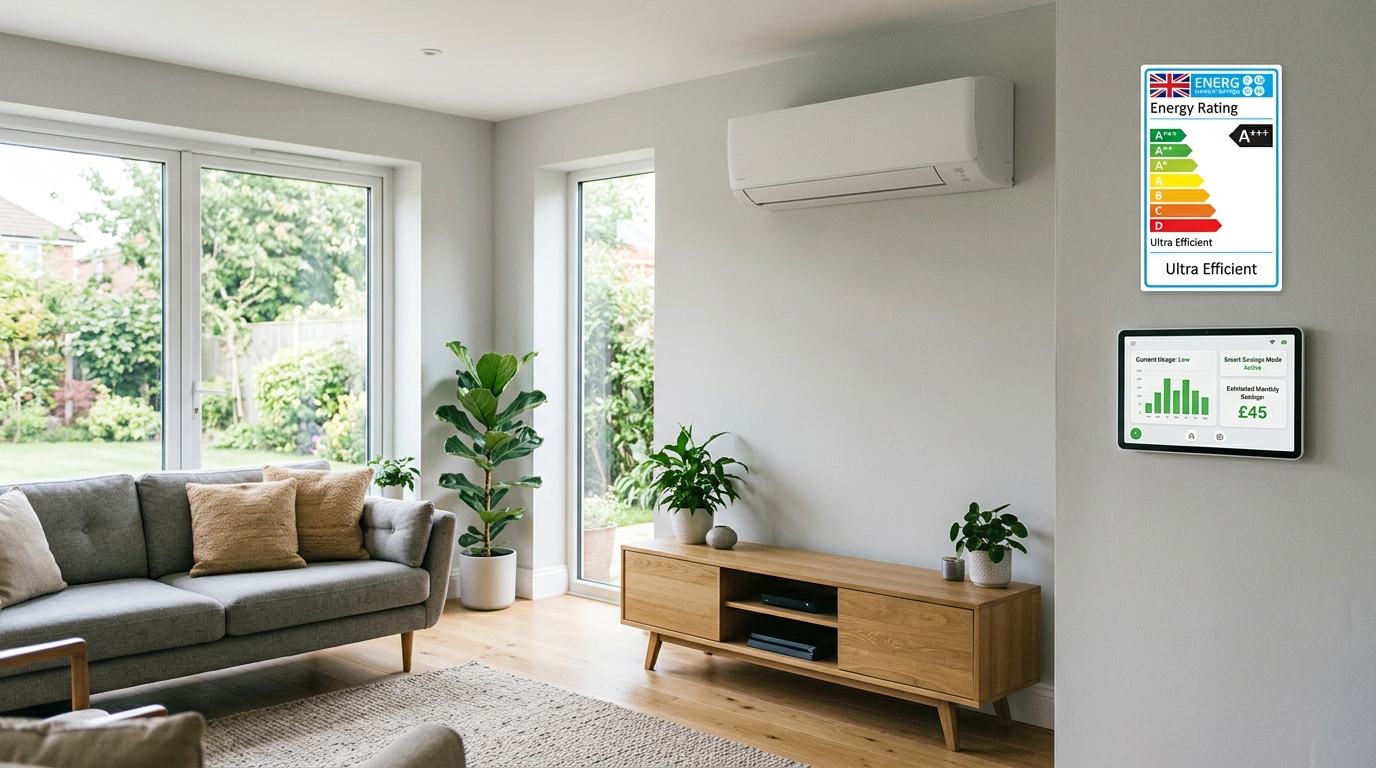
Two numbers decide running cost, and they’re different things people constantly confuse. The BTU (or kW cooling) figure is how much cooling the unit delivers. The efficiency rating — the A–G energy label, and the EER or SEER behind it — is how much electricity it burns to deliver that cooling. A higher rating means you get the same cool room for fewer pennies per hour. The honest catch: efficiency costs more upfront, and if you only run it for a couple of hot weeks a year, that premium takes a long time to pay back. Run it a lot, and the label is worth paying for.
You don’t need to become an engineer to buy well — you need to know which number tells you what. Here’s each one, in plain terms.
Cooling output vs energy use — keep them separate
The single most common mix-up. A portable air conditioner has:
- A cooling output — usually stated in BTU (British Thermal Units per hour), sometimes in kW of cooling. This is how much heat it can shift out of the room. Bigger room, bigger number needed. Our sizing guide covers matching this to your room, and our BTU vs kW explainer covers why the same unit gets described in two different units.
- A power draw — how much electricity (in watts or kW) it consumes to do that. This is what shows up on your bill.
Efficiency is the ratio between the two. Two units can both be “9,000 BTU” and cool the same room equally, while one draws noticeably more electricity to do it. That difference is the whole point of the rating.
The A–G energy label
Air conditioners sold in the UK carry an energy label with a colour-coded scale from A (most efficient) to G (least), the same family of label you see on fridges and washing machines. It’s the quickest at-a-glance signal.
A couple of things worth knowing so the label doesn’t mislead you:
- The scale gets re-based over time. Labelling scales have been tightened in recent years so that the top grades stay meaningful — which means an older “A+++” style rating and a current “A” aren’t directly comparable. Compare like-for-like against current labels.
- Cooling and heating can be rated separately. A reverse-cycle unit that both cools and heats may show a rating for each. If you’re buying mainly for winter heating, look at the heating figure, not just the cooling one — our heat pump guide covers that.
EER and SEER — the numbers behind the letter
The letter grade is derived from an efficiency ratio, and you’ll often see the ratio quoted directly:
- EER (Energy Efficiency Ratio) — cooling output divided by power input, measured at a single set of test conditions. A higher EER means more cooling per watt. It’s a snapshot.
- SEER (Seasonal Energy Efficiency Ratio) — the same idea, but averaged across a range of conditions to reflect a whole cooling season rather than one test point. Because real weather varies, SEER is the more realistic guide to what you’ll actually spend over a summer.
How to use them: when two units are the same BTU, the one with the higher SEER will cost less to run for the same cooling. That’s the comparison the numbers are for — don’t compare a SEER on one listing to an EER on another, because they’re measured differently.
Turning the rating into a running cost
You can estimate running cost yourself, and doing it with current figures beats trusting any number printed in an article — because electricity unit rates change, and a fixed figure quoted today is wrong by next quarter.
- Find the unit’s power draw in kW (e.g. a label figure like 1.0 kW). If only watts are given, divide by 1,000.
- Multiply by hours you’ll run it to get kWh used.
- Multiply kWh by your current electricity unit rate in pence per kWh — the figure on your latest bill, or the current price-cap rate from Ofgem.
That gives cost per session. The unit won’t draw full power the whole time — the compressor cycles once the room is cool — so treat it as a ceiling, not an average. Our running cost guide walks through a worked example.
When the rating is worth paying for — and when it isn’t
Here’s the honest trade-off nobody selling you the top model mentions.
A higher rating costs more upfront and saves per hour of use. So the maths depends entirely on how much you’ll run it:
- Heavy use — you cool a home office all day, or you run it most of a long summer, or it’s a reverse-cycle unit you also heat with in winter. Here the efficiency premium pays back, and the label is worth prioritising.
- Light use — a few genuinely uncomfortable weeks a year, an hour or two before bed. Here the running-cost difference between a good and an excellent rating may be small in absolute pennies, and other factors (noise, size, drainage) matter more than squeezing the last few percent of efficiency.
Neither answer is “always buy the most efficient.” Match the spend to the use.
The free efficiency nobody rates
Worth saying, because it dwarfs the label difference: how you use the unit affects running cost more than its rating does.
- Seal the room and the window kit — a single-hose unit under negative pressure pulls warm air in through every gap, and no efficiency rating compensates for that. Our seal kits guide covers it.
- Shade the window from mid-morning so there’s less heat to remove in the first place.
- Size it correctly — an oversized unit short-cycles and wastes energy; an undersized one runs flat out. Our sizing guide covers it.
- Use the timer — pre-cool, then let a sealed room coast rather than running all night.
Frequently asked questions
Is an A-rated unit always cheaper to run than a B?
For the same cooling output and the same use, yes — it uses less electricity per unit of cooling. Whether that saving justifies the higher purchase price depends on how many hours a year you’ll actually run it.
Why do two “9,000 BTU” units cost different amounts to run?
Because BTU is cooling output, not electricity use. The more efficient unit delivers the same 9,000 BTU while drawing less power — that’s exactly what the efficiency rating measures.
Should I compare EER or SEER between models?
Compare like with like. SEER reflects a whole season and is the more realistic guide, but only compare a SEER to another SEER — mixing it with a single-point EER isn’t a fair comparison.
Does the rating cover heating too?
On a reverse-cycle unit, heating is usually rated separately from cooling. If winter heating is your main use, look at the heating figure specifically rather than assuming the cooling grade applies.
Sources
- GOV.UK — Energy labelling of products
- Ofgem — Energy price cap (current unit rates)
- Energy Saving Trust — Home appliances and energy use
Related reading: our running cost guide and BTU vs kW explainer.
Compare the energy rating and the BTU together at Amazon UK — and size to your room before you optimise for efficiency.