Why Is My Air Conditioner Freezing Up? Ice on the Coils Explained
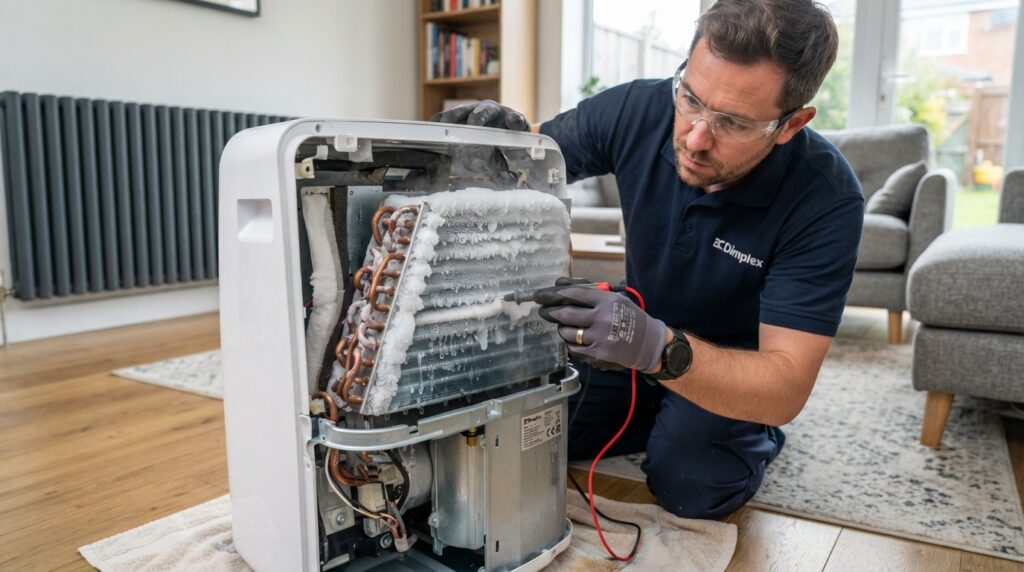
Ice on an air conditioner nearly always comes down to one of two things: not enough warm air flowing over the cold coil, or low refrigerant because of a leak. Restricted airflow is by far the commoner cause and is usually a dirty filter — something you can fix yourself in ten minutes. Low refrigerant is not a DIY job and needs a qualified engineer. Whatever the cause, the first move is the same: stop cooling and run the unit on fan-only to melt the ice completely before doing anything else. Do not chip or scrape ice off, and do not keep running the compressor while it’s iced up — both are good ways to turn a cheap fix into a dead unit.
A frozen coil looks alarming and is genuinely bad for the machine, but the diagnosis is usually straightforward once you understand why it happens at all. Here’s the mechanism, the causes in order of likelihood, and what to do.
Why a cooling coil freezes — the mechanism
This is worth understanding, because it explains every cause below and why the problem accelerates once it starts.
Inside the unit, refrigerant evaporates in the evaporator coil, making it very cold. Room air is blown across that coil: the air gives up its heat (cooling your room) and its moisture condenses on the cold fins and drains away. That constant stream of warm room air is what keeps the coil above freezing — the coil is being continuously warmed by the very air it’s cooling.
Reduce that flow of warm air, and the coil has less heat arriving to absorb. Its surface temperature falls. Once it drops below 0°C, the condensation forming on it freezes instead of draining. And here’s the vicious part:
The causes, in order of likelihood
1. A dirty or clogged air filter (most common by far)
Filters catch dust, pet hair and fluff, and they clog faster than people expect — often within weeks of heavy use. A blocked filter strangles the airflow over the coil, which is precisely the condition that causes freezing. If your unit is icing up, check the filter first; it’s the answer most of the time.
2. Blocked or obstructed airflow
- The unit pushed against a wall, into a corner, or behind furniture or curtains so it can’t draw air in or blow it out.
- The exhaust hose kinked, crushed or coiled on a portable unit — restricting the condenser side upsets the whole system. Our exhaust hose guide covers why hose routing matters more than people think.
- Blocked intake or outlet grilles, or an obstructed vent kit.
3. A dirty evaporator coil
Even with a clean filter, fine dust builds on the coil fins over seasons, insulating them and restricting airflow. Cleaning a coil needs care — the fins bend very easily and the coil is part of a sealed pressurised system. Our coil cleaning guide covers doing it without causing damage, including what not to attempt.
4. A weak or failing fan
If the fan motor is failing, running at the wrong speed, or its blades are caked in dust, it moves less air than the design assumes — same result as a blocked filter. A noticeably weak airflow from the outlet when the filter is clean points this way.
5. Running it when the room is already cool
An under-appreciated cause, and a common one in the UK. Air conditioners have a minimum operating temperature, and running one to cool a room that’s already cool — overnight as the temperature drops, in a cool garage or cellar, or on a mild day — means the returning air is too cold to keep the coil above freezing. If your unit ices up overnight but not in the afternoon, this is very likely why. Check the manual’s stated minimum operating temperature.
6. Thermostat set very low, running continuously
Setting 16°C and leaving it running means the compressor never cycles off, so the coil never gets a chance to warm up and shed frost. A sensible set point isn’t just cheaper — it reduces icing.
7. Low refrigerant from a leak (engineer territory)
Refrigerant circuits are sealed and shouldn’t lose charge. If the charge is low, it’s because there’s a leak. Low charge lowers the pressure and evaporating temperature in the coil, taking it below freezing even with good airflow.
Telltale signs: cooling that has got gradually worse over a season or two, icing that returns quickly after defrosting with a clean filter and clear airflow, or a hissing or bubbling noise. “Topping it up” is not a repair — the gas leaked out and will leak out again; the leak has to be found and fixed.
8. Blocked condensate drainage
If condensate can’t drain away it can back up around the coil and freeze, and on some units a full tank or blocked drain causes symptoms easily mistaken for icing. Our tank-full guide covers drainage.
What to do right now, step by step
- Turn cooling off. Stop the compressor running against a blocked coil.
- Run it on fan-only to defrost, with the room warm. This blows room-temperature air over the coil and melts the ice gently and evenly. It can take a while — possibly an hour or more for a heavy build-up. Be patient; this is the safe method.
- Catch the water. A lot of ice becomes a lot of water. Have the drain set up, the tank emptied, or towels down.
- While it defrosts, check the filter. Remove it, and clean or replace it per the manual. If it’s visibly grey and matted, you’ve probably found your fault.
- Clear the airflow. Pull the unit away from walls and furniture, uncoil and straighten the exhaust hose, check the vent kit and grilles.
- Check the room isn’t too cold for the unit to be cooling at all, and set a sensible temperature rather than the minimum.
- Restart and watch it. Once the coil is completely ice-free, run cooling again and check after an hour or two.
- If it refreezes with a clean filter and clear airflow, stop using it and call a qualified engineer — that pattern points to refrigerant or a fan/control fault.
Safety: what not to do
Don’t keep running the compressor on an iced-up unit. Beyond cooling nothing, it risks liquid refrigerant returning to the compressor, which is a classic way to destroy one.
Unplug before cleaning or removing panels, and don’t spray water into a unit or towards the electrics. Don’t attempt refrigerant work — it requires certification, and R290 requires specific competence with flammable refrigerants. Don’t use a hairdryer, heat gun or boiling water to force a defrost.
Preventing it happening again
- Clean the filter regularly — the single highest-value habit. Monthly during heavy use is reasonable; more often with pets. Our maintenance guide covers the routine.
- Give it breathing space — clearance around intake and outlet as the manual specifies.
- Keep the exhaust hose short and straight, never coiled behind the unit.
- Use a sensible set point rather than the lowest setting, so the compressor cycles.
- Don’t run it below its minimum operating temperature, including overnight when the room has already cooled — our overnight running guide covers sensible unattended use.
- Service fixed systems annually, which catches slow leaks before they cause icing.
- Clean the coils periodically, carefully.
Frequently asked questions
Why is there ice on my air conditioner in hot weather?
Because the coil is being starved of warm airflow — usually a clogged filter or blocked airflow — or the refrigerant charge is low. Both drop the coil below freezing so condensation freezes instead of draining, and the ice then blocks airflow further.
Can I just scrape the ice off?
No. The fins are fragile and the coil is pressurised — scraping can puncture it, which scraps the unit and releases refrigerant (often flammable R290). Run it on fan-only and let the ice melt.
How long does it take to defrost?
Anything from a few minutes for light frost to well over an hour for a heavy build-up. Run fan-only in a warm room and wait until the coil is completely clear before cooling again.
Does icing mean I need a re-gas?
Not usually — a dirty filter is far more common. But if it refreezes with a clean filter and clear airflow, low refrigerant from a leak is likely, and that needs an engineer to find and fix the leak. Simply topping it up isn’t a repair.
Why does it only freeze at night?
Almost certainly because the room cools below the unit’s minimum operating temperature overnight, so the returning air is too cold to keep the coil above freezing. Use a timer or a higher set point rather than cooling a room that’s already cool.
Is a frozen unit dangerous?
The ice itself isn’t, but running the compressor in that state can damage it, and attempting to chip ice off risks puncturing a refrigerant circuit. Switch off cooling, defrost on fan-only, and don’t force it.
Sources
- GOV.UK — Fluorinated gases (F-gases): rules (certified refrigerant work)
- Electrical Safety First — Electrical safety around the home
- Energy Saving Trust — Home appliances and energy use
- BESA — Building Engineering Services Association (competence for A3 refrigerants)
Related reading: our maintenance guide and troubleshooting guide.
A clean filter prevents most icing — replacements and cleaning kit are cheap. Compare current options at Amazon UK.