Air Conditioner vs Dehumidifier: Do You Need Both?
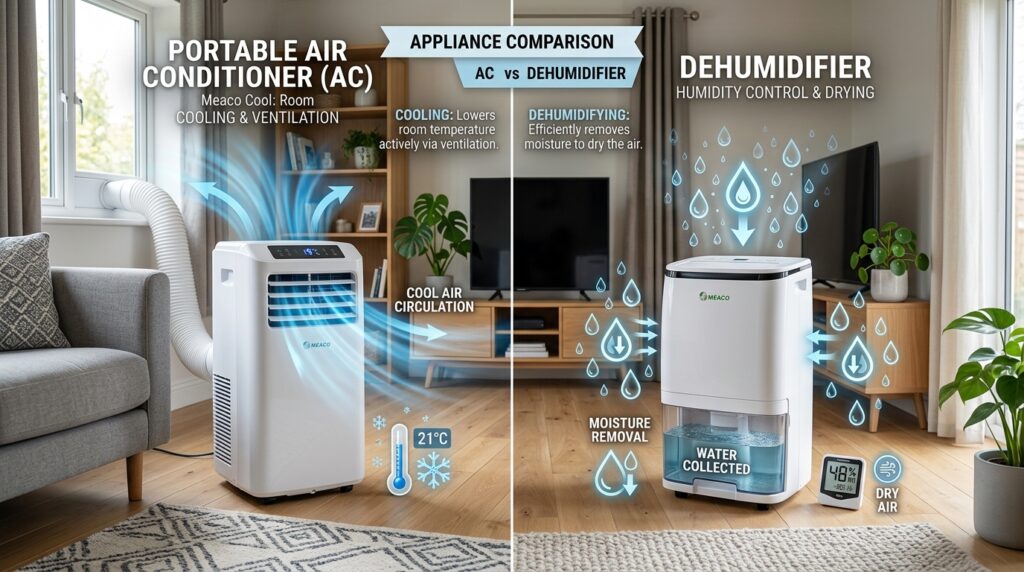
Usually you need one, not both — and which one depends on the problem you actually have. If the issue is heat, buy an air conditioner: it removes heat from the room (and takes out a little moisture as a side effect). If the issue is damp, condensation or mould, buy a dehumidifier: it removes moisture (and adds a little heat as a side effect). They are not interchangeable, and an air conditioner’s “dry mode” is not a proper substitute for a dehumidifier, especially in a cold room. The genuine case for both is a home with a summer heat problem and a separate winter damp problem — different seasons, different rooms, two different jobs.
These get confused because both blow air and both produce water. But they’re built to solve opposite problems. Sort out which problem you have and the answer is usually obvious.
What each machine is actually for
An air conditioner removes heat. It pumps warmth out of the room (through a hose, for a portable), lowering the temperature. In doing so it condenses out some moisture — so it dehumidifies a bit — but cooling is the job.
A dehumidifier removes moisture. It condenses water out of the air and drops it into a tank or a drain. In doing so it releases a little heat back into the room — so it slightly warms the space. Drying is the job.
Notice the side effects run in opposite directions: the AC cools and dries a little; the dehumidifier dries and warms a little. That’s the whole basis for choosing.
Match the machine to the problem
| Your problem | The machine |
|---|---|
| Room too hot in summer | Air conditioner |
| Condensation on windows, musty smell, mould | Dehumidifier |
| Drying washing indoors in winter | Dehumidifier |
| Muggy, sticky heat where the temperature isn’t extreme | Either can help — see below |
| Cold, damp garage or cellar | Dehumidifier (desiccant type) |
The muggy-but-not-boiling case
The one genuinely blurry situation. On a humid UK day the temperature might be only moderately high, but the humidity makes it feel oppressive and sticky. Here either machine can improve comfort:
- An air conditioner lowers the temperature and wrings out some moisture — comfort from both directions.
- A dehumidifier leaves the temperature roughly the same (nudging it up slightly) but cuts the humidity, which can make a room feel markedly more comfortable even without cooling. Sweat evaporates more easily in drier air.
If your discomfort is mostly the stickiness rather than raw heat, a dehumidifier can be the cheaper, quieter answer — and it earns its keep year-round rather than a few weeks a summer.
Why “dry mode” isn’t a dehumidifier
Air conditioners have a dry mode, and people reasonably ask whether it replaces a dehumidifier. For summer stickiness in a warm room, it helps. But it’s not a substitute for a proper dehumidifier, for two reasons:
- It’s optimised for cooling, not drying. Dry mode reduces moisture as part of a cooling cycle; a dedicated dehumidifier is engineered to extract far more water per hour.
- It struggles in a cold room. This is the important one. A standard (compressor) dehumidifier — and an AC’s dry mode — loses effectiveness as the air gets colder, roughly below about 15°C, because there’s less heat to drive the cycle. That’s exactly the condition of a cold garage, cellar or unheated back room in winter, which is when damp is worst.
Our dry mode vs dehumidifier guide covers this comparison in detail.
The compressor vs desiccant point (for winter damp)
When you genuinely need both
Real, but less common than sellers imply. It applies when you have two separate problems in two separate seasons:
- A summer heat problem — a bedroom or office that overheats on hot days — which wants an air conditioner; and
- A winter damp problem — condensation, mould, or drying washing in the colder months — which wants a dehumidifier.
In that case a reverse-cycle air conditioner (cools in summer, heats in winter) plus a dehumidifier sized to the damp problem covers the year. But if you only clearly have one of the two problems, buy for that one — you can always add the other later if a real need appears.
A note on picking either
Some manufacturers — Meaco among them — make both air conditioners and dehumidifiers, so you can stay within one brand’s support if you do end up needing both. As always, buy on a documented specification for the specific model rather than the badge; our brands guide covers checking that, and our main buying guide covers choosing an AC.
Start with the machine that matches your actual problem
Heat → AC · Damp → dehumidifier
Add the second only if needed
Desiccant for cold damp
The sensible buy is the one that fixes the problem you can actually name today. If that’s heat, browse air conditioners; if it’s damp in a cold space, browse desiccant dehumidifiers. Resist buying both “to be safe” unless you genuinely have both a summer heat problem and a winter damp problem.
Good for: anyone with a single clear problem; a budget better spent doing one job well than two jobs adequately.
Less good for: a home with both a real summer overheating problem and a real winter damp problem — that’s the genuine both-case, and there a reverse-cycle AC plus a suitable dehumidifier is justified.
Frequently asked questions
Will an air conditioner fix my condensation and mould?
Not reliably, and not in winter. It removes some moisture while cooling, but damp and mould are a humidity problem best solved by a dehumidifier — a desiccant one if the room is cold.
Will a dehumidifier cool my room down?
No — it slightly warms the room, because the process releases heat. It can make a muggy room feel more comfortable by cutting humidity, but it won’t lower the temperature.
Can I just use my AC’s dry mode instead of a dehumidifier?
For summer stickiness in a warm room, it helps. For winter damp in a cold space it barely works, because the cycle loses effectiveness as the air cools. A desiccant dehumidifier is the right tool there.
Is it cheaper to buy one machine that does both?
An air conditioner and a dehumidifier are optimised for opposite jobs, so a single machine compromises on at least one. If you clearly have only one problem, buy the right single-purpose machine for it.
Sources
- Energy Saving Trust — Home appliances and energy use
- NHS — Can damp and mould affect my health?
- Meaco Dehumidifiers — Dehumidifiers and air conditioners
Related reading: our dry mode vs dehumidifier guide and winter damp guide.
If your problem is heat, an air conditioner is the right buy. Compare current options at Amazon UK — and size it to your room first.