Is It Safe to Use Air Conditioning During Pregnancy?
This article covers the room, not your health, and it is not medical advice. Your midwife or GP is the right person for anything about how you’re feeling.
Yes — a domestic air conditioner cools and dehumidifies room air, and there’s nothing specific to pregnancy that makes that unsafe. The sensible precautions are ordinary ones: keep the filter clean, don’t sit in the direct airflow for hours, and don’t set it much colder than you need. The more useful point is the other way round: pregnancy makes heat genuinely harder to cope with, and NHS guidance lists pregnancy among the factors raising risk in hot weather. Keeping the bedroom cool overnight matters more than most advice acknowledges.
The question usually comes from a reasonable place — pregnancy brings a lot of “is this safe?” — so here’s the straightforward answer, then the part that actually helps.
The safety question, answered
A portable air conditioner takes room air, passes it over a cold coil, and returns it cooler and drier. It doesn’t introduce anything into the air. The refrigerant is sealed inside the machine and stays there.
The reasonable precautions:
- Keep the filter clean. This is the one that matters. A neglected filter blowing dust and mould around a bedroom is a genuine issue, and it’s entirely avoidable — fortnightly during use, and let it dry completely before refitting. Our maintenance guide covers the routine.
- Don’t sit or sleep in the direct airflow for hours. Cool the room, not yourself. Direct moving air across skin accelerates drying and some people find it causes stiffness or a dry throat.
- Don’t over-cool. Setting 18°C when 23°C would do costs more and over-dries the room without cooling you any faster.
- Deal with any musty smell rather than living with it — our smell guide covers it.
If you have specific concerns — a respiratory condition, a complicated pregnancy, anything your midwife has flagged — ask them rather than an article.
Why heat is harder when you’re pregnant
Without straying into medical territory: pregnancy increases blood volume and raises the metabolic rate, so your body is generating more heat and working harder to shed it. Sleep is frequently disrupted anyway, and an overheated bedroom compounds that considerably.
NHS and UKHSA guidance both list pregnancy among the factors that increase risk in hot weather, alongside older age and certain health conditions. That’s reason to take the room seriously rather than push through a bad fortnight.
The bedroom is the priority
If you do one thing, make it this. Overnight heat carries the most consequence and you have least ability to escape it.
- Shade the window from mid-morning, before the room heats. Closing curtains at bedtime achieves very little — the energy has been arriving all day and is stored in the walls and furniture. A reflective outward face matters more than opacity. Our blinds guide covers it.
- Consider sleeping downstairs for the worst weeks. Ground floor and north-facing beats upstairs — our stack effect guide covers why. A sofa bed in a cool room beats a hot bedroom.
- Purge ventilate once outside is genuinely cooler than inside — often later than people assume — then shut everything in the morning. Our timing guide covers judging it.
- A fan pointed at you rather than at the room. It doesn’t lower the air temperature but it increases evaporation from skin, which is what makes you feel cooler.
- Lighter bedding, natural fibres over synthetics.
- A cool shower before bed, and a damp flannel on wrists and neck if you wake.
Our night waking guide covers why temperature swings wake people, and why consistency matters as much as the number.
Through the day
- Identify your cool room — ground floor, north-facing, ideally a solid floor.
- Avoid conservatories and loft rooms entirely in hot weather. These are the worst spaces in any house.
- Keep water within reach wherever you settle, and drink before you feel thirsty.
- Cook early or less. An oven in a small kitchen adds a lot of heat at the wrong time of day.
- Feet up where you can — swelling in the feet and ankles is common and heat makes it more noticeable. But note that sudden swelling of the face, hands or feet is a symptom to report, not one to manage with a footstool.
- Switch off electronics generating heat in the room you’re using.
If you’re working
Worth knowing, and rarely mentioned. Employers have specific duties around risk assessment for new and expectant mothers, and heat is a relevant factor. Where a risk is identified, the employer should act — which can include adjusting conditions or hours.
There is no maximum legal working temperature in the UK, so quoting a figure won’t help. What exists is the duty to assess and control risk. Our workplace temperature guide covers the position properly, including for homeworkers, whose employers’ duties don’t disappear because they’re at a kitchen table.
Practical asks that often succeed: flexible start times to avoid the afternoon, a desk away from direct sun, a fan, more frequent breaks, or working from an air-conditioned office on the worst days.
The picks
MeacoCool MC Series Pro 9000
Quiet, with a timer
16–26m²
52 dB low fan
App control
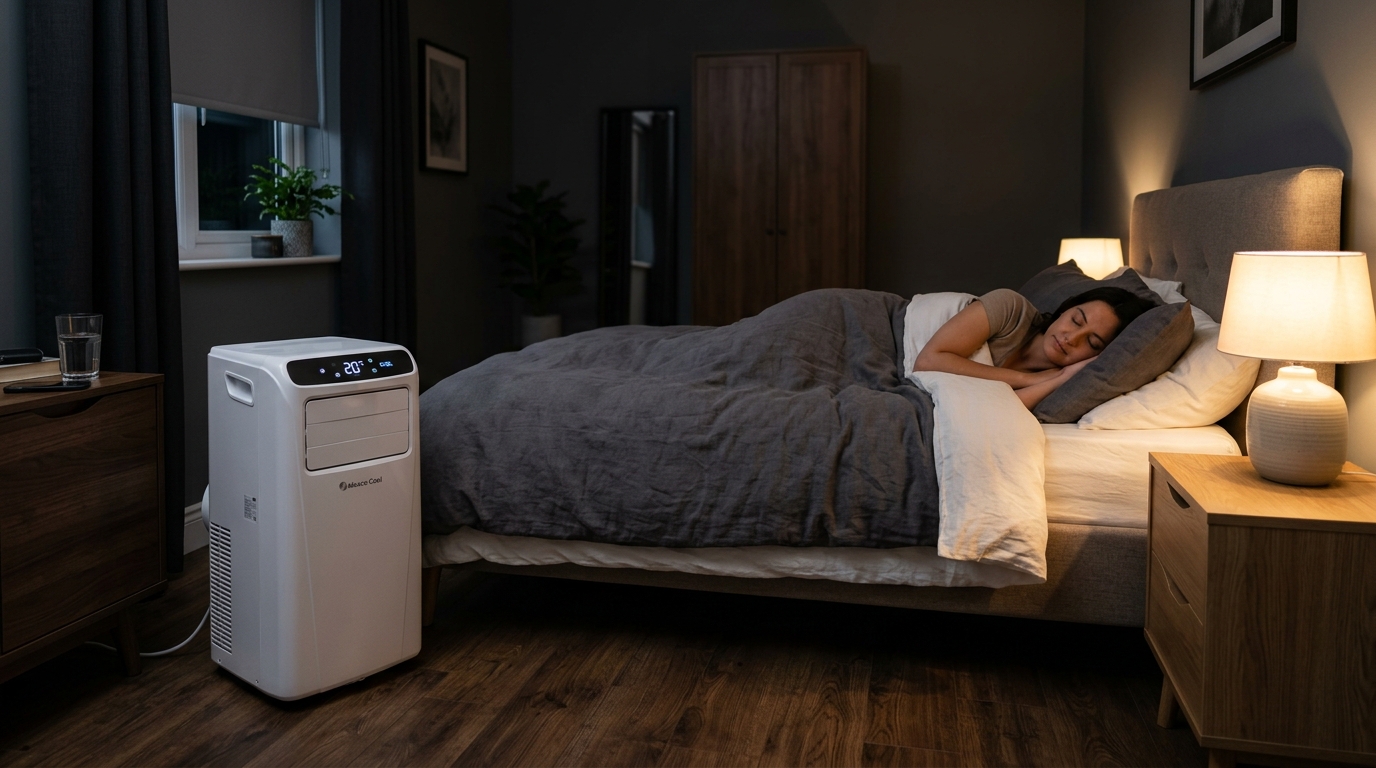
Meaco publish 52 dB on the low fan setting, a 16–26m² room range, an A rating and a two-year warranty, with app control. The app matters here specifically — being able to pre-cool the bedroom before you go up means arriving at a cool room rather than starting the machine from a baked one and waiting an hour while uncomfortable.
Good for: a bedroom you need cool before bedtime; anyone whose sleep is already disrupted and can’t afford a noisy machine.
Less good for: anyone expecting quiet. Trusted Reviews measured 58.5 dB fan-only in independent testing, above the published low-fan figure — it’s an audible appliance. Compressor cycling can also be more disturbing than steady noise. Many people find pre-cooling and switching off for the night is the better arrangement.
A pedestal or tower fan
Often enough
Quiet on low
No venting
For most British summers and most bedrooms, a fan plus shading from mid-morning is genuinely sufficient, and it costs a fraction to run. Look for a remote so you don’t have to get up, a timer, and a stable base.
Good for: moderate heat; anyone who’d rather not spend heavily on a few uncomfortable weeks; overnight use where a compressor would be too loud.
Less good for: tropical nights and humid conditions, where the air is too warm for evaporation from your skin to help much. It also can’t pre-cool a room. Don’t aim it directly at yourself all night — circulating the air works better than blowing at you.
Looking ahead to the baby
If the unit will end up in a nursery, the considerations change. The Lullaby Trust recommends a room temperature of 16–20°C for safer sleep — cooler than most people expect — and there are specific safety points around airflow direction and, importantly, blind and curtain cords near a cot. Our nursery guide covers that properly.
Frequently asked questions
Can air conditioning cause a cold?
No — colds are caused by viruses, not cool air. A dry throat on waking is usually the room being over-dried or you sitting in the airflow, and both are easily adjusted. Our dryness guide covers it.
What temperature should I aim for?
There’s no official pregnancy figure — go by comfort, and prioritise avoiding overnight overheating. Consistency matters as much as the number. Your midwife can advise if you have specific concerns.
Should I avoid hot baths and hot tubs?
There is guidance around raising core body temperature in pregnancy, including very hot baths, saunas and hot tubs. That’s a question for your midwife or the NHS pregnancy pages rather than a home cooling site.
My rented flat is unbearable. What can I do?
Raise it in writing, particularly if a specific defect is involved. Excess heat is a recognised hazard under housing standards. Our renter’s guide covers the approach, and Shelter or Citizens Advice can advise.
Sources
- NHS — Pregnancy
- NHS — Pre-eclampsia (symptoms to report)
- NHS — Heatwave: how to cope in hot weather
- NHS — Heat exhaustion and heatstroke
- HSE — New and expectant mothers at work
- UKHSA — Adverse Weather and Health Plan
- The Lullaby Trust — Room temperature
- Trusted Reviews — MeacoCool MC Series Pro 9000 review
Related reading: our nursery guide and night waking guide.
Compare options at Amazon UK. For a bedroom, check the noise figure and the fan speed it was measured at, and look for a timer so the room is cool before bedtime.