Why Does My Air Conditioner Smell? A Smell-by-Smell Guide
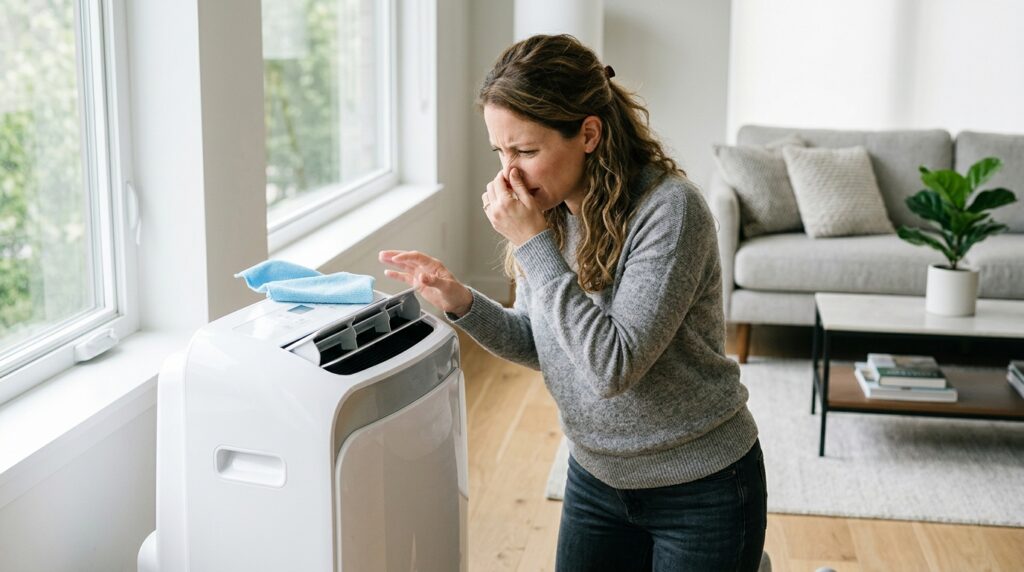
A musty or damp smell — the commonest by far — is moisture sitting on the internal coil or in a filter that was put away damp. It’s the price of skipping the end-of-season dry-out, and it’s fixable: run the unit on fan-only mode for several hours to dry the coil, and clean the filter properly, letting it dry completely before refitting. A brief dusty smell on the first run of the season is normal and clears within an hour. Anything burning or electrical is not in this category at all.
Air conditioners smell for a small number of reasons, and the smell itself usually tells you which one.
Musty, damp, or “dirty socks”
The classic, and the one most people mean.
What’s happening: an air conditioner removes moisture from the air as it cools — that’s where the tank water comes from. When the unit stops, moisture is left on the cold evaporator coil and in the filter. Dark, damp and still is exactly what mould and bacteria need.
It’s worst after winter storage, because a unit put away damp has spent eight months as a sealed, dark, humid box.
The fix:
- Remove and clean the filter. Vacuum or rinse it, depending on what the manual says — some filters shouldn’t get wet. Let it dry completely, over hours rather than minutes. A damp filter refitted is the single commonest cause of a returning smell.
- Run fan-only mode for several hours. No cooling. This dries the coil, and it’s the step that actually fixes the problem rather than masking it.
- Empty and rinse the condensate tank if it has one, and check the drain port isn’t blocked.
- Wipe the accessible surfaces around the intake and outlet with a damp cloth.
- Open a window while you do it so you’re not circulating what you dislodge.
Don’t spray anything into the vents. Air fresheners and sprays mask the smell without addressing the moisture, and forcing liquid into a unit near electrical components is a poor idea. If a manufacturer supplies a specific coil cleaner for your model, follow their instructions; otherwise, drying is the answer.
Preventing it recurring
- Use fan-only for 20–30 minutes after each cooling session. Many units do this automatically on shutdown — if yours has that setting, leave it on.
- Clean the filter fortnightly during heavy use, weekly with pets. Our pets guide covers why fur clogs filters so quickly.
- Dry it properly before storage. Two to four hours of fan-only, then drain fully, clean the filter and let it dry, then store upright somewhere dry. Our storage guide covers the routine, and this is the step that decides whether next June smells.
- Never store it under a cover while damp.
Dusty or slightly burnt on the first run of the season
Normal. Dust has settled on the heating and electrical components over months, and burns off when the unit first runs.
It should be faint and should clear within an hour or so with a window open. If it’s strong, acrid, or persists beyond that, treat it as the electrical category and switch off.
Chemical or sweet
Uncommon, and worth taking seriously.
A sweet or faintly chemical smell alongside declining cooling performance can indicate a refrigerant leak. Most modern portable units use R290, which is refrigerant-grade propane — classed A3, the highest flammability class.
A sealed system shouldn’t lose refrigerant at all, so any loss is a fault rather than normal wear. Work on the refrigerant circuit requires certification and isn’t a DIY job.
Sewage or drains
Almost never the air conditioner itself — it’s usually the drainage arrangement.
If you’ve run a condensate hose into a drain, sink overflow or gully, a dry trap can let sewer gas travel back up the hose into the room. The unit is simply the route, not the source.
Fix: make sure the hose discharges over a drain rather than being pushed into it, or use a proper trap arrangement. Our drainage guide covers setting up continuous drainage properly.
Cigarette smoke or cooking smells
The filter and internal surfaces absorb odours from the room over time, then release them when the unit runs.
Filter cleaning helps. If the unit came from a smoking household — relevant if you bought it second-hand — the smell can take several cleaning cycles to clear and may never fully go. Our second-hand guide covers what to check before buying.
A quick reference
| Smell | Likely cause | Action |
|---|---|---|
| Musty, damp, socks | Moisture on coil or filter | Fan mode several hours, clean filter |
| Dusty, first run only | Dust burning off | Normal, ventilate |
| Burning, hot plastic, acrid | Electrical fault | Unplug now |
| Sweet or chemical | Possible refrigerant leak | Off, ventilate, no sparks |
| Drains or sewage | Drainage arrangement | Check hose discharge |
| Smoke, cooking | Absorbed odours | Clean filter repeatedly |
Is a smelly air conditioner a health problem?
Worth being measured about. A musty smell indicates moisture and microbial growth, and blowing that around a room you’re sleeping in isn’t ideal — particularly for anyone with asthma or allergies.
It isn’t a reason to panic, and it’s straightforwardly fixable with the drying routine above. But it is a reason to deal with it rather than live with it, and to keep on top of filter cleaning.
If someone in the household has a respiratory condition and symptoms seem linked to the unit running, that’s worth mentioning to a GP or asthma nurse. Our dryness and irritation guide covers the related complaints, where the filter is more often the culprit than the humidity.
When the smell won’t go
If you’ve dried it thoroughly, cleaned the filter, and it still smells after a full season:
- Check whether the filter is replaceable. Some are consumable rather than washable, and a saturated one won’t clean up.
- Check for standing water somewhere in the unit that isn’t draining — an unlevel unit is a common cause. Our drainage and leaks guide covers it.
- Contact the manufacturer if it’s in warranty, rather than attempting a deep clean that might void it.
- Consider replacement if it’s an older unit with growth on internal surfaces you can’t reach. Our disposal guide covers doing that properly — these can’t go in a household bin.
Frequently asked questions
Can I put an air freshener in it?
Don’t. It masks the smell rather than removing the moisture causing it, and introducing liquids or aerosols near electrical components isn’t sensible. Dry it out instead.
Why does it only smell when it first starts?
Accumulated moisture and whatever has grown in it gets blown out in the first rush of air, then disperses. It’s the same underlying problem — the drying routine addresses it.
Is a vinegar solution safe to clean it with?
Check your manual. Manufacturers vary on what’s acceptable on filters and accessible surfaces, and some materials react badly. Never introduce liquid into the body of the unit, and always unplug first.
Does dry mode help?
It removes moisture from the room, but it also runs the coil cold and produces condensate, so it doesn’t dry the unit. Fan-only is the mode that dries it — no cooling, just air movement over the coil.
Sources
- NHS — Can damp and mould affect my health?
- GOV.UK — Damp and mould: health risks
- GOV.UK — Fluorinated gases (F-gases): rules
- BESA — Rise of propane sparks safety fears (R290 flammability classification)
- Electrical Safety First — Electrical safety around the home
Related reading: our maintenance guide and storage guide.
If the unit is past cleaning up, compare current specifications at Amazon UK. A model with an automatic fan-only dry cycle on shutdown helps prevent this recurring.