What Temperature Is Too Hot to Work In? UK Law and Your Rights
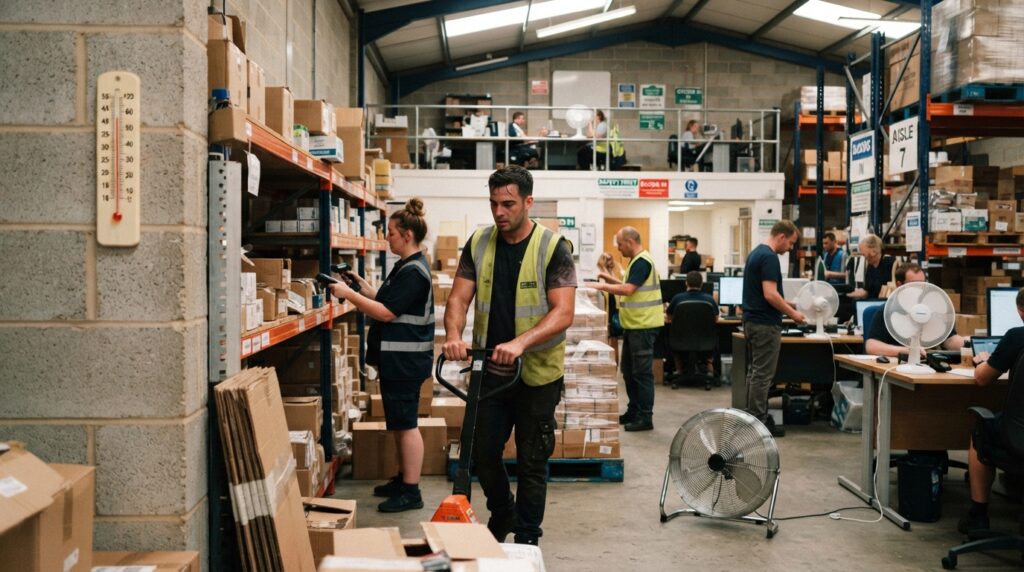
There is no maximum legal working temperature in the UK. This surprises people, and the widely repeated figures of 30°C or “you can go home at 30 degrees” have no basis in law. What the law does require is that employers keep indoor workplace temperatures at a level that is reasonable, and — more usefully — that they assess and control risks to health and safety, which includes heat. There is a stated minimum in guidance, but no maximum. For homeworkers, your employer’s duties don’t disappear because you’re at your kitchen table.
This question spikes every heatwave, usually alongside a viral post claiming a legal cut-off. Here’s the actual position.
The rule everyone gets wrong
The Workplace (Health, Safety and Welfare) Regulations 1992 require that the temperature in indoor workplaces be reasonable. The Approved Code of Practice attached to those regulations gives suggested minimum temperatures — commonly cited as around 16°C for general work, or around 13°C where the work involves severe physical effort.
There is no equivalent maximum. HSE is explicit that no maximum temperature is specified, because workplaces vary enormously — a bakery or a foundry cannot operate at an office temperature, and setting a universal ceiling would be unworkable.
So the “you can leave at 30°C” claim is wrong. It circulates every summer and it isn’t law.
What your employer does have to do
The absence of a number doesn’t mean the absence of duties. Under the Health and Safety at Work etc. Act 1974 and the Management of Health and Safety at Work Regulations 1999, employers must:
- Assess risks to employees’ health and safety, which includes heat where it’s a foreseeable issue
- Take reasonably practicable steps to control identified risks
- Provide a reasonable working temperature indoors
- Provide drinking water at accessible points
- Consult employees on health and safety matters
In practice, “reasonably practicable” steps in hot weather commonly include fans or cooling, relaxed dress codes, adjusted or flexible hours to avoid the hottest part of the day, more frequent breaks, moving people away from direct sun or heat-generating equipment, and providing water.
The useful framing: rather than arguing about a number, the productive question is whether your employer has assessed the risk and taken reasonable steps. That’s the duty that actually exists.
Thermal comfort, and why a thermometer isn’t the whole answer
HSE approaches this through thermal comfort rather than air temperature alone, and the reasoning matches the physics covered in our radiant temperature guide.
Six factors are generally considered: air temperature, radiant temperature from surrounding surfaces, air velocity, humidity, clothing, and how physically demanding the work is.
That’s why 26°C in a still, humid room with a west-facing window feels very different from 26°C with a fan running and dry air. It’s also why humidity matters so much — our “feels like” guide covers the mechanism.
HSE suggests that where a significant number of employees complain about thermal discomfort, that’s a trigger for a risk assessment.
If you work from home
The bit most coverage skips, and it applies to a lot of people now.
Your employer’s health and safety duties extend to homeworkers. HSE publishes specific guidance on protecting home workers, covering the working environment as well as equipment and mental health.
What that means practically:
- Raise it. An unusable home office in July is a legitimate working environment issue, not a personal comfort preference. Put it in writing.
- Ask what support exists. Many employers have homeworking policies with equipment provisions written since 2020 that employees have never read. Some will contribute to a fan or cooling.
- Ask about flexibility. Starting earlier to avoid an afternoon west-facing room is often the cheapest fix available, and costs your employer nothing.
- Ask about coming into the office if there’s an air-conditioned one.
Our home office cooling guide covers the practical side, and our business expense guide covers the tax question if you’re self-employed — where you have no employer to ask, and the equipment decision is yours.
Who’s at greater risk
A risk assessment should account for individual circumstances. Heat affects people differently, and some groups face materially higher risk:
- Pregnant workers. There are specific duties around risk assessment for new and expectant mothers, and heat is a relevant factor.
- Older workers.
- Anyone with a heart, respiratory or circulatory condition, or a condition affecting thermoregulation.
- People taking certain medications — some affect how the body handles heat. A GP or pharmacist can advise.
- Workers with disabilities, where reasonable adjustments may be required under the Equality Act 2010.
- Anyone doing heavy physical work, or wearing PPE that prevents heat loss.
Raising it constructively
What tends to work better than quoting a number that doesn’t exist:
- Gather facts. Take temperature readings at your workstation, at the times it’s worst, over several days. A cheap thermometer makes this concrete rather than anecdotal.
- Raise it collectively if you can. Several people reporting discomfort is a stronger trigger for a risk assessment than one.
- Ask specifically whether a risk assessment has been done covering heat. That’s the actual legal duty.
- Propose practical measures. Fans, blinds, flexible hours, relaxed dress code, more breaks. Employers respond better to solutions than complaints.
- Speak to your union rep if you have one. Unions have pushed on this for years and reps often know what’s already been agreed.
- Escalate to HSE or your local authority if there’s a genuine unaddressed risk and internal routes have failed. HSE covers some workplaces, local authorities others.
Can you refuse to work?
A serious question with a nuanced answer, and one where you should take advice rather than act on a blog.
Employment law provides protections for workers who leave or refuse to return to a workplace in circumstances of serious and imminent danger which they could not reasonably be expected to avert. Whether heat meets that threshold in a given case is fact-specific, and the bar is meaningfully high.
Before anything else, talk to Acas or your union. Walking out without advice risks your position; raising a documented concern through proper channels generally doesn’t.
Frequently asked questions
Is 30°C the legal limit?
No. There is no maximum legal working temperature in the UK. The figure circulates widely and has no statutory basis.
Is there a minimum?
Guidance suggests minimums — commonly cited as around 16°C for general indoor work, or around 13°C for severe physical work. These sit in an Approved Code of Practice rather than being an absolute statutory floor, but they carry real weight.
Does my employer have to provide air conditioning?
Not specifically. The duty is to maintain a reasonable temperature and control risk by reasonably practicable means. Fans, shading, flexible hours and breaks may satisfy that without air conditioning.
What about outdoor workers?
The indoor temperature requirement doesn’t apply, but the general duty to assess and control risk does — including sun exposure, hydration and shade. HSE publishes guidance specifically on working in hot weather outdoors.
I’m self-employed and work from home. Who’s responsible?
You are, which makes it a practical and financial question rather than a legal one. Our business expense guide covers the questions to put to an accountant.
Sources
- HSE — Temperature FAQs (no maximum temperature; suggested minimums)
- HSE — Thermal comfort (the six factors)
- HSE — Managing workplace temperature
- HSE — Protecting home workers
- Legislation.gov.uk — Workplace (Health, Safety and Welfare) Regulations 1992
- Acas — Working in hot weather
- NHS — Heat exhaustion and heatstroke
- Citizens Advice — Work advice
Related reading: our home office cooling guide and heat health alerts guide.
Related guides



Compare current prices, stock and reviews on portable air conditioners at Amazon UK. Prices and stock move fast in a heatwave, so it is worth checking before you commit.
Browse air conditioners →