Portable Air Conditioner in a Rented Home: Deposit-Safe Setup (UK)
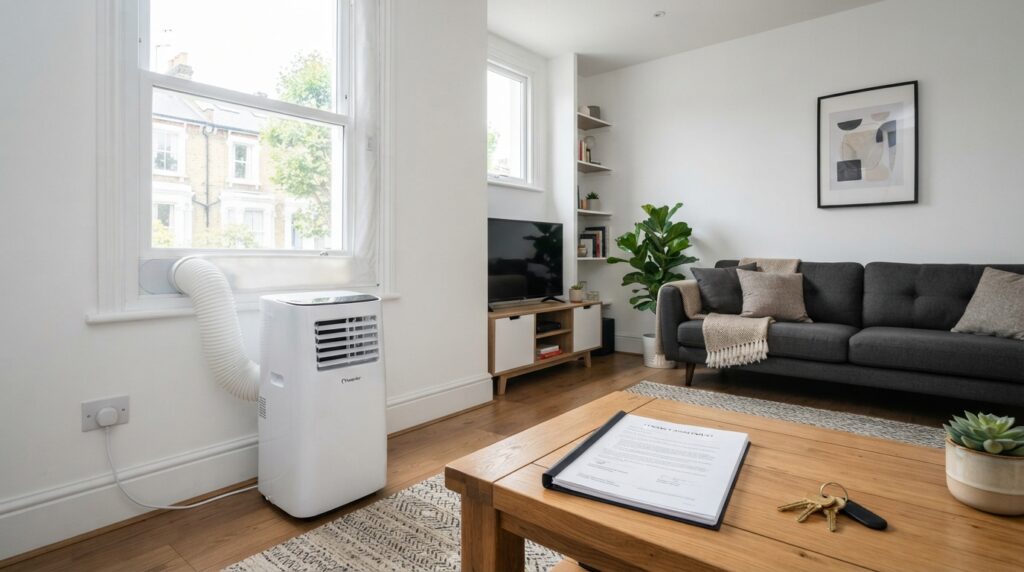
A portable air conditioner is designed to be a free-standing, plug-in appliance — used carefully, it shouldn’t put your deposit at risk at all. The two real risks are physical damage from drilling, taping or wedging a window kit badly, and condensation or damp staining on a sill or frame from a poorly fitted hose. Use a window kit that clips or wedges in place rather than anything screwed or permanently fixed, check your tenancy agreement for any appliance clauses, take photos before you start as evidence of the room’s original condition, and remove everything completely — with no residue — when you move out or store it for winter.
Renting shouldn’t mean sweltering through summer, and in most tenancies it doesn’t have to — here’s how to run a portable unit without any deposit worries.
Check your tenancy agreement first
Most tenancy agreements are silent on plug-in appliances like a portable air conditioner — they’re treated the same as a fan, a lamp or a kettle, something you bring and take away, not a fixture. Where agreements do say something, it’s usually about not making permanent alterations to the property (drilling, fixing things to walls or window frames) rather than appliances themselves. Read your agreement, and if it’s unclear, a quick message to your landlord or letting agent confirming you’d like to use a free-standing air conditioner (no drilling, no fixed installation) is a sensible, low-effort way to remove any doubt — this is quite different from asking about a permanently installed split system, which is its own conversation. Our landlords and renters guide and planning permission guide cover that bigger step if it’s ever relevant.
Venting the hose without damaging anything
The main physical-damage risk comes from how the exhaust hose exits the window, so this is worth getting right:
- Use a proper window kit that clips onto the window frame or wedges into the open sash, rather than screwing brackets into the frame or windowsill.
- Avoid strong adhesive tape directly on paintwork — it can pull paint or leave residue when removed, especially on older gloss finishes. Where a kit does use foam strips or a seal, check it’s designed to come away cleanly.
- Mind window restrictors. Many rented properties have them fitted, and they can limit how far you can open a window for the hose. Never remove or disable a restrictor yourself — our window restrictors guide explains why they’re there.
- Check the fit before you commit — a kit that’s slightly wrong for your window and gets forced into place is far more likely to mark the frame than one that’s properly matched.
Stopping condensation and damp becoming a deposit issue
A poorly sealed or badly angled hose can let condensation drip onto a sill or run down a wall, and staining or mould on paintwork is exactly the kind of thing that can come up at check-out. A few habits prevent it:
- Make sure the hose has a slight downward slope away from the unit where possible, rather than a low dip where condensation can pool and later escape.
- Wipe any condensation off the sill promptly rather than letting it sit and mark the paintwork.
- Empty the internal tank regularly so it never overflows onto flooring or a windowsill — see our leaking-water guide if you notice more water than expected.
- Ventilate briefly after use if the room feels muggy, rather than sealing it up completely, to avoid condensation building on cold surfaces.
Evidence is your friend
Before you fit anything, take dated photos of the window, frame and sill in their current condition — the same good practice you’d use for a check-in inventory. If a dispute ever arose about a mark or a window fitting, having a clear “before” record is the simplest way to resolve it. Deposits protected under a government-approved scheme (TDS, DPS or mydeposits) have a formal dispute process if it ever came to that, but good photographic evidence usually means it never does.
Electrical safety in an older rental
Moving out or putting it away for the season
- Remove the window kit completely, including any seals or foam strips, and clean any residue from the frame.
- Check for marks on the sill or frame and address anything minor before check-out.
- Store the unit properly rather than leaving it set up in a room you’re vacating — our winter storage guide covers doing this so it’s ready to go again wherever you live next.
- Take a final photo of the window area once everything’s removed, for your own records.
Frequently asked questions
Do I need my landlord’s permission to use a portable air conditioner?
Usually not for a free-standing, plug-in unit with no drilling or permanent fixing — it’s generally treated like any other appliance you bring with you. Check your tenancy agreement, and ask if it’s ever unclear; this is different from installing a fixed split system, which does need permission.
Will a window kit damage my window frame?
Not if you use a clip-in or wedge-style kit designed not to be permanently fixed, and avoid strong adhesive directly on paintwork. Check the kit fits your window properly before forcing anything into place.
What if my window has a restrictor fitted?
Common in rented properties, and it can limit how a hose kit fits. Never remove or disable a restrictor yourself — check the window’s maximum opening against the kit before buying, and ask your landlord if you’re unsure.
Should I tell my landlord I’m using one?
Not usually required for a free-standing appliance, but a quick message costs nothing and removes any doubt — especially useful if your tenancy agreement doesn’t mention appliances explicitly.
Sources
- Shelter — Renters’ rights and housing advice
- GOV.UK — Tenancy deposit protection
- Electrical Safety First — Electrical safety in the home
Related reading: our landlords and renters guide and winter storage guide.
A clip-in or wedge-style kit avoids drilling or damage. Compare current options at Amazon UK.