Do Under-Desk Foot Warmers and Heated Seat Cushions Actually Work? (UK)
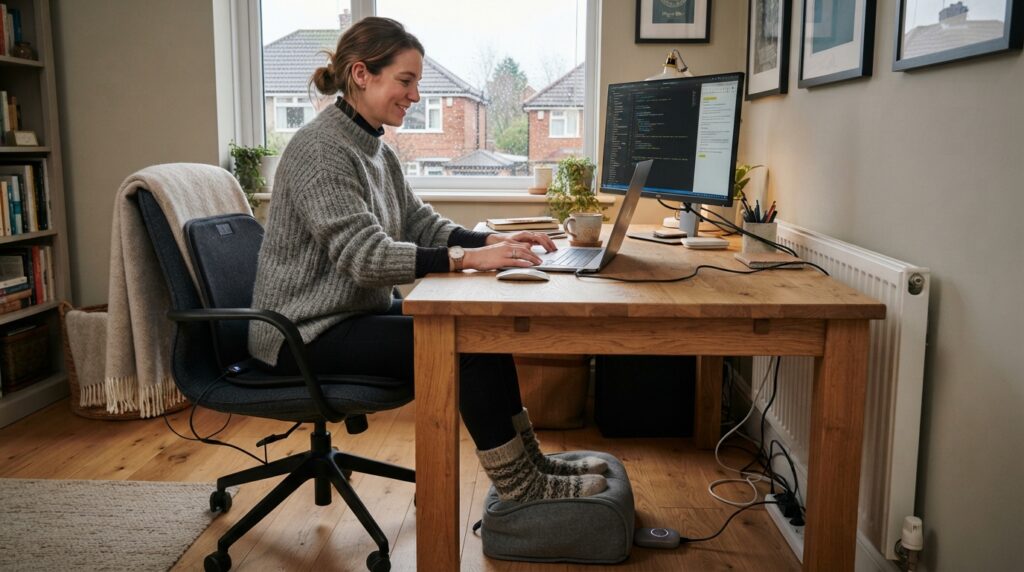
Yes, and per hour they’re the cheapest heat in the house. A typical under-desk foot warmer or heated seat cushion draws between 60W and 200W, which costs somewhere between 1.6p and 5.3p an hour at the current electricity price cap. That’s a fraction of what a fan heater costs to run, and it goes where you actually need warmth — the parts of you that are sitting still all day. The catch is what they don’t do: they only warm you, not the room. UK Health Security Agency advice is still to heat the home to at least 18°C where you can. Think of these as a way to make a warm-enough room comfortable, not to work in an actually cold one.
The maths of working from home in winter is unforgiving. You’re sitting still for eight hours in one room, at the coldest end of the day, with a body that generates less heat than it would if you were moving. Turning up the whole-house heating to suit that single room is expensive, and using a fan heater at your desk is only marginally better. Under-desk heaters and heated cushions are the tools designed for exactly this problem.
Why they cost so little to run
The reason personal heat is cheap is simple physics. A fan heater tries to warm 30 cubic metres of air. A heated cushion warms perhaps a square foot of you, in direct contact. It doesn’t need much power because it isn’t wasting any — the heat goes straight into your body rather than escaping through the walls and windows.
At the Ofgem electricity price cap of 26.32p per kWh for October to December 2026, the sums look like this for an eight-hour working day:
- Heated seat cushion at 60W: about 1.6p an hour, or 13p a day.
- Under-desk foot warmer at 150W: about 4.0p an hour, or 32p a day.
- Bigger radiant panel at 200W: about 5.3p an hour, or 42p a day.
- 2 kW fan heater for comparison: 52.6p an hour, or £4.21 a day.
The gap is enormous. If you’re used to running a small heater at your desk, switching to a heated cushion and foot warmer can cut winter desk-heating from pounds a day to pence.
Heated seat cushions
A heated seat cushion is a padded seat pad with a heating element woven through it, powered by a mains adapter, USB from your laptop, or (in car versions) a 12V socket. Home models generally offer two or three heat settings and a timer.
A mains-powered heated seat cushion
Cheapest desk warmth you can buy
Two or three heat settings
Auto shut-off timer on most models
Look for one with a proper UK three-pin mains adapter (better warmth than USB versions), an auto shut-off timer of a couple of hours, and a washable removable cover. Fleece surfaces are warmer against the leg than smooth vinyl. Straps that fit around your office chair back stop it sliding when you get up. If you have a heated car seat you’ll know how much difference constant low-level warmth makes; a heated cushion is the same idea. Check the stated wattage on the listing so you can work out the actual cost per hour for your rate.
Good for: desk work; people who feel the cold in the lower back and thighs; a very low running cost.
Less good for: heating a whole room, or on its own if the room is genuinely cold. USB-powered versions usually run too cool to feel worth it.
Under-desk foot warmers
There are two broad types. A heated footrest or foot pad is a padded box you rest your feet on, with a heating element inside. It’s low-wattage, safe to touch, and directly warms your feet. A radiant panel heater is a small flat heater mounted under the desk that radiates gentle warmth downward onto your legs; it draws more power (150–300W typically) but heats a wider zone.
An under-desk heated foot pad
Direct warmth for cold feet
Low wattage (60–150W typical)
Some tilt for footrest use
Look for a soft padded top surface (feet on hard plastic gets uncomfortable within an hour), a stated wattage in the 60–150W range, and either a timer or a plug-in timer you can add. Some doubled as a tilted footrest, which is more ergonomic than sitting flat. Check the cover is removable and washable, since it will get scuffed. The USB-only versions rarely produce enough warmth to be worth it — go for mains-powered.
Good for: cold feet on a suspended timber or tiled floor; ergonomic footrest use; Raynaud’s flare-ups affecting the feet.
Less good for: warming the room, or if you don’t rest your feet in one place for long stretches. USB versions are usually too weak.
Where they fit in the wider picture
Personal heat has two limits worth being clear about.
First, it doesn’t warm the room. The UK Health Security Agency’s advice remains to heat your home to at least 18°C where you can, particularly for older people or anyone with a health condition. If your home office sits at 12°C all day, the cushion and foot warmer will make you comfortable at your desk but the room itself is still cold and damp, and condensation and mould will follow. Our heating a home office guide covers the room side; our winter condensation guide explains why letting the room stay very cold is a problem in its own right.
Second, they only work while you’re sitting on or above them. Once you get up to make coffee, you’re back to whatever the room happens to be. That’s fine for desk work, but it’s why our heated throws and blankets guide is the better companion piece if you spend part of the day on the sofa too.
The safety points
- Buy from a named brand with a UK returns route, not an anonymous marketplace listing.
- Check the plug is a proper UK three-pin moulded plug, not a two-pin adapter.
- Don’t cover a heated cushion or foot pad with blankets. They’re designed to shed their heat into a person, not build up under a blanket.
- Don’t use them if a wire or heating element is exposed. If the cover has torn, replace the cushion.
- Turn them off when you leave the desk for a long break, and always at the end of the day. An auto shut-off is a useful backup, not a replacement.
Frequently asked questions
Are heated seat cushions cheap to run?
Yes. At 26.32p per kWh, a 60W cushion costs about 1.6p an hour. Even a bigger 200W under-desk radiant panel is around 5.3p an hour — a fraction of a 2 kW fan heater’s 52.6p.
Can I use a heated seat cushion instead of heating the room?
For desk comfort, often yes. But UK Health Security Agency advice is still to heat your home to at least 18°C where you can, both for health and to prevent condensation and mould in a very cold room. Think of a cushion or foot warmer as a supplement, not a replacement.
Are USB heated cushions worth it?
Rarely. USB-powered versions draw so little power (typically under 10W) that most people find they don’t feel warm enough to be useful. A mains-powered model at 60–100W costs almost nothing to run and actually keeps you warm.
Are they safe to leave on all day?
Modern products with auto shut-off and low wattage are generally designed for extended use, but treat “all day” as “the working day” — switch them off when you leave. Don’t cover them with blankets, and stop using one if the cover tears.
Sources
- Ofgem — Energy price cap, 1 October to 31 December 2026
- UK Health Security Agency — Cold weather alert issued by UKHSA
Related reading: our heating a home office guide, heated gloves and socks guide and heated throws and hot water bottles.
Compare current mains-powered heated seat cushions at Amazon UK.