Is There a Maximum Working Temperature in UK Law?
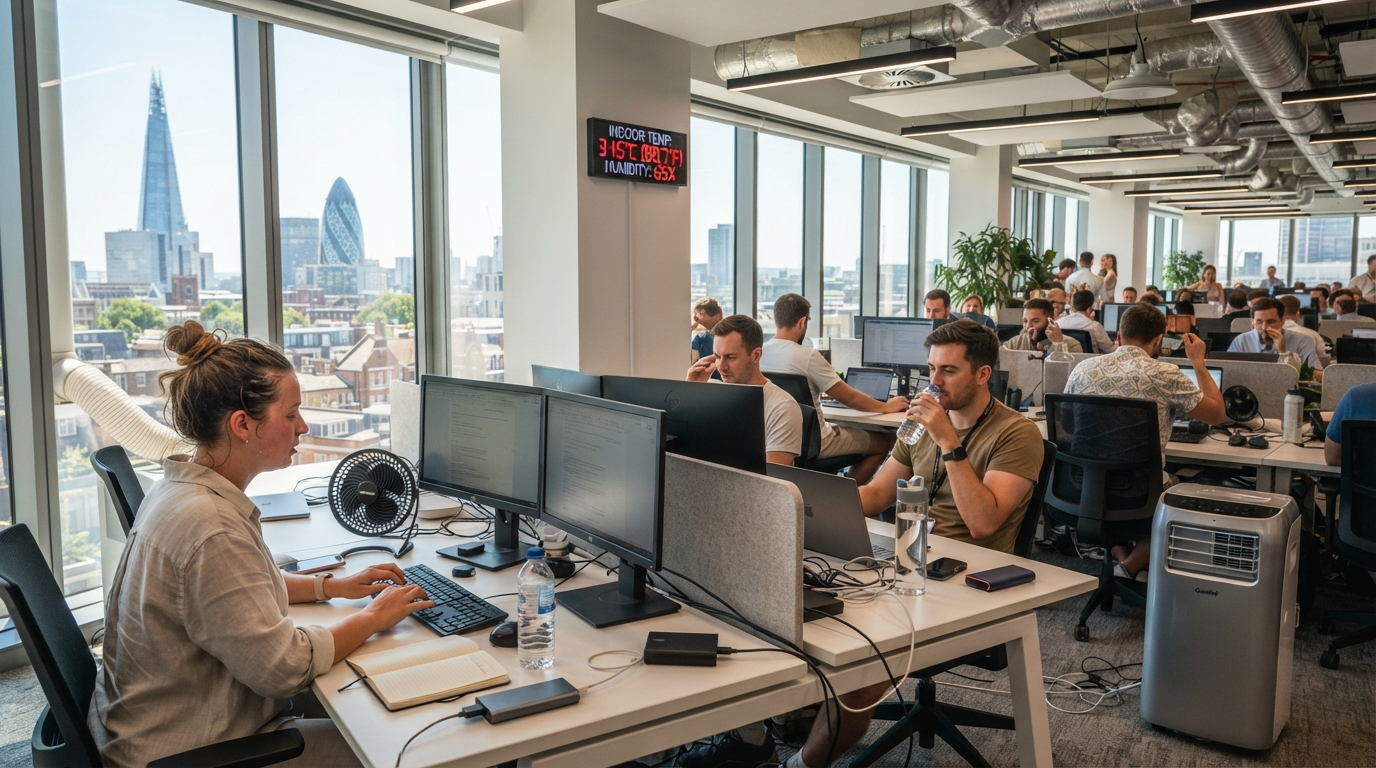
No — there is no maximum working temperature set in UK law. There is no figure at which you are legally entitled to stop work or go home, and the widely shared claim that “you can leave at 30°C” is not the law. What does exist is a duty on employers to keep the temperature in indoor workplaces “reasonable”, and a broader duty to assess and control risks to health and safety — which includes heat. The regulations go further in the other direction: guidance suggests a minimum of around 16°C (or about 13°C for physically demanding work), but deliberately sets no upper number. Understanding why there’s no maximum is the key to knowing what you can actually ask for.
This question comes up in every heatwave, usually alongside a confidently wrong number. Here is the actual legal position, why it’s built that way, what your employer must do, and what you can do if your workplace is genuinely too hot.
What the law actually says
The relevant rule for most indoor workplaces is the Workplace (Health, Safety and Welfare) Regulations 1992. Regulation 7 requires that, during working hours, the temperature inside buildings must be “reasonable”.
That’s it. The word is “reasonable” — not a number. The accompanying Approved Code of Practice fleshes out the cold end, indicating that workroom temperature should normally be at least around 16°C, or about 13°C where the work involves severe physical effort. No equivalent maximum is given.
Sitting above that is the Health and Safety at Work etc. Act 1974 and the Management of Health and Safety at Work Regulations 1999, which require employers to assess risks to employees’ health and safety and take reasonable steps to control them. Heat is a workplace risk like any other, so it falls within that duty even though no temperature threshold is specified.
Why there’s no maximum number
This looks like a gap, but it’s a deliberate design choice, and once you see the reasoning it’s hard to argue with.
A single legal maximum would have to apply equally to a glass-fronted office, a commercial kitchen, a foundry, a bakery, a laundry and a greenhouse. Some of those workplaces are inherently hot — you cannot run a bakery at 20°C. A hard cap would either be set so high it protected nobody in an office, or so low it made legitimate industries unlawful.
More importantly, air temperature alone is a poor measure of whether people are actually too hot. That’s the real reason the law avoids a number.
The six factors of thermal comfort
HSE approaches workplace heat through thermal comfort, which depends on six factors — not just the reading on a thermometer. This is genuinely useful to understand, because it tells you what to ask your employer to change:
- Air temperature — the obvious one, and the only one most people mention.
- Radiant temperature — heat radiating from hot surfaces: sun through glass, ovens, furnaces, machinery, a hot roof. A room at 24°C next to a blazing window feels far hotter than 24°C elsewhere.
- Humidity — high humidity stops sweat evaporating, so the same temperature becomes far more punishing. This is why a muggy 26°C is worse than a dry 28°C.
- Air velocity — moving air helps you shed heat. A fan doesn’t lower the temperature but genuinely improves comfort.
- Clothing — uniforms, PPE, protective overalls. Someone in required protective clothing is far more heat-stressed at the same temperature.
- Work rate — your body generates heat. Heavy manual work in 25°C can be harder than sitting at a desk in 30°C.
A legal maximum based on air temperature alone would ignore five of these six. That’s the honest reason the regulations talk about what’s “reasonable” instead.
What your employer must actually do
“No maximum” does not mean “no obligations”. In practice, an employer should be:
- Assessing the risk. If heat is a foreseeable problem, it belongs in the risk assessment, with controls that are actually implemented — not just written down.
- Keeping the temperature reasonable for the work being done, as far as reasonably practicable.
- Providing adequate ventilation — a supply of fresh or purified air is a separate requirement in the same regulations.
- Providing drinking water. An adequate supply of wholesome drinking water is also required, and matters enormously in heat.
- Acting on complaints. If a significant number of people are complaining about thermal comfort, that’s a signal the employer is expected to investigate.
Reasonable control measures are often unglamorous and cheap: blinds and shading on sun-facing glass, fans to increase air movement, relaxing dress codes or uniform requirements, moving workstations away from hot glass or machinery, adjusting shift patterns or break frequency, providing cold water, and in some workplaces mechanical cooling. Many of the measures we cover for homes apply directly — our window and shading guide and fan types guide explain why shading and air movement do the heavy lifting.
Where the duty is stronger
Some situations attract more specific attention, and it’s worth knowing if one applies to you:
- Pregnant workers. Employers have specific duties to assess risks to new and expectant mothers, and heat is a recognised factor. This is one of the clearest cases for individual adjustments. Our pregnancy guide covers staying cool more generally.
- Disability and health conditions. Under the Equality Act 2010, employers may be required to make reasonable adjustments for a disabled employee — which can include changes to their working environment. Some conditions and some medications genuinely affect heat tolerance.
- Vulnerable and older workers, and anyone whose condition is aggravated by heat.
- Outdoor workers, where sun exposure and UV are an additional risk alongside heat — shade, sun protection, timing of heavy work and hydration all come into it.
- Work in protective clothing or PPE, where clothing is dictated by another hazard and heat stress builds quickly.
What you can do if your workplace is too hot
- Raise it informally first with your manager. Many fixes (blinds, a fan, a relaxed dress code, more breaks) are easy and get done once someone asks.
- Be specific rather than just saying it’s hot. Using the six factors helps: “the afternoon sun on the south window is radiating onto three desks and there are no blinds” is far more actionable than “it’s boiling in here”.
- Go through your health and safety representative or union if there is one. A collective complaint carries more weight, and employers are expected to take a pattern of complaints seriously.
- Ask about the risk assessment. Asking whether heat has been assessed and what controls were identified is a reasonable question and often prompts action.
- Escalate externally if it isn’t resolved. HSE or your local authority’s environmental health team regulate workplaces depending on the sector. Acas and Citizens Advice can advise on the employment side.
What about working from home?
An employer’s health and safety duties don’t simply vanish because you work at home, but the practical picture is different — they don’t control your house, and there’s no obligation to air-condition it for you. In practice, homeworking heat is usually handled through flexibility (hours, working elsewhere) rather than equipment. If you’re cooling a home office yourself, our work-from-home cooling guide and laptop cooling guide cover the practical side.
The “30 degrees and you can go home” myth
Frequently asked questions
Is there a legal maximum working temperature in the UK?
No. UK law requires a “reasonable” indoor workplace temperature but sets no maximum figure. Guidance gives a suggested minimum of around 16°C (13°C for strenuous work) and no upper limit.
Can I legally go home if it’s over 30°C?
Not on the basis of a temperature alone — that rule doesn’t exist. The 30°C figure comes from campaign proposals, not legislation. Raise it with your employer, your safety rep or union, and escalate to HSE or your local authority if it isn’t addressed.
Does my employer have to provide air conditioning?
There’s no specific duty to install air conditioning. The duty is to keep the temperature reasonable and control the risk so far as is reasonably practicable — which may be met with shading, ventilation, fans, dress-code changes or altered working patterns rather than cooling.
Why is there a minimum but no maximum?
Because some workplaces are inherently hot (kitchens, bakeries, foundries), and because air temperature alone doesn’t determine whether people are too hot — humidity, radiant heat, air movement, clothing and work rate all matter. A single number would be either meaningless or unworkable.
What if I’m pregnant or have a health condition?
Those cases attract stronger duties — specific risk assessment for new and expectant mothers, and potentially reasonable adjustments under the Equality Act 2010 for a disabled employee. Raise it directly, and take advice from Acas or Citizens Advice if needed.
Sources
- HSE — Temperature in the workplace
- HSE — Thermal comfort and the six factors
- Legislation.gov.uk — Workplace (Health, Safety and Welfare) Regulations 1992
- Legislation.gov.uk — Health and Safety at Work etc. Act 1974
- Legislation.gov.uk — Equality Act 2010 (reasonable adjustments)
- Acas — Working in hot weather
Related reading: our work-from-home cooling guide and heatwave checklist.
A desk fan and shading do most of the work where you control the space. Compare current options at Amazon UK.