Why Does My Boiler Keep Losing Pressure? (UK)
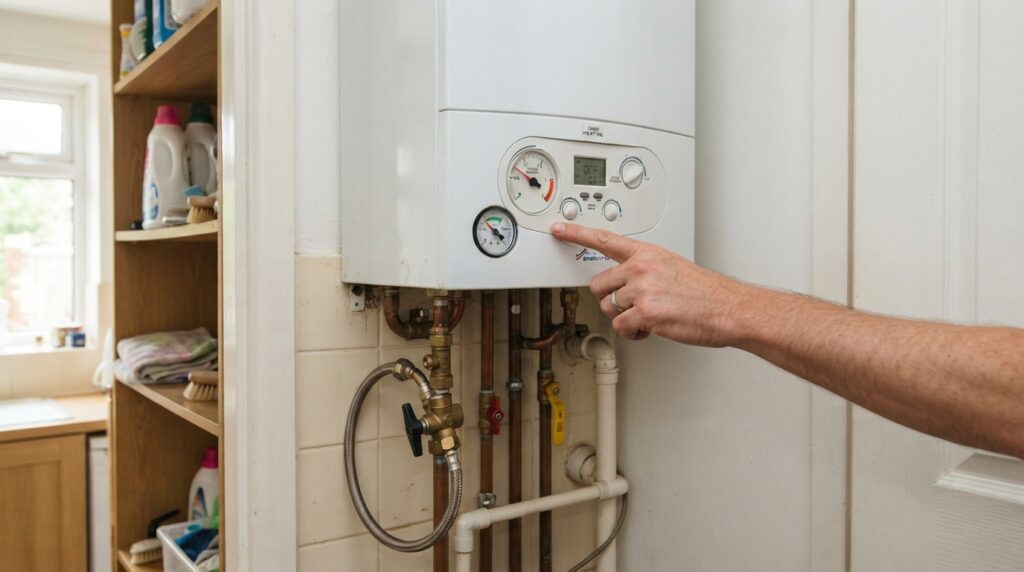
A sealed heating system shouldn’t lose pressure on its own, so if yours keeps dropping, water is going somewhere. British Gas and Vaillant both say boiler pressure should be 1 to 1.5 bar with the heating off. The usual causes are: a small leak, most often at a radiator valve; bleeding radiators, which lets air out and lowers the pressure; a pressure relief valve letting water out through the pipe on the outside wall; or a faulty expansion vessel. Topping it up once after bleeding radiators is normal. If you’re topping it up every week or two, look for drips and damp patches, check the relief pipe outside, and if you can’t find the cause, book a Gas Safe engineer. Ideal advises against just refilling if the expansion vessel might be the problem.
You glance at the boiler and the needle is sitting near zero, or the heating has stopped with a low-pressure fault. You top it up with the filling loop, and a week later it’s dropped again. It’s one of the most common boiler problems in the UK, and nearly always has a findable cause. Here’s how to work out which one you’ve got.
What pressure should a combi boiler be?
British Gas says: “When the heating is off, your boiler pressure should be between 1 to 1.5 bar.” Vaillant agrees, and adds that the pressure will “usually sit between 1 and 2 bars when it is turned on”. That rise is normal: Ideal says “it’s normal for the pressure to rise slightly” as the water heats up and expands. Exact limits vary by boiler, so check the manual or the markings on your pressure gauge. Vaillant, for example, gives an operating range of 0.7 to 2.5 bar on one of its pages.
What matters is the reading with the heating off and the system cold. If that keeps creeping down over days or weeks, something is wrong.
The four usual causes
1. A small leak somewhere in the system
This is the most common cause. Vaillant says the usual culprit is “a leak from the appliance or on the system most commonly from radiator valves or system components”. Worcester Bosch also points to pipework under the floor, where you’d never see it. A leak can be tiny, a drip every few minutes, and still drain the pressure over a week.
Ideal suggests some clues that point to a hidden leak:
- “clean spots on hard floors that are surrounded by dust”, where drips have been evaporating;
- “black marks where persistent dampness has taken hold”;
- Stains on ceilings, “especially around the edges where they meet the walls”.
Vaillant adds two more: a visible drip from the underside of the boiler, and damp patches around radiators. Check every radiator valve with a dry tissue: wrap it round the valve and the joint, leave it a few minutes with the heating on, and look for damp.
2. You’ve bled the radiators
British Gas explains that “as air is released from your central heating system, it lowers the pressure.” If you’ve just bled a few radiators, a drop is expected. Top it back up once and keep an eye on it. If it holds, there’s nothing wrong. Our guide to bleeding a radiator properly covers the whole routine.
If you find yourself bleeding radiators often because they keep filling with air, that’s worth mentioning to an engineer too, as air has to be getting in somewhere.
3. The pressure relief valve is letting water out
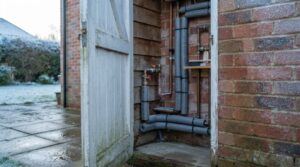
Every combi has a safety valve that releases water if the pressure gets too high. It drains through a small pipe, usually copper, that runs through the wall to the outside. Ideal says to check this outlet pipe, “usually on the outside wall behind your boiler”, and that “it should be dry”. Worcester Bosch says: “If it is wet, this may mean that the pressure relief valve is faulty.”
Don’t confuse it with the plastic condensate pipe (usually wider), which normally discharges water now and then while the boiler is running. If the relief pipe is wet, Ideal’s advice is to “call a Gas Safe registered engineer”. The relief valve opens when the pressure gets too high, usually because the system was overfilled or the expansion vessel has lost its charge. Once it has opened, it may not reseal properly and can keep weeping.
4. The expansion vessel needs attention
Inside the boiler is an expansion vessel, a tank with an air cushion that soaks up the extra volume as the water heats. If it loses its charge, the pressure swings sharply between hot and cold and the relief valve may open. Ideal says: “If you have a sudden drop in pressure and there’s no obvious sign of a leak, the expansion vessel could need investigating.” It also warns that in this case “it wouldn’t be advisable to refill” the system yourself. The vessel is inside the boiler, so this one is engineer work.
How to top up the pressure safely
Most combis have a filling loop: a short braided hose underneath the boiler connecting the mains water to the heating system, or, on some boilers such as many Worcester Bosch models, a filling key that fits behind the lower panel. Your boiler manual shows exactly where it is and how it works. The general sequence from Ideal and British Gas is:
- Turn the boiler off and let it cool. Ideal says to “wait for it to cool down completely”. British Gas’s guide for Worcester boilers says to turn off the electrics first.
- Check the filling loop is connected at both ends. British Gas says to make sure both ends are secure.
- Open the valve or valves slowly; some loops have only one. You’ll hear water flowing and see the needle rise.
- Close the valves at about 1.5 bar, never above. Ideal says: “When it reaches the recommended 1.5 bar, turn off both valves, one after the other.”
- Disconnect and store the loop if it’s the removable type, as British Gas advises, and turn the boiler back on.
- Make a note of the date and reading. It’s the easiest way to tell how fast you’re losing pressure, which is useful for an engineer.
When to call a Gas Safe engineer
- It keeps losing pressure and you can’t find a drip. Worcester Bosch says that if your heating system keeps losing pressure, contact your installer.
- The relief pipe outside is wet. Ideal says to call a Gas Safe engineer.
- The pressure drops suddenly with no sign of a leak, pointing to the expansion vessel.
- There’s water under the boiler or coming from inside the casing.
- The pressure is above about 2.5 bar when cold and bleeding a radiator doesn’t bring it down, as Vaillant advises.
Never remove the main boiler casing yourself. Your annual service is a good time to raise a slow pressure loss, as the engineer can check the expansion vessel and relief valve while they’re there.
Is a pressure drop urgent?
Usually not dangerous, but it can stop your heating and hot water working until you top it up, and a slow leak can damage floors and ceilings over time. Ideal’s hidden-leak signs, such as stains spreading along a ceiling edge, are worth taking seriously: water damage gets more expensive the longer it goes unnoticed. If you’re going away in winter, leave the heating on a low or frost setting and check the pressure first: a boiler that locks out on low pressure won’t fire, so it can’t protect the house from freezing.
SwitchBot Water Leak Detector
Best for: catching a slow leak under the boiler
Phone notifications
Up to 2 years battery, IP67
SwitchBot says this detector connects straight to Wi-Fi without a hub, sends notifications to your phone, detects dripping and standing water, runs for up to two years on a battery and is rated IP67. Put one on the floor under the boiler, where a leak from the boiler or its valves would land first. It won’t find a leak under the floorboards, but it will tell you quickly if the boiler itself starts dripping.
Good for: under combi boilers and airing cupboards; homes where nobody notices a puddle for days.
Less good for: leaks under floors or behind walls; stopping the water, as it alerts you rather than shutting anything off.
A radiator bleed key with a water catcher
Best for: bleeding without the drips
Reservoir catches the water
No more towels on the carpet
Bleeding radiators lowers the pressure, so you’ll often bleed and top up in the same session. A bleed tool with a built-in key and a small reservoir catches the water that spits out of the valve, which saves stained carpets and wet cloths. Check the key fits your radiators before you need it; most UK radiators take a standard square key.
Good for: the start-of-winter bleed; homes with carpet under radiators.
Less good for: radiators with automatic air vents or slotted screws, which need a different tool. It doesn’t fix a leak; it just makes bleeding tidier.
Frequently asked questions
What should my boiler pressure be?
British Gas and Vaillant both say boiler pressure should be 1 to 1.5 bar when the heating is off. It’s normal for it to rise a little, to around 1 to 2 bar, when the heating is running. Check your boiler manual for its exact range.
Is it normal for boiler pressure to drop?
A drop after bleeding radiators is normal, because you’ve let air out. A sealed system shouldn’t keep losing pressure week after week; if it does, there’s usually a leak, a faulty pressure relief valve or an expansion vessel problem.
How often is it OK to top up boiler pressure?
There’s no official figure, but if you need to top up more than occasionally, Worcester Bosch says to contact your installer, and Ideal says to call a Gas Safe engineer if the relief pipe is wet or the drop is sudden with no visible leak.
Why is the pipe outside my boiler dripping?
If it’s the copper pressure relief pipe, Worcester Bosch says a wet pipe may mean the pressure relief valve is faulty, and Ideal says to call a Gas Safe engineer. The plastic condensate pipe discharging water now and then while the boiler runs is normal.
Can I repressurise my boiler myself?
Usually, yes, using the filling loop as your manual describes, with the boiler off and cool. Don’t do it if the expansion vessel might be faulty: Ideal says refilling wouldn’t be advisable in that case. Never open the boiler casing.
Sources
- British Gas — Boiler pressure guide
- British Gas — How to repressurise your Worcester Bosch boiler
- Vaillant — What pressure should my boiler be?
- Vaillant — Why is my boiler losing pressure?
- Ideal Heating — Why is my boiler losing pressure?
- Worcester Bosch — The heating system is constantly losing pressure
- SwitchBot — Water Leak Detector
Related reading: our how to bleed a radiator, why your heating smells of burning and autumn heating changeover checklist.
Compare the SwitchBot Water Leak Detector at Amazon UK.