Ice on the Inside of Your Windows? Why It Happens and How to Stop It (UK)
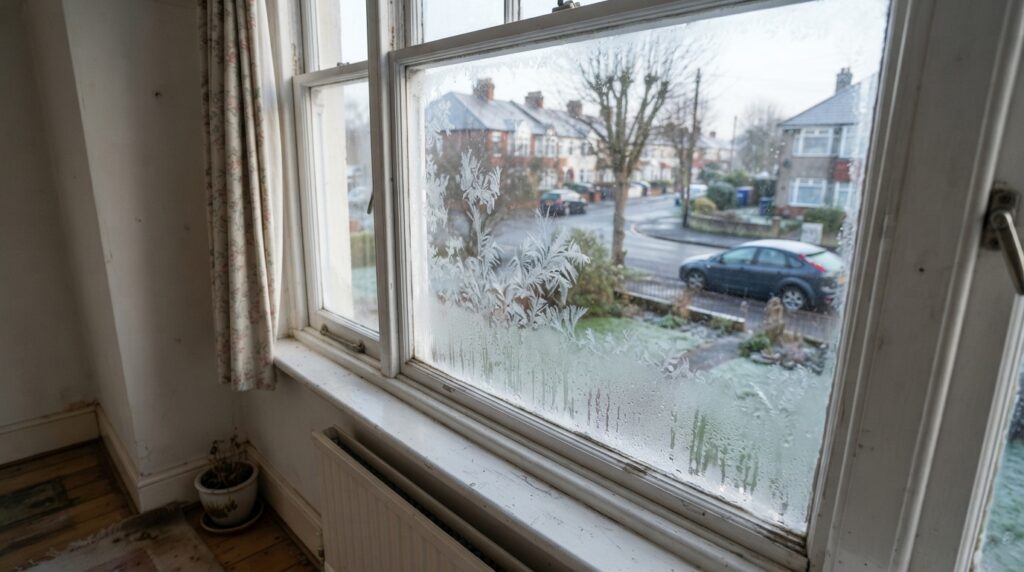
It’s frozen condensation. When the inside surface of the glass drops below freezing, moisture from the room air turns to ice on it, the same process the Met Office describes for hoar frost outdoors. It’s most likely on single glazing, which Historic England calls “a poor thermal insulator”, and in cold bedrooms, where Chesterfield Borough Council says a sleeping adult’s breath adds about a third of a litre of water to the air overnight. Once the glass is below 0°C, even normal indoor humidity can be enough to form ice, so the surest fix is warmer glass: keep a low background heat on in cold weather and, longer term, consider secondary glazing. Cutting the moisture you add, using trickle vents, airing the room in the morning and keeping an eye on humidity all reduce how much ice and meltwater you get. Dorset Council says around 40–55% humidity is comfortable, and homes regularly above 60% are at higher risk of condensation and mould. And don’t pour hot water on it: the RAC warns that hot water can crack a frozen windscreen, so don’t risk it on a window.
You wake up on a frosty morning and the inside of the bedroom window is iced over. It’s startling the first time. It’s a clear sign the glass is below freezing, and the more moisture the room air carries, the thicker the ice. Here’s why it happens, whether it’s a problem, and how to stop it coming back.
Why ice forms on the inside of a window
Ordinary condensation and inside ice are the same thing at different temperatures. Historic England explains condensation like this: “Warm damp air passing over a cold surface may be cooled locally below the dew point in which case condensation will take place.” That, it says, causes “the familiar condensation on the inside of cold windows”.
If the glass itself is below freezing, the moisture doesn’t stay as droplets. The Met Office describes hoar frost as “formed by the same process as dew”, but on a surface that’s below freezing, and says: “When vapour turns directly to ice crystals on a surface, this is the white, or hoar frost”. It also points out that a car windscreen can frost over even when the car’s thermometer reads above zero, because surfaces cool faster than the air overnight and can end up colder than it.
So inside ice needs glass below freezing and moisture in the room air. Once the glass is below 0°C, even normal indoor humidity can be enough to form ice, so warming the glass is the surest fix. Cutting humidity still matters: the less moisture in the air, the less ice and meltwater you’ll get.
Which windows and rooms get it
Single glazing
Historic England says “single glazing is a poor thermal insulator and readily conducts heat”, so the inside of the glass gets very cold on a frosty night. Its figures show how big the gap is. A U-value measures heat loss, and lower is better:
| Window | Typical U-value (W/m²K) |
|---|---|
| 4mm single glass | 5.4 |
| Timber-framed single-glazed window | 4.8 |
| With secondary glazing (separate frames) | About 2.5 |
| With low-emissivity secondary glazing | Under 2.0 |
Cold bedrooms
Castle Point Borough Council notes that condensation most often occurs in unheated bedrooms. Bedrooms often combine a cold room, a closed door and people breathing out moisture for eight hours. Chesterfield Borough Council says a sleeping adult’s breath adds “about one third of a litre” of water vapour overnight, and a leaflet from the former Hambleton District Council (now part of North Yorkshire Council) puts it at half a pint per person. Two people in a small, closed bedroom add roughly two-thirds of a litre by morning, and it has to go somewhere. The coldest surface in the room is often the window.
Rooms where washing dries or showers run
Hartlepool Borough Council says drying clothes indoors can add 10 to 15 litres of moisture a week, and showering, cooking, bathing and washing another 15 to 20 litres a week. That moisture can spread around the house, and some of it ends up on the coldest glass.
Behind secondary glazing
If you have secondary glazing and the ice or condensation forms on the original window behind it, look at the inner seal first. Historic England says the secondary unit should be well sealed, with “efficient perimeter sealing (to prevent condensation on the primary window)”, while the outer window is best left without draught-proofing so the air gap gets some ventilation. It also notes condensation can form on the outer window if the secondary panel is opened for ventilation in cold weather, particularly where rooms are humid.
Is it a problem?
The odd frosty morning isn’t a disaster, but don’t ignore it. When the ice melts, the water runs onto sills and frames. The government’s guidance on damp and mould names window frames among the cold spots where condensation forms, and warns that damp and mould affect some people more than others, including children, older people, and people with health conditions or a weakened immune system.
Ice inside tells you the glass is very cold, and often that the room is colder than it should be. The NHS says that, if you can, the rooms you regularly use, such as your living room and bedroom, should be at least 18°C. Dorset Council also recommends at least 18°C in rooms other than the living room, and Hartlepool Borough Council says to keep all rooms above 15°C to reduce condensation. If one bedroom is always much colder than the rest of the house, our guide to why your bedroom is freezing but the living room is warm covers the usual causes.
If you rent and it keeps happening, tell your landlord. In England, the government’s guidance for landlords says that working with tenants on things like ventilation must sit alongside tackling the root causes of damp and mould, not replace it.
How to clear it safely
- Warm the room and let it melt. Turn the heating on and give it time.
- Don’t pour hot water on it. The RAC warns that pouring hot water on a frozen windscreen can crack the glass through “thermal shock”. There’s no reason to take that risk with a window.
- Catch the meltwater. The Hambleton leaflet says to dry windows and windowsills every morning, and Watford Borough Council suggests wiping condensation with a cloth and then opening the window for about 15 minutes. A window vac makes this quicker.
- Don’t dry the cloth on a radiator. That just puts the water back into the room. Wring it out in the sink.
How to stop it coming back
1. Keep a low background heat
Switching the bedroom radiator off completely in a hard frost can make inside ice more likely. Chesterfield Borough Council advises: “In cold weather, set your thermostat to provide a low background heat throughout the day, even if you’re not at home.” The Hambleton leaflet says keeping the heating on low all day in cold weather helps control condensation, and that “it is better to have a medium-to-low level of heat throughout the house”. Our guide to whether to turn the heating off at night looks at the trade-offs.
2. Let the moisture out
Overnight, leave trickle vents open if your windows have them, as Watford Borough Council advises. The NHS says it’s best to keep bedroom windows closed at night in cold weather, so air the room after you get up instead: South Ribble Borough Council recommends opening windows for 5 to 10 minutes every day, in the morning and evening, to swap the air over.
3. Add less moisture
The government’s damp and mould guidance suggests drying laundry outdoors where possible, using extractor fans, covering pans and closing internal doors when cooking or showering. Watford Borough Council advises against drying clothes on radiators. If you have to dry washing indoors, do it in a room with the door closed and a window open, or with a dehumidifier running.
4. Measure the humidity
A cheap hygrometer in the bedroom tells you how much moisture you’re dealing with. Dorset Council says “a comfortable relative humidity level within an occupied home is normally around 40-55%”, and that homes regularly above 60% are at higher risk of condensation and mould. If it’s regularly high first thing in the morning, ventilation and a dehumidifier are your next steps. Our winter condensation guide goes further.
5. Choose the right dehumidifier for a cold room
Not all dehumidifiers cope with cold. Meaco’s published figures show the difference. Its Arete One 20L, a compressor model, removes up to 8.5 litres a day at 20°C and 60% humidity, but only 3.4 litres at 10°C. Its DD8L Zambezi, a desiccant model, manages 8.0 litres at 20°C and 6.6 litres at 10°C on its middle setting. The trade-off is power: on that middle setting the DD8L draws 656W, against 216W for the Arete One at 20°C and 180W at 10°C. Per litre of water removed, the compressor model is still cheaper to run, even in a cold room. The desiccant model’s advantage is that it removes far more water when it’s cold, and desiccant models give off some warmth as they run. Our dehumidifier guide compares models.
6. Make the glass warmer
The lasting fix is a warmer inner pane. Historic England cites research showing that secondary glazing with a low-emissivity coating can cut the heat lost through a window by conduction and radiation by over 60%. Our guides to whether secondary glazing is worth it and window insulation shrink film cover the permanent and the cheap-and-cheerful options.
TP49 thermometer and hygrometer
Best for: keeping an eye on bedroom humidity
±2% between 30 and 80%
1 × AAA
A small digital monitor that shows temperature and humidity, with face icons for dry, comfortable and wet air. Its maker, now trading as TempPro (formerly ThermoPro), quotes humidity accuracy of ±2% between 30% and 80%, which is the range that matters for Dorset Council’s 40–55% comfort zone and 60% warning level. Put it on a bedside table or shelf and check it when you wake up.
Good for: checking whether a room is regularly above 60%; seeing whether ventilation or a dehumidifier is working.
Less good for: alerts or a record of readings overnight, because it has neither. For alerts to your phone, see our room thermometer guide.
Kärcher WV 6 Plus window vac
Best for: getting meltwater off the glass fast
280mm blade
150ml tank, 0.8kg
Kärcher says the WV 6 Plus runs for up to 100 minutes per charge, has a 280mm suction blade and a 150ml dirty water tank, and weighs 0.8kg with its battery. It’s designed for smooth surfaces such as windows, tiles and mirrors. On a wet morning, it lifts the water off the glass and into the tank, rather than leaving it to soak into the sill or a towel.
Good for: streaming windows every morning; homes with several cold windows; shower screens the rest of the year.
Less good for: frames and sills, as it’s designed for smooth surfaces; very wet mornings, when the 150ml tank needs emptying more often. It takes 170 minutes to recharge.
EcoAir DD1 Classic MK6 desiccant dehumidifier
Best for: cold bedrooms and unheated rooms
Works from 1°C
300W low, 580W high
EcoAir says the DD1 Classic MK6 removes up to 7.5 litres a day at 20°C and 60% humidity, works from 1°C to 40°C, and releases slightly warm air as it runs. As a desiccant model, it’s the type that holds up better in cold rooms, where compressor dehumidifiers lose much of their performance. It also has a laundry mode. At the Ofgem price cap average of 26.32p per kWh (Direct Debit, October to December 2026), that’s about 7.9p an hour on low and 15.3p an hour on high.
Good for: cold bedrooms, box rooms and conservatories; homes where the heating is kept low.
Less good for: running costs: it draws 300W to 580W, more than a compressor model, though a compressor removes much less water in a cold room; emptying, as the tank holds 2 litres.
Frequently asked questions
Is ice on the inside of windows normal?
It happens in cold snaps, particularly with single glazing and in unheated bedrooms. It means the glass is below freezing; moisture from the room air does the rest. Background heat and warmer glass tackle the cause, while ventilation and lower humidity reduce how much ice forms.
Is ice on the inside of windows dangerous?
Not in itself, but the meltwater soaks into sills and frames and can lead to damp and mould, which the government’s guidance says affect some people more, including children and older people. It’s also a sign the glass, and often the room, is very cold.
Why do my bedroom windows freeze on the inside?
Bedrooms are often the coldest rooms, with the door shut, and the people sleeping in them breathe out moisture all night. Chesterfield Borough Council puts it at about a third of a litre per adult overnight. That moisture freezes on the coldest surface, which is often the glass.
Should I open the window if there’s ice on the inside?
Once it’s melted and you’ve wiped it, yes: Watford Borough Council suggests wiping condensation and then opening the window for about 15 minutes. At night, use trickle vents rather than an open window; the NHS says it’s best to keep bedroom windows closed at night in cold weather.
Will a dehumidifier stop ice on the inside of windows?
It reduces how much ice forms, but on glass below freezing it may not stop it completely. Choose the right type: Meaco’s figures show a compressor model removing far less water at 10°C than at 20°C, while a desiccant model holds up better in the cold. Background heat and warmer glass are the lasting fixes.
Sources
- Met Office — What is frost and ice?
- Historic England — Energy efficiency and historic buildings: secondary glazing for windows
- Chesterfield Borough Council — Condensation and how to reduce it
- Hambleton District Council (now part of North Yorkshire Council) — Condensation and mould: how to control it (2014)
- NHS — Keep warm, keep well
- Castle Point Borough Council — Condensation advice leaflet
- Hartlepool Borough Council — Damp and condensation leaflet
- Dorset Council — How to control damp, condensation and mould in your home
- Watford Borough Council — Mould, damp and condensation: your prevention guide
- South Ribble Borough Council — Condensation
- GOV.UK — Understanding and addressing the health risks of damp and mould in the home
- RAC — How to de-ice your car
- Meaco — MeacoDry Arete One 20L
- Meaco — DD8L Zambezi
- EcoAir — DD1 Classic MK6
- Ofgem — Energy price cap unit rates and standing charges
- Kärcher — WV 6 Plus
- TempPro — TP49 indoor thermometer and hygrometer
- PR Newswire — ThermoPro becomes TempPro
Related reading: our winter condensation and mould guide, is secondary glazing worth it? and winter thermostat guide.
Compare the EcoAir DD1 Classic MK6 desiccant dehumidifier at Amazon UK.