Heating a Home Office in Winter Without Heating the Whole House
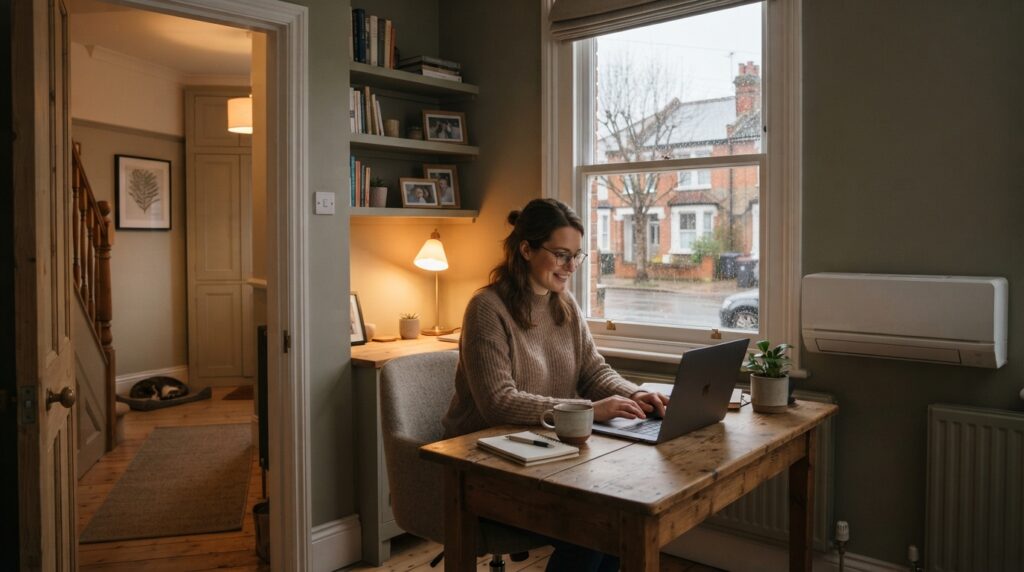
If you work from home alone during the day, firing the whole central heating system to keep one small room warm is usually the expensive option. The cheaper approach is turn the system down or off, heat one room, and close the door. Among electric options, a reverse-cycle heat pump beats every resistive heater on running cost — and it cools the same room in summer, which for a small, equipment-filled office is genuinely valuable. There’s also a legal minimum temperature worth knowing, and it applies to your own workspace too.
Working from home in a British winter creates a specific and slightly absurd problem: heating a four-bedroom house so one person can sit in a box room. Here’s how to do it properly.
The temperature you’re aiming for
Workplace guidance in the UK suggests a minimum of around 16°C for normal work, or 13°C where the work involves severe physical effort. That’s a floor, not a comfort target — for sedentary desk work most people want something closer to 18–21°C.
Worth knowing that being cold isn’t just uncomfortable: it affects dexterity, concentration and error rates. If you’re routinely working in a cold room, that’s a productivity cost as well as a comfort one.
Why heating one room usually wins
The maths is straightforward. Heat loss is roughly proportional to the surface area you’re keeping warm and the temperature difference across it. Heating one 10m² room instead of a whole house dramatically reduces the area you’re paying to heat.
Two caveats that matter:
Don’t let the rest of the house get properly cold. Unheated rooms develop cold surfaces, and moisture from the rest of the house condenses on them — which is why the unused spare room is so often the mouldy one. Keep other rooms ticking at a low background temperature rather than off entirely. Our condensation guide covers this.
If you have gas central heating, it may still be cheaper per unit of heat. Gas costs substantially less per kilowatt-hour than electricity in the UK. The winning move is often to use the central heating with TRVs turned right down everywhere except your office — not to abandon it. Our one-room heating guide covers the comparison.
Your computer is already a heater
Worth factoring in, because it’s larger than people expect. Electronic devices convert essentially all the electricity they consume into heat — a desktop PC drawing 80W idle plus two monitors at 25W each plus a router is putting well over 100W of continuous heat into the room.
In a small office that’s genuinely noticeable, and it’s why some home offices are the warmest room in the house by mid-afternoon despite having no heating on. Our electronics and room heat guide covers the numbers.
The practical implication: your office may need less heat than you assume once you’ve been working for an hour, and it may need cooling in summer well before the rest of the house does.
Do the cheap things first
- Close the door. Free, and the single biggest factor in whether heating one room works at all.
- Draught-proof the room. Under-door strip, window seals, and any service penetrations. Our draught-proofing guide covers it.
- Check the radiator works properly. A stuck TRV pin or air at the top is extremely common — our cold room guide covers the checks.
- Move your desk away from the window if you can. Glass is the coldest surface in most rooms, and sitting beside it means radiant heat loss from you to the glass.
- Close curtains behind you if the desk has to stay at the window.
- Put a rug down on a suspended timber or tiled floor. Cold feet make the whole room feel colder than it is.
The heating options, honestly compared
Resistive electric heaters — fan heaters, oil-filled radiators, convectors, halogen — all convert electricity to heat at essentially 100%, so at the same wattage they cost the same to run. Any claim that one type is “more economical” at the same wattage is describing heat distribution, not efficiency.
What differs is how you feel it. For desk work, a directional radiant heater warms you rather than the room, which can mean comfort at lower total energy use if you’re sitting still.
A reverse-cycle heat pump is the exception. It moves heat rather than generating it, so it delivers more heat energy than the electricity it consumes — the only electric option that beats the 100% ceiling. Our running costs comparison covers the physics and the cold-weather caveats.
The summer half of the argument
This is what tips the decision for a home office specifically.
A small room containing a person, a computer and two monitors, with the door closed, gets genuinely hot in summer — often before any other room in the house. Our quiet air conditioner guide covers the summer side, including the noise-on-calls problem.
So a reverse-cycle unit isn’t a winter purchase that sits idle for eight months. It’s the appliance that makes the room workable in both directions — which is a much better value proposition than a heater plus, later, a separate air conditioner.
The picks
ElectriQ Eco Silent 12000
Best year-round office unit
53 dB
A-rated
Heat pump
Reverse-cycle heating through winter, cooling through summer, on a single appliance with its own controls independent of the house system. A-rated efficiency across both. At 53 dB it’s quiet enough not to dominate calls, though see the positioning advice in our video calls guide. Suits rooms up to around 28m², which is generous for most home offices — worth it if the room doubles as anything else.
Pro Breeze 7000 BTU
Small office, cooling only
53 dB
~£296
~19p/hr
If your office already has a working radiator and the winter problem is solved, this handles the summer half at the lowest running cost of our picks. Right for a box room or small spare bedroom up to around 20m². Cooling only — it won’t heat.
Safety, briefly
Frequently asked questions
Can I claim heating costs against tax if I work from home?
There are HMRC rules for both employees and the self-employed, and they work differently — employees may be able to claim tax relief in certain circumstances, while the self-employed can apportion costs or use simplified flat rates. Check the current HMRC guidance linked below, or ask an accountant; the rules change and depend on your employment status.
Is 16°C really a legal minimum?
Workplace guidance suggests a minimum of around 16°C for normal work, or 13°C for physically demanding work. It’s guidance rather than a hard legal figure, and it applies to workplaces — but it’s a sensible reference point for your own workspace regardless.
What about a garden office or converted outbuilding?
Different problem — usually poorly insulated, no connection to the house system, and often a long cable run. Insulation matters far more there than the appliance does. A reverse-cycle unit is often the right answer once the fabric is sorted.
Should I heat the room before I start work or as I go?
Pre-heating for half an hour before you start, then holding a lower setting, is usually more comfortable than starting cold and chasing. A basic plug-in timer does this — our smart plugs guide covers the options.
Compare current prices, stock and reviews on heat pump air conditioners at Amazon UK.
Sources
- HSE — Temperature in the workplace (16°C guidance for normal work, 13°C for strenuous work)
- Energy Saving Trust — Thermostats and heating controls
- Energy Saving Trust — Draught-proofing
- Ofgem — Energy price cap (gas and electricity unit rates)
- Electrical Safety First — Portable heater safety
- HMRC / GOV.UK — Tax relief for working at home
Related reading: our video calls guide and one-room heating guide.