The Cheapest Way to Heat One Room in Winter (UK Guide)
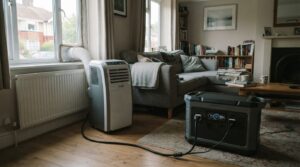
The genuinely cheapest option is the heat you don’t need to generate — draught-proofing and closing the door cost almost nothing and cut demand permanently. After that, if you have gas central heating, using it with the radiator valves turned down elsewhere is usually cheapest per unit of heat, because gas costs substantially less per kWh than electricity. Among electric options, a reverse-cycle heat pump beats every resistive heater, because it moves heat rather than generating it. All resistive electric heaters cost the same to run at the same wattage.
This question gets a lot of confidently wrong answers, so it’s worth working through properly. The short version is that the marketing distinctions between electric heater types are almost entirely meaningless for running cost — but there is one genuine exception, and it’s worth knowing about.
The rule that settles most of the argument
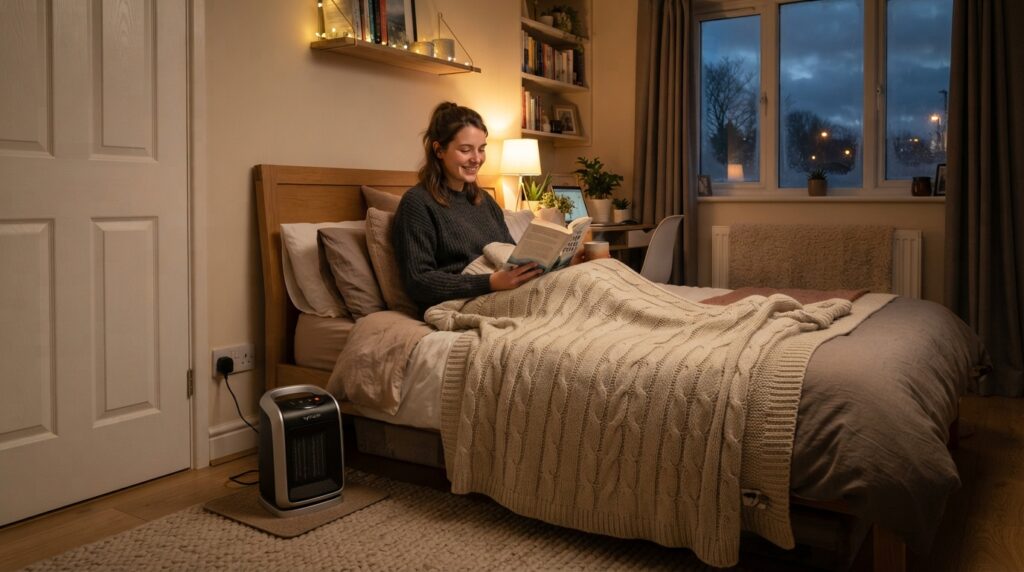
Every resistive electric heater converts electricity to heat at essentially 100%. A 2kW fan heater, a 2kW oil-filled radiator, a 2kW halogen heater and a 2kW convector all produce the same amount of heat for the same electricity and therefore cost exactly the same to run per hour.
This is physics, not a product comparison. Any claim that one type of resistive heater is “more economical” than another at the same wattage is describing something other than energy conversion — usually how the heat is distributed, or how quickly you feel it.
What genuinely differs between them:
- How fast you feel warm. A fan heater moves air, so you feel it in seconds. An oil-filled radiator takes twenty minutes to come up to temperature.
- How long it stays warm after switching off. Oil-filled radiators retain heat; fan heaters stop instantly.
- Directional vs ambient. A halogen heater warms objects and people in its line of sight quickly, which can mean comfort at a lower total energy use if you’re sitting still in one spot.
- Noise. Fan heaters are noisy; oil-filled radiators and convectors are near-silent.
- Thermostat and timer quality. This does affect cost, because a good thermostat stops the heater running when it doesn’t need to. It’s the one specification worth paying for.
The exception: heat pumps
A reverse-cycle heat pump breaks the 100% ceiling, because it isn’t converting energy — it’s moving it. Electricity runs the compressor and fans; the heat itself is extracted from outside air and delivered indoors.
That means it can deliver more heat energy than the electrical energy it consumes, expressed as a coefficient of performance above 1. No resistive heater can do this, at any price.
The practical consequence: for the same electricity cost, a heat pump mode warms a room more than a resistive heater of equivalent wattage. Our detailed running costs comparison covers the maths, and our guide to using an air conditioner as a heater covers how to tell whether a unit actually has the capability.
Gas central heating: usually still cheapest per unit
Worth being straightforward about this. In the UK, gas costs substantially less per kilowatt-hour than electricity — the exact ratio moves with the price cap, but gas has consistently been the cheaper fuel per unit of energy.
So if you have gas central heating, the cheapest way to heat one room is often to use it, with thermostatic radiator valves turned right down in rooms you’re not using and the room thermostat set sensibly. The objection — “but I’m heating the whole house” — is only partly true if the TRVs are actually managing the other rooms.
Where a standalone heater wins is when you’d otherwise fire the boiler for one room for a short period, or when the room in question is poorly served by the existing system. Our cold room guide covers that second case.
The free measures that beat every appliance
Genuinely the highest-value part of this article.
- Close the door. Obvious and routinely ignored. Heating one room with the door open means heating a hallway and stairwell that no portable appliance is sized for.
- Draught-proof. Under-door strips, letterbox brushes, gaps around frames, unused chimneys. Our draught-proofing guide covers the whole job. This is the cheapest permanent reduction in heating demand available to most households.
- Close curtains at dusk. Glass is the weakest thermal element in most rooms. Thermal or lined curtains, closed before the temperature drops, meaningfully reduce heat loss overnight.
- Move furniture off radiators. A sofa in front of a radiator absorbs the heat you’re paying for.
- Use a thermostat and timer properly. Heating an empty room is pure waste. A basic plug-in timer or smart plug costs very little — our smart plugs guide covers the options.
The picks
ElectriQ Eco Silent 12000
Most efficient electric option
53 dB
A-rated
Heat pump
The only category of electric appliance that beats a resistive heater on running cost, because it moves heat rather than making it. It also cools in summer, which is the real argument — you’re buying one appliance that works for most of the year rather than a heater that sits in a cupboard from March. Suits rooms up to around 28m². Higher upfront cost than a fan heater, recovered over seasons rather than weeks.
Choosing between resistive heaters, if that’s your budget
Since running cost is identical at the same wattage, choose on how you’ll actually use the room:
- Sitting still at a desk or in a chair: a directional halogen or radiant heater warms you rather than the room, which can mean comfort at lower total energy use.
- A room you occupy for hours: an oil-filled radiator with a decent thermostat — silent, steady, and retains heat after cycling off.
- Quick warmth in a room you’re in briefly: a fan heater. Noisy, but instant.
- Whatever you choose, get one with a real thermostat. A heater that runs flat-out until you switch it off costs far more than one that cycles to hold a temperature.
Heating one room vs heating the house
Heating a single occupied room is usually cheaper than heating a whole house, and for a household spending most evenings in one room it’s a sensible strategy.
Two caveats worth knowing. First, unheated rooms get cold and damp — condensation and mould tend to appear in the rooms you stopped heating, as covered in our condensation guide. Keeping unused rooms at a low background temperature rather than off entirely avoids most of that.
Second, cold homes carry real health consequences. Cold remains a larger cause of temperature-related mortality in England and Wales than heat. If cost is genuinely forcing you to under-heat, it’s worth checking what support is available rather than simply enduring it — Citizens Advice and the Energy Saving Trust both have current information on grants, discounts and payments.
Frequently asked questions
Are oil-filled radiators cheaper to run than fan heaters?
No, not at the same wattage — both convert electricity to heat at essentially 100%. Oil-filled radiators feel more economical because they retain heat and cycle off more, and because they’re usually lower wattage than fan heaters. That’s a distribution and thermostat difference, not an efficiency one.
Is it cheaper to leave heating on low all day?
Generally no. A house loses heat continuously in proportion to the temperature difference with outside, so keeping it warmer for longer means losing more heat overall. Heating when you need it, with a timer, is usually cheaper — with the exception noted above of keeping unused rooms at a low background temperature to prevent damp.
Do halogen heaters really cost pennies per hour?
They’re often lower wattage than other heaters, which is why the hourly figure looks small — a 1.2kW halogen costs less per hour than a 2kW convector because it uses less power, not because it’s more efficient. It also heats you directionally rather than heating the room, so it may not be comparable in outcome.
What about electric blankets?
Very low wattage, and they heat you directly rather than the air, so for sitting or sleeping they’re among the cheapest comfort options available. They don’t warm a room, so they’re a complement rather than a substitute. Follow the manufacturer’s safety guidance and replace old ones.
Compare current prices, stock and reviews on heat pump air conditioners at Amazon UK.
Sources
- Energy Saving Trust — Home appliances and energy use
- Energy Saving Trust — Air source heat pumps (COP and how heat pumps exceed 100% efficiency)
- Ofgem — Energy price cap (current gas and electricity unit rates)
- Electrical Safety First — Portable heater safety
- Citizens Advice — Grants and benefits to help pay energy bills
- ONS / BBC — Heat and cold related deaths in England and Wales
Related reading: our running costs comparison and draught-proofing guide.