Heat Pump vs Electric Heater: Which Is Actually Cheaper to Run?
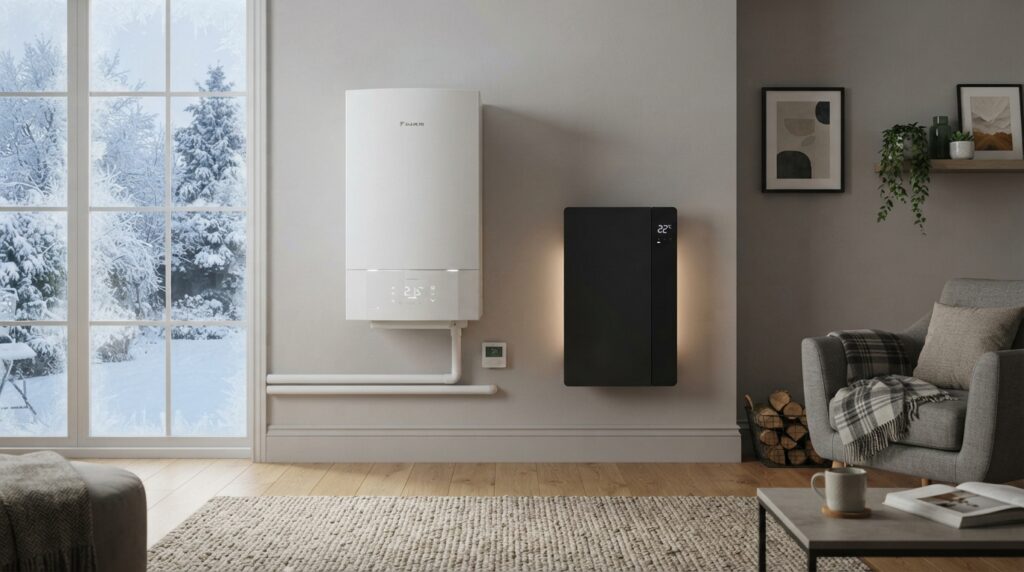
The heat pump, and it isn’t close on the physics. An electric heater is capped at one unit of heat per unit of electricity — that’s the theoretical maximum for any resistive heater, and every type hits it. A heat pump moves heat rather than generating it, so it routinely delivers several units of heat per unit of electricity. The caveats: efficiency falls as outdoor temperature drops, and the upfront cost is much higher, so payback depends on how much you actually use it.
This comparison gets muddled by marketing on both sides, so it’s worth working through the actual numbers and, more importantly, the actual limits.
The ceiling every electric heater hits
All resistive electric heating converts electricity to heat at essentially 100%. Not approximately — essentially all of the electrical energy ends up as heat in the room, because that’s what resistance does.
This applies identically to fan heaters, oil-filled radiators, convectors, halogen heaters, panel heaters and electric radiators. At the same wattage they cost the same to run and produce the same heat.
It also means 100% is the ceiling. No resistive heater can be more than 100% efficient, so no amount of product development or price premium buys you a cheaper-to-run electric heater. Anything claiming otherwise is describing heat distribution or thermostat behaviour, not energy conversion.
Why a heat pump breaks the ceiling
A heat pump isn’t a heater in the conversion sense. It’s a heat mover.
The refrigerant circuit absorbs heat from outside air — which contains usable thermal energy even when it feels cold — compresses it to raise its temperature, and releases it indoors. The electricity powers the compressor and fans. The heat itself is harvested, not manufactured.
Because you’re paying to move energy rather than create it, output can exceed input. This is measured as the coefficient of performance (COP): heat energy out divided by electrical energy in. A COP of 3 means three units of heat for one unit of electricity.
Compare that with a resistive heater’s COP of 1, by definition. That’s the whole comparison.
Where the real-world caveats bite
Three honest limitations, because the theoretical advantage doesn’t fully survive contact with a British winter.
COP falls as outdoor temperature falls. The colder the source air, the harder the compressor works for each unit of heat. Manufacturer COP figures are quoted at specified test conditions, typically milder than a UK cold snap. On a mild, damp winter day — likely most of this winter, given the storm-leaning outlook — performance is strong. In a hard frost, expect meaningfully lower output and efficiency.
Defrost cycles. In cold, humid conditions, frost can form on the outdoor-side coil. The unit periodically runs a defrost cycle, during which it isn’t heating your room. This is normal operation, not a fault, but it reduces average output in exactly the conditions where you want it most.
Portable units are less efficient than fixed systems. A portable heat pump has both coils inside one box, with air ducted through a hose. A fixed split system puts the outdoor coil genuinely outdoors, with far better airflow and no hose losses. A portable unit still beats a resistive heater comfortably; it doesn’t match a properly installed system.
What about gas central heating?
Worth addressing, because for most UK households it’s the actual alternative.
Gas costs substantially less per kilowatt-hour than electricity in the UK. The exact ratio moves with the price cap, but gas has consistently been the cheaper fuel per unit of energy delivered.
That means a gas boiler, despite being less efficient than a heat pump in energy terms, can still be cheaper per unit of useful heat, because the fuel is cheaper. Whether a heat pump beats it depends on the COP achieved versus the price ratio on the day.
Where a portable heat pump clearly wins is the specific case this site cares about: heating one room, especially one poorly served by the existing system, or when you’d otherwise fire the whole boiler for a single room. Our one-room heating guide covers that decision.
The upfront cost question
A resistive heater is cheap to buy and expensive to run. A heat pump unit is the reverse. Payback therefore depends entirely on usage.
The calculation that actually makes a portable heat pump worthwhile isn’t the winter one in isolation — it’s that the same appliance cools in summer. You’re comparing one unit that works most of the year against buying both a heater and an air conditioner separately. That’s the genuine value case, and it’s why we recommend buying in autumn or winter rather than spring.
The pick
ElectriQ Eco Silent 12000
Genuine reverse cycle
53 dB
A-rated
Heat pump
A genuine reverse-cycle heat pump rather than a resistive element bolted into an air conditioner — a distinction worth checking on any unit, since the marketing language is used loosely. A-rated efficiency, quiet enough for a living room at 53 dB, and enough capacity for spaces up to around 28m². Bought in autumn, it heats through winter and cools through summer, which is the arrangement that actually justifies the price difference over a fan heater.
How to work out your own numbers
- Find your electricity unit rate in pence per kWh — on your bill or in your app. Ofgem publishes current price cap rates.
- Find the appliance’s power draw in watts, from the rating plate or manual.
- Cost per hour = (watts ÷ 1000) × unit rate in pence.
- For a heat pump, divide by the COP to get cost per unit of heat delivered. This is the step that reveals the advantage — and use a realistic COP for cold weather, not the headline figure.
Our running cost guide works through the same method for cooling.
The measure that beats both
Worth ending here. The cheapest kilowatt-hour is the one you don’t need.
Draught-proofing, insulation, closing curtains at dusk and closing internal doors all reduce demand permanently, for far less money than either appliance. A heat pump heating a draughty room is still heating a draughty room. Our draught-proofing guide covers the highest-value jobs.
Frequently asked questions
Is a portable heat pump the same as an air source heat pump system?
No. Same underlying physics, very different scale and installation. A fixed air source heat pump heats a whole home and may qualify for government grant schemes; a portable reverse-cycle appliance heats one room and doesn’t. Don’t conflate the two when researching.
Do heat pumps work in UK winters at all?
Yes — they operate well below freezing, just less efficiently as it gets colder. Given this winter’s mild-and-stormy outlook, a portable unit is likely to spend most of the season in conditions where it performs well. Our cold snap guide covers when that might not hold.
Why does my “4-in-1” air conditioner not heat?
Because “4-in-1” usually means cool, fan, dehumidify plus something like sleep mode — not heat. Look for “heat pump” or “reverse cycle” explicitly, with a stated heating capacity. Our guide to using an AC as a heater covers how to check.
Does it need the hose fitted in heating mode?
Yes. In heating mode it expels cold air outside rather than hot, so the window kit stays fitted through winter — and needs to be sealed properly, since the indoor–outdoor temperature difference is often larger than in summer.
Compare current prices, stock and reviews on heat pump air conditioners at Amazon UK.
Sources
- Energy Saving Trust — Air source heat pumps (COP; how heat pumps exceed 100% efficiency; cold weather performance)
- Ofgem — Energy price cap (current gas and electricity unit rates)
- Energy Saving Trust — Home appliances and energy use
- GOV.UK — Boiler Upgrade Scheme (applies to installed systems, not portable appliances)
Related reading: our one-room heating guide and heat pump guide.