Quietest Air Conditioner for Video Calls and Working From Home (UK)
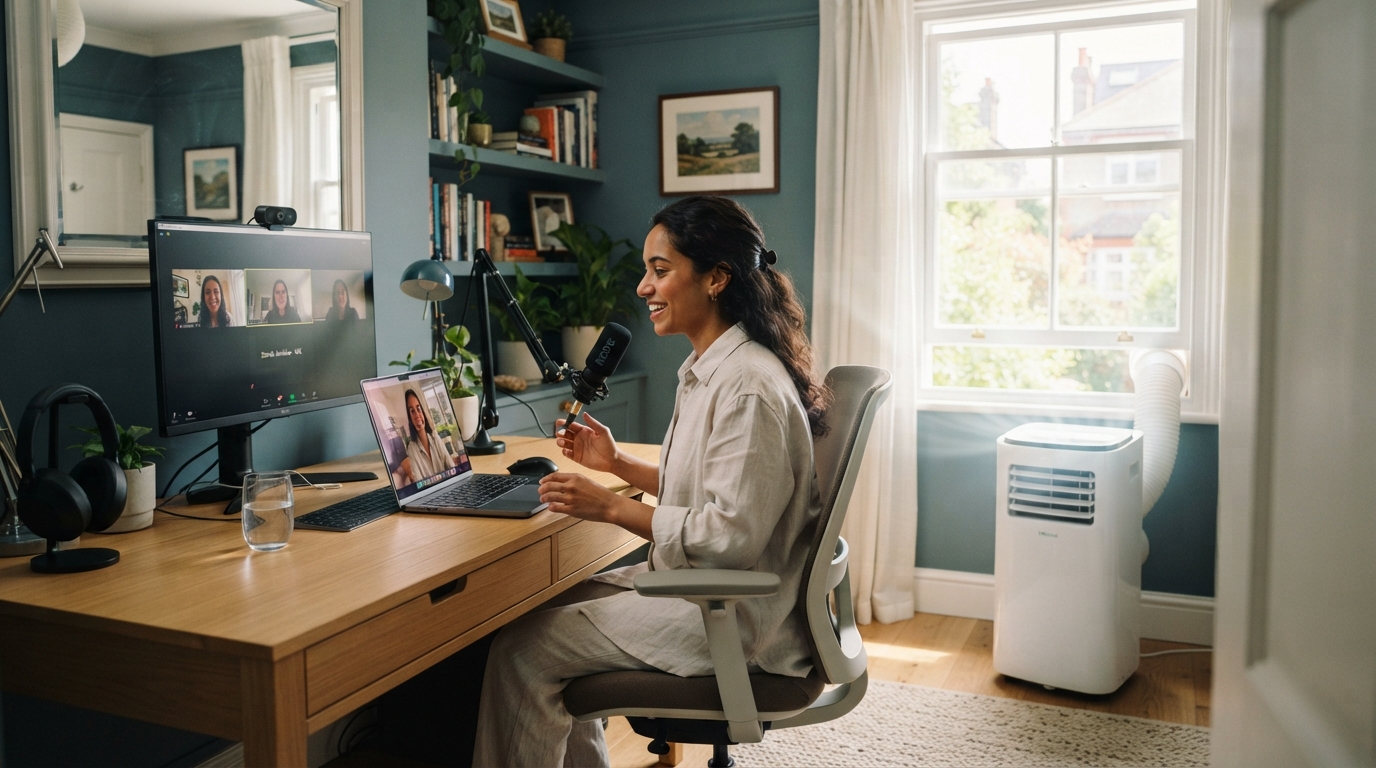
For working from home, the noise that matters most isn’t necessarily what you notice — it’s what the other people on your call hear through your microphone. A steady, consistent hum is far less disruptive on a video call than a compressor that cycles on and off every few minutes, because each restart is a fresh interruption other participants notice even if the overall volume isn’t that different. Look for a unit with a genuine quiet or eco mode you can switch to specifically during calls, check independent reviewer measurements rather than the manufacturer’s quoted decibel figure (which is often measured at the lowest fan speed, in ideal conditions), and consider a directional or noise-cancelling headset as a complementary fix — it won’t make the room quieter, but it can stop your mic picking up as much of whatever hum remains.
Cooling a home office is a genuinely different problem from cooling a bedroom or living room, because the bar isn’t just “not annoying” — it’s “doesn’t derail other people’s calls.” Here’s how to think about it properly.
Why cycling noise is worse than steady noise on a call
A compressor that runs continuously at a lower level produces a fairly consistent background hum, which most video-calling software is reasonably good at treating as steady background noise and partially suppressing. A unit that cycles on and off — running hard for a few minutes, stopping, then restarting — creates a much more noticeable pattern: a sudden increase in volume right as the compressor kicks back in, which is far more likely to make someone on the call stop and ask “sorry, what was that?” than a quieter but constant hum ever would. When comparing units, a genuinely low continuous noise level is usually more useful for this specific purpose than a slightly lower peak figure on a unit that cycles more aggressively.
Don’t fully trust the manufacturer’s decibel figure
Use quiet or eco mode deliberately, not just by default
Most portable air conditioners with a “quiet,” “sleep,” or “eco” mode reduce the fan speed and sometimes the compressor’s output to cut noise, at some cost to cooling power. For working from home, it’s worth treating this as a mode you switch into specifically before a call, rather than something you either always use or never use. Running at full power between calls to bring the room down to a comfortable temperature, then dropping to quiet mode for the 30 minutes you’re actually on camera, gets you both effective cooling and a quieter mic environment exactly when it matters.
If noise is genuinely your top priority
For some home workers, especially with back-to-back calls through the day, even a well-chosen, well-sized portable air conditioner’s cycling compressor is more interruption than they want to manage. If that’s you, it’s worth weighing a pedestal or tower fan for the hours you’re actually on camera, rather than active cooling — a fan produces a continuous, low hum with no cycling at all, which many people find easier to talk over on a call, even though it doesn’t lower the room’s actual temperature the way an air conditioner does. A common practical compromise is running the air conditioner on full power between calls to bring the room down, then switching to a fan alone, or the air conditioner’s quietest mode, just for the call itself.
Positioning matters as much as the unit itself
- Distance from your desk — noise falls off quickly with distance, so even a few extra feet between the unit and your microphone can make a real difference, more than switching to a marginally quieter model might.
- Which side faces your mic — if your desk setup allows it, positioning the unit so the exhaust or intake isn’t pointing directly at your microphone can reduce how much of the noise it actually picks up.
- A directional or noise-cancelling headset microphone is a genuinely useful complementary step — it won’t reduce the room’s actual noise level, but many are noticeably better at focusing on your voice and suppressing steady background hum than a laptop’s built-in microphone.
Sizing correctly also reduces noise
A unit that’s undersized for the room has to run harder, more of the time, to keep up — which generally means more noise, not less, even before you factor in a specific model’s quoted decibel rating. Getting the sizing right for your room, using a proper BTU guide rather than guessing, often does as much for reducing how often you hear the compressor working hard as choosing between two similarly rated units does. Our maintenance guide is also worth a look — a unit with a clogged filter or low refrigerant has to work harder for the same cooling, which tends to make it louder over time even if it started out reasonably quiet.
Frequently asked questions
Is a lower decibel rating always quieter in practice?
Not necessarily — manufacturer figures are usually measured at the lowest fan speed in ideal conditions, and don’t always reflect how the unit sounds when working harder in a genuinely warm room. Independent reviews and real owner feedback are generally more reliable.
Does cycling noise really matter more than steady noise on a call?
Generally yes — video-calling software tends to handle consistent background noise reasonably well, but a sudden change in volume when a compressor restarts is much more likely to be noticed and commented on by other participants.
Will a noise-cancelling headset solve the problem on its own?
It helps, but it’s a complementary fix, not a substitute for a reasonably quiet, well-sized unit positioned sensibly relative to your desk. It reduces how much background hum your microphone picks up; it doesn’t make the room itself quieter.
Sources
- Health and Safety Executive — Noise at work
- Energy Saving Trust — Keeping your home cool in summer
Related reading: our maintenance guide and running cost guide.
Compare current quiet-mode portable air conditioners at Amazon UK.