Cooling a Garage or Workshop: What Works and What Doesn’t
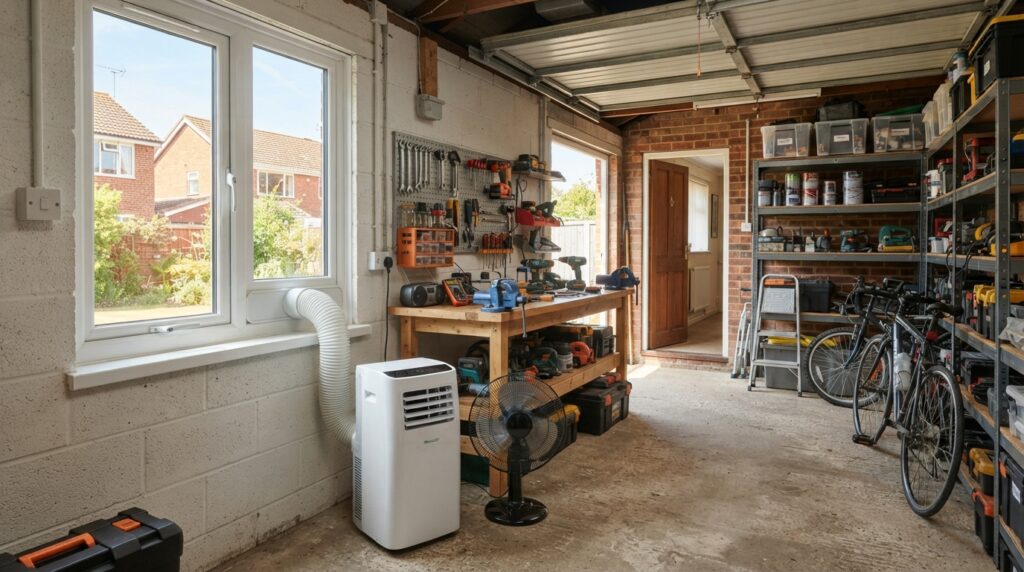
Garages are thermally awful — uninsulated walls, a concrete floor, a thin roof, and usually a large metal door facing the sun. That door is frequently the single biggest heat source, and insulating it is often worth more than any cooling equipment. Venting is the easy part here, unlike in a house: a wall vent or an existing opening is usually straightforward, and nobody minds how it looks. The thing that decides your approach is whether the garage still holds a vehicle, fuel or a boiler, because that changes what you can safely do about ventilation.
Workshops, home gyms, hobby spaces and garden offices in converted garages all share this, and it’s one of the few situations where a portable unit is straightforward to install.
Why a garage heats up so badly
- Little or no insulation in walls, roof or door. Most garages were built as somewhere to park, not somewhere to be.
- A large metal or GRP door, often facing the sun. Metal conducts heat readily and a sun-facing up-and-over door becomes a radiator by mid-afternoon.
- A thin or flat roof with minimal build-up, taking the full solar load. Our flat roof guide covers why upward-facing surfaces are the worst case.
- A concrete floor, which helps a little with thermal mass but also produces condensation.
- Poor ventilation, particularly with the door shut for security.
Do these before buying anything
1. Insulate the door
The highest-value intervention, and frequently overlooked. Insulation kits exist for up-and-over and sectional doors, and fitting one is usually a straightforward afternoon.
It works in both directions — the same insulation that keeps summer heat out keeps winter cold out, which matters if you use the space year-round.
2. Insulate the roof and walls if you can
Bigger job, bigger payoff. If you’re converting the garage properly this is part of that work anyway.
3. Ventilate
Get hot air out and cooler air in. A wall-mounted extractor fan is inexpensive and permanent, and in a garage nobody cares that it’s visible.
4. Shade the door and any windows
A shade sail, an awning, or anything that keeps direct sun off a metal door makes a noticeable difference for very little money.
Venting a portable unit — the easy bit
This is where a garage beats a house. Your options are genuinely good:
- A permanent wall vent — core-drilled, with an external grille and backdraught flap. Tidy, permanent, and seals far better than any window kit. In a garage there’s rarely an aesthetic objection.
- An existing window, with a cut panel.
- An existing air brick position, if it isn’t doing a ventilation job you need.
- Through the door itself, if it’s a side-hinged door you can fit a panel into.
Our seal kits guide covers making a panel, and our windowless room guide covers wall vents in more detail.
If you rent or it’s a leasehold property, drilling an external wall needs written permission — our renter’s guide and leasehold guide cover that.
The electrical point
Sizing
Standard guidance of roughly 500–600 BTU per square metre assumes an insulated room. A garage needs more, and how much more depends on:
- Whether the door and roof are insulated
- Whether the door faces the sun
- What you’re doing in there — a person working hard, a treadmill motor, or welding equipment are all substantial heat sources
- How much ventilation you’re maintaining for safety
Our BTU sizing guide covers the adjustments. If it’s a home gym specifically, our gym guide covers the occupant heat load, which is larger than people expect and continuous.
The picks
MeacoCool MC Series 9000 (MC9000)
Sized for a single garage
16–26m²
53 dB minimum
A-rated
Meaco publish this as suitable for 16–26m², which covers a typical single garage with capacity to spare — and spare capacity matters more here than in a bedroom, because an uninsulated space keeps gaining heat. A-rated, with a dehumidify mode that earns its place in a garage, and castors so you can push it aside when you need the floor.
Good for: a converted single garage used as a workshop, gym or office; anyone who wants documented specifications rather than a marketplace listing.
Less good for: a large double garage, or an uninsulated one with a sun-facing door — insulate first or it will run continuously without winning. It also takes floor space and needs the hose routed, which in a tight workshop is a real consideration. And it won’t help with winter damp, since compressors need a room temperature above roughly 16–18°C to work properly.
A desiccant dehumidifier
Often the real answer
Runs year-round
Protects tools
Frequently the more useful purchase, because in a UK garage the complaint is more often damp than heat — rust on tools, condensation on a concrete floor, a musty smell. Desiccant rather than compressor is the key point: compressor dehumidifiers lose performance below roughly 15°C, and an unheated garage spends most of the year below that. Look for a humidistat so it cycles, and a continuous drainage option so you’re not emptying a tank.
Good for: protecting tools, machinery and stored items from corrosion; clearing the damp smell; running unattended year-round.
Less good for: cooling — it does the opposite, emitting a small amount of heat. Welcome in January, unwelcome in July. This complements cooling rather than replacing it. Our dehumidifier guide covers choosing one.
Where an evaporative cooler genuinely works
A garage is one of the few UK situations where these make sense — provided the door is open.
They cool by evaporating water, which adds humidity. With the door up and good airflow, that moisture disperses and you get a useful effect for a fraction of a compressor’s power draw. In a sealed garage they’re counterproductive, adding moisture to a space that already has a damp problem.
Our comparison covers when they work and when they don’t.
If you’re converting the garage properly
Converting a garage into habitable space is generally building work requiring Building Regulations approval — covering insulation, ventilation, fire safety and structure. It may also need planning permission depending on the property, and there are additional restrictions if it’s listed or in a conservation area.
Done properly, the space is insulated to current standards and most of this article becomes unnecessary. It also improves the room above, if there is one — our room above a garage guide covers why that room is such an outlier.
Frequently asked questions
Should I insulate or buy cooling first?
Insulate the door first. It’s usually cheaper than the equipment, it works in both seasons, and it reduces the load so a smaller unit is enough. Buying a big machine to fight an uninsulated metal door is the expensive route.
Can I run it with the garage door open?
An air conditioner, no — you’d be cooling the street. An evaporative cooler, yes, and it needs the airflow. If you need the door open for safety reasons because a vehicle or fuel is stored there, that points you toward a cooler or a fan rather than air conditioning.
Why do my tools rust in there?
Humidity, not temperature. A concrete floor and poor ventilation produce condensation on cold metal. A desiccant dehumidifier running between visits is the fix, and it’s cheap to run compared with the cost of replacing tools.
Does a garage need planning permission for a wall vent?
Usually not for a detached domestic garage, but check if the property is listed, in a conservation area, or leasehold. Our heritage guide covers those cases.
Sources
- GOV.UK — Approved Document F: Ventilation
- GOV.UK — Approved Document P: Electrical safety
- GOV.UK — Approved Document B: Fire safety
- Planning Portal — Garage conversion
- Gas Safe Register — Carbon monoxide safety
- Electrical Safety First — Overloading sockets
- Energy Saving Trust — Home appliances and energy use
Related reading: our home gym guide and dehumidifier guide.
Compare options at Amazon UK. For a garage, size up from the floor-area figure and consider whether a dehumidifier addresses the actual complaint.