Air Conditioning in a Listed Building or Conservation Area
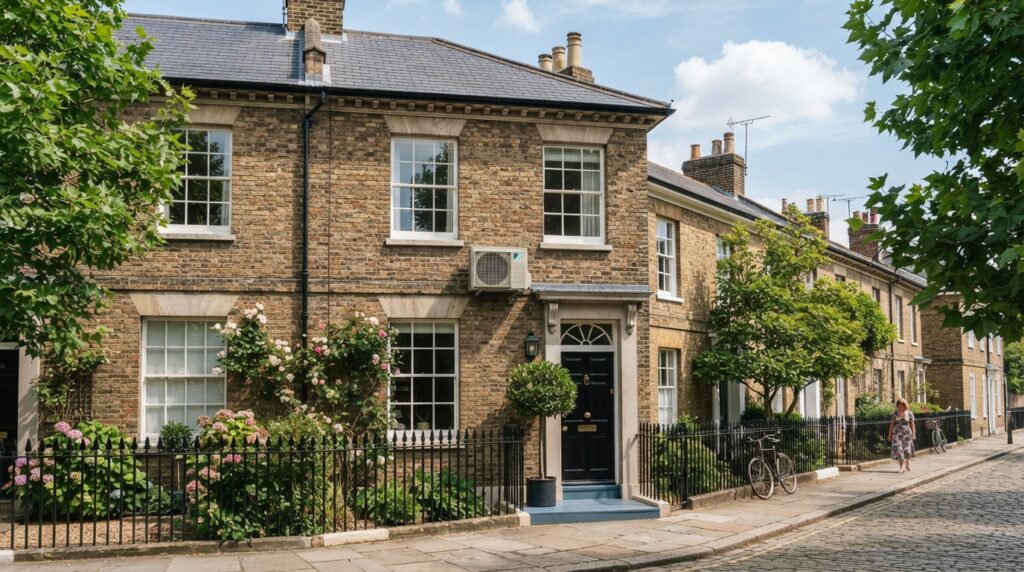
A portable unit vented through an existing opening window needs no consent anywhere — you’re not altering the building. Everything else depends on which category you’re in. Listed buildings have no permitted development rights for this: you need planning permission and, separately, Listed Building Consent, and approval is far from guaranteed. Conservation areas generally retain permitted development rights but with an extra condition — the outdoor unit must not go on a wall or roof fronting a highway. And an Article 4 Direction can remove those rights entirely, anywhere.
Around half a million buildings in England are listed, and conservation areas cover a great deal more. If you’re in one, the rules are genuinely different — and the penalties for getting it wrong are unusually serious.
First: establish which category you’re actually in
People frequently confuse these. They’re separate designations and can overlap.
- Listed building — the individual building is on the national list for its special architectural or historic interest. Graded I, II* or II in England and Wales. Protection covers the whole building, inside and out, plus objects and structures fixed to it and often those within its curtilage.
- Conservation area — an area designated for its special character or appearance. Protects the character of the area rather than each building’s interior.
- Article 4 Direction — a council can use one to remove specified permitted development rights in a defined area. Common in conservation areas but can apply anywhere.
- Locally listed — a non-statutory local designation. Doesn’t carry the same legal force but is a material planning consideration.
How to check yours: Historic England’s National Heritage List for England is searchable by address. Conservation area boundaries and Article 4 Directions sit with your local planning authority — ask them, or check their online mapping. All linked in the sources below. Do this before anything else; it takes ten minutes and determines everything that follows.
If your building is listed
Permitted development rights do not apply for this kind of external alteration. You will generally need:
- Planning permission, and
- Listed Building Consent — a separate application, considering the impact on the building’s special interest
Both are needed. One doesn’t substitute for the other.
What conservation officers typically care about:
- Visibility. Anything visible from a public vantage point is scrutinised hardest.
- Penetration of historic fabric. Core-drilling through a solid historic wall is a permanent loss of original material, and that is exactly what listing exists to prevent.
- Reversibility. Proposals that can be removed later, leaving the building as found, are received far better than permanent ones.
- Cumulative harm. Small interventions add up across a building’s life.
- Routing of pipework and cabling internally, which can be as contentious as the external unit.
What tends to help a case: siting on a modern extension rather than the historic core; using existing openings rather than making new ones; a discreet rear location; a genuinely quiet unit; and early informal engagement with the conservation officer before you submit anything.
If you’re in a conservation area (but not listed)
Better news. Permitted development rights generally still apply, with an additional restriction: the outdoor unit must not be installed on a wall or roof that fronts a highway.
“Highway” in planning terms is broader than people assume — it includes public roads, footpaths and bridleways. So a rear or side elevation is usually the answer, and corner plots with two highway-facing elevations have fewer options.
The standard permitted development conditions still apply on top of that — size, siting relative to boundaries, and noise. We’re deliberately not quoting a volume threshold here, because the published sources we checked contradicted one another and none was the legislation itself. Get the current figure from the Planning Portal or your local planning authority rather than a blog. Ours included.
Article 4 Directions
Worth checking specifically, because it’s the one that catches people who’ve correctly established they’re not listed and have found a rear wall.
An Article 4 Direction removes permitted development rights in a defined area. If one applies to your property, you need planning permission regardless of size, siting or property type.
Some councils apply them broadly across whole conservation areas; others target specific streets or specific rights. There’s no way to know without asking your local planning authority.
A Lawful Development Certificate is worth the money
If you conclude your installation is permitted development, you can apply to the council for a Lawful Development Certificate confirming that in writing.
It isn’t compulsory, and it costs a fee. But in a conservation area it’s genuinely worth having: it removes the risk of an enforcement dispute later, and it’s a document your buyer’s solicitor will be glad to see when you sell. Given how much confusion exists in this area, paying for certainty is reasonable.
What you can do without any consent
The practical route for most people in heritage properties:
- A portable unit vented through an opening window. Nothing is fixed or altered, so no consent arises. Our sash window guide covers sealing the awkward window types common in period homes — that’s usually the real challenge.
- Fans and dehumidifiers.
- Internal blinds and curtains, though on a listed building be careful about fixing into historic joinery, and check whether the window dressings themselves are covered.
- Loft insulation, in most cases — though on a listed building even this can require consent, and old buildings need to breathe. Take advice specific to traditional construction rather than applying modern-house assumptions.
The passive measures, which are usually the better answer anyway
Period buildings often have advantages worth using before reaching for machinery:
- Thick solid walls have real thermal mass, which moderates temperature swings.
- Shutters, if the building has them, are extremely effective — they were designed for exactly this and predate air conditioning by centuries.
- Tall sash windows allow excellent purge ventilation when opened top and bottom, driving a convection current.
- High ceilings let warm air rise away from occupants.
- External shading — where acceptable in heritage terms, awnings on a rear elevation may be viewed more favourably than a condenser. Our shading guide covers effectiveness.
Frequently asked questions
Does listing cover the inside of my house?
Yes. Listing protects the whole building, including interiors, and often objects and structures fixed to it or within its curtilage. That’s why internal pipework routing for a split system can need consent too.
My neighbour has a unit on their listed building. Doesn’t that set a precedent?
Not reliably. They may have consent you don’t know about, or they may have installed unlawfully. Each application is judged on its own merits, and an existing unauthorised installation nearby doesn’t help your case.
What if the previous owner installed it without consent?
Take advice. Options may include applying for retrospective consent or indemnity insurance, but the position on listed building offences is more serious than for ordinary planning breaches. This is a solicitor question, not a blog question.
Are the rules the same across the UK?
No. Listed building and planning systems differ between England, Wales, Scotland and Northern Ireland, including terminology and grading. The relevant bodies are Historic England, Cadw, Historic Environment Scotland and the Department for Communities in Northern Ireland.
Would a water-cooled or ducted system avoid the problem?
Systems without an external condenser are sometimes proposed in heritage contexts for exactly that reason. They bring their own requirements and costs, and internal routing may still need consent. Worth raising with a heritage-experienced installer and your conservation officer together.
A portable unit vented through an existing window avoids all of this. Compare current prices, stock and reviews at Amazon UK.
Sources
- Historic England — National Heritage List for England (check if your building is listed)
- Historic England — Energy efficiency in traditional buildings
- GOV.UK — Listed buildings and conservation areas: planning guidance
- Planning Portal — Listed buildings
- Planning Portal — Do you need permission? (current permitted development conditions)
- GOV.UK — When is permission required? (Article 4 Directions, Lawful Development Certificates)
- Cadw — Cadw (Wales) · Historic Environment Scotland — HES (Scotland)
Related reading: our sash window guide and installation law guide.