Cooling a Home Gym or Garage Gym
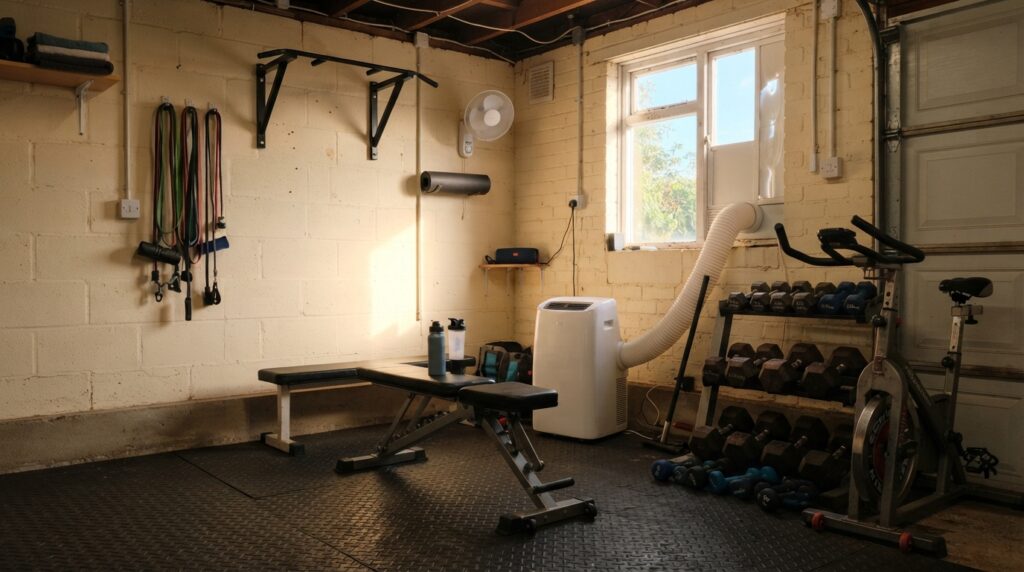
A home gym has a heat load nothing else in the house does: you are the heat source, and a person working hard produces several hundred watts of it continuously. Add a garage or outbuilding with minimal insulation and no ventilation, and the space heats far faster than its size suggests. The two things that matter most are air movement — a fan does more per pound here than anywhere else in the house, because you’re sweating and evaporation is doing the work — and ventilation, because moisture has to go somewhere or you’ll get condensation on your equipment.
Why a gym is a special case
You’re the heat source
Most rooms are heated by the sun and by appliances. A gym is heated by its occupant. A person working hard produces heat continuously and at a rate that matters — several hundred watts, comparable to a small heater, and it doesn’t stop when the room reaches temperature.
That’s why a gym feels hot far faster than its size predicts, and why sizing a cooling unit on floor area alone underestimates the requirement.
You produce a lot of moisture too
Sweat, and heavy breathing, both add water to the air. In a sealed garage that humidity has nowhere to go.
Two consequences. First, rising humidity makes evaporative cooling less effective, so your body’s own cooling gets worse exactly as you need it most — which is the mechanism in our “feels like” guide. Second, moisture condenses on cold surfaces and on metal, which is bad for equipment and produces the musty smell familiar to anyone with a garage gym.
Garages are thermally awful
Most are uninsulated, with a large metal or timber door, a concrete floor, and often a flat or shallow roof. In summer a metal up-and-over door in afternoon sun becomes a radiator. In winter the same space is barely above outside temperature.
Our guide to rooms above garages covers why these spaces behave the way they do.
What to do, cheapest first
1. A fan — the highest value item here
More effective in a gym than almost anywhere else in the house, because you’re sweating. Moving air accelerates evaporation from skin, which is the body’s main cooling route during exercise.
A fan removes no heat from the room, but it substantially improves how you feel and how well you regulate. Point it at yourself, not at the room. Our fan explainer covers the mechanism, and our ceiling fan piece covers the fixed option if your ceiling has height.
2. Ventilation
Open the door or window while you train, wind permitting. You need moisture and heat to leave, and a sealed garage prevents both.
If security or noise makes an open door impractical, an extractor fan is a permanent solution and not expensive. Note that fixed electrical work is notifiable under Part P of the Building Regulations in England and Wales — a registered electrician can self-certify.
3. Shade and insulate the door
A sun-facing metal garage door is often the single biggest heat source in the space. Insulating it — kits exist for up-and-over and sectional doors — helps in both seasons, and it’s usually a straightforward job.
4. Train at the right time
Free, and effective. Early morning is when the space is coolest and hasn’t yet absorbed the day’s heat. Late evening works too, though a garage releases stored heat for hours after sunset.
Air conditioner or dehumidifier?
A genuine question here, because the complaint is often humidity rather than temperature.
An air conditioner removes heat and reduces humidity as a by-product. It’s what you want if the space is genuinely too hot to train in. It needs somewhere to vent the exhaust hose, which in a garage is often easier than in a house — a wall vent, an existing opening, or a window.
A dehumidifier removes moisture but adds a small amount of heat. It’s the right tool if the problem is condensation on equipment, a musty smell, or rust on weights — and it can run when you’re not there. For an unheated garage specifically you want a desiccant model, since compressor dehumidifiers lose performance below roughly 15°C. Our dehumidifier guide covers the distinction, and our dry mode comparison covers why an air conditioner can’t do this job in winter.
Plenty of garage gyms end up with both: an air conditioner for summer sessions, a dehumidifier running year-round to protect the equipment.
Sizing, if you go for cooling
The standard guidance of roughly 500–600 BTU per square metre is a floor, not an answer, for a gym. Adjust upward for:
- The occupant heat load — this is the big one, and it’s continuous
- Poor or absent insulation, which most garages have
- A large sun-facing door
- Equipment — a treadmill motor is a meaningful heat source in a small space
- More than one person training
Our BTU sizing guide covers working through the adjustments. Undersizing here is the common mistake, because people size on floor area and forget they’re standing in the middle of the heat load.
MeacoCool MC Series 9000
Sized for a single garage
16–26m²
53 dB minimum
A-rated
Meaco publish this as suitable for rooms of 16–26m², which covers a typical single garage with room to spare for the occupant heat load — and having spare capacity matters more here than in a bedroom, because the heat keeps arriving as long as you’re training. A-rated, with a dehumidify mode that’s useful in a damp garage, and castors that make it easy to move aside when you need the floor space.
Good for: a converted single garage or a spare room gym; anyone who trains through summer and has somewhere to vent the hose.
Less good for: noise-sensitive situations — at a 53 dB minimum it’s audible, though in a gym that matters less than in a bedroom. It also takes up floor space and needs the hose routed somewhere, which in a tight garage is a real consideration. And it won’t help with winter damp, since compressors need a room temperature above roughly 16–18°C to work properly.
A desiccant dehumidifier
Protects the equipment
Runs year-round
Adds slight warmth
The answer to rust, condensation and the musty smell rather than to heat. Desiccant rather than compressor, because an unheated garage spends most of the year below the temperature at which compressor models work well. Look for a humidistat so it cycles rather than running constantly, and a continuous drainage option if it’ll live somewhere you won’t empty a tank.
Good for: protecting weights, bars and machines from corrosion; clearing the damp smell; running unattended between sessions.
Less good for: cooling. It does the opposite — it adds a small amount of heat, which is welcome in January and unwelcome mid-session in July. This is a complement to cooling, not a substitute.
Practical points specific to garages
- Check the electrical supply. Many garages run off a single spur not designed for a high-current appliance. A treadmill plus an air conditioner on the same circuit can approach its limit — our electrical safety guide covers checking, and don’t run either through an extension lead.
- Never block ventilation serving a fuel-burning appliance or a space where a vehicle or fuel is stored. If there’s a boiler in the garage, its air supply is doing a safety job, and a CO alarm is worth fitting regardless.
- Dust and rubber flooring shed particles that clog filters faster than in a normal room. Expect to clean the filter more often than the manual suggests.
- Condensation on a concrete floor is a slip hazard as well as a damp problem. Rubber matting helps with both.
- If you’re converting the garage properly, that’s building work needing Building Regulations approval — and insulating it at that point solves most of this permanently.
Frequently asked questions
Is a fan enough on its own?
For many people, most of the time, yes — evaporative cooling from moving air is doing most of the work during exercise. It stops being enough when the space is so hot that the air itself is close to skin temperature.
Can I use an evaporative air cooler in a garage?
This is one of the few places they make sense, because a garage with the door open is well ventilated enough for the added humidity to disperse. In a sealed garage they’re counterproductive — you’d be adding moisture to a space that already has too much. Our comparison covers when they work.
What temperature should a home gym be?
Cooler than a living room, because you’re generating heat. There’s no official figure — go by how you feel, and prioritise air movement and ventilation over hitting a number.
My weights are rusting. Is that the air conditioner’s fault?
No — that’s ambient humidity, and an air conditioner reduces it when running. A dehumidifier running between sessions is the fix, since the problem happens when nobody’s there.
Sources
- NHS — Heat exhaustion and heatstroke
- NHS — Heatwave: how to cope in hot weather
- Meaco Dehumidifiers — MeacoCool MC9000 specifications (room size, noise, energy class)
- GOV.UK — Approved Document P: Electrical safety
- GOV.UK — Approved Document F: Ventilation
- Planning Portal — Garage conversion
- Gas Safe Register — Carbon monoxide safety
Related reading: our spare room guide and dehumidifier guide.
Related guides


Compare current prices, stock and reviews on portable air conditioners at Amazon UK. Prices and stock move fast in a heatwave, so it is worth checking before you commit.
Browse air conditioners →