Best Air Conditioner for a Home Office or Loft Conversion
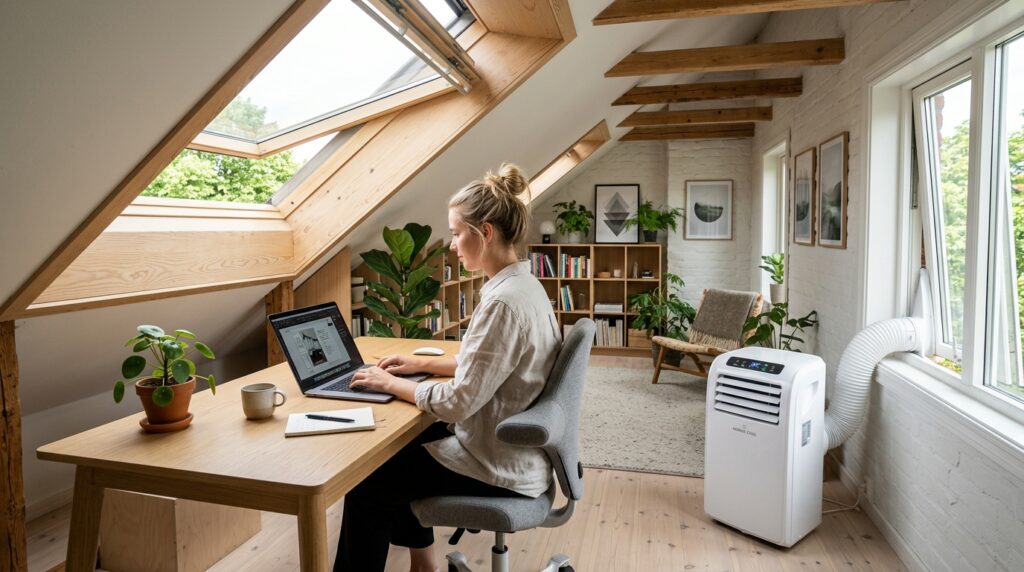
For a working room, noise is the buying criterion, not capacity — a unit you have to switch off during every call isn’t cooling anything. Check the published decibel figure and the fan speed it was measured at, because a figure quoted without that tells you very little. For loft conversions specifically, size up from the floor-area figure: a loft room takes heat down from the roof all afternoon, often has limited insulation depth between rafters, and sits at the top of the house where warm air collects. It’s the hottest room in most homes for structural reasons, and a unit sized to its square metres will lose.
Two rooms with different problems, often the same room. Here’s what each needs.
Why loft conversions are the hottest room in the house
Three things compound:
Roof heat. The roof takes the full solar load all day and radiates it downward into the room below. In an unconverted loft that heat has space to sit; in a conversion it’s in your room.
Limited insulation depth. Insulation between rafters is constrained by the rafter size, which is usually far less than the depth you’d put in a loft floor. There’s a physical limit to what can be fitted.
Stack effect. Warm air rises through the house and collects at the top. Our stack effect guide covers the mechanism, and a loft room is the end of that chain.
Add a roof window — glass facing upward is the worst possible orientation for solar gain, taking sun from mid-morning to late afternoon regardless of which way the house faces. Our skylight guide covers what to do about it, and an external awning blind is the single most effective intervention available.
Why a home office is different
Even in a normal room, a home office generates its own heat load continuously:
- You. A person at rest produces a steady output of heat, all day, in one room.
- Equipment. A desktop, two monitors, a docking station, a printer and a router add up to a meaningful continuous load — more than most people estimate. Our standby guide covers the figures.
- The door is usually shut for quiet, which traps all of it.
- You’re there at the hottest part of the day, unlike a bedroom.
Noise: the criterion that actually decides it
More important here than anywhere except a bedroom, and the thing to check before capacity.
- Check which fan speed the decibel figure refers to. Units are considerably louder at full speed than at their advertised minimum, and a figure quoted without the speed is close to meaningless. Where a manufacturer publishes a specific quiet-mode figure, that’s the number that matters.
- Independent measurements differ from manufacturer figures. Trusted Reviews measured 58.5 dB fan-only on the Meaco Pro 9000 against a published 52 dB low-fan figure. Not a scandal — test conditions differ — but worth knowing that the published number is a floor, not a ceiling.
- Compressor cycling is the intrusive part. A unit clicking in and out mid-sentence is more disruptive on a call than a slightly louder one running steadily. Correct sizing reduces cycling.
- Position it behind you, not between you and the microphone.
- Use a directional or noise-cancelling microphone if calls are constant — this often does more than changing the air conditioner.
Our quiet operation guide covers this in depth.
Sizing
Roughly 500–600 BTU per square metre is the starting point. Adjust up for:
- A loft room, or any room under an uninsulated or shallow-insulated roof
- A roof window or skylight
- A west or south-facing aspect
- A desktop computer and multiple monitors
- A high or sloped ceiling — size on volume, not floor area
Our BTU sizing guide covers the calculation. Undersizing is the standard mistake in loft rooms.
Venting
Work this out before buying. Loft rooms frequently have only a roof window, and venting through one is awkward — the hose has to rise, which fights the unit, and sealing a sloped opening is difficult.
A gable-end window is much better if the room has one. If it doesn’t, a permanent wall vent may be the answer — our windowless room guide covers that, and our seal kits guide covers making a panel.
The picks
MeacoCool MC Series Pro 9000
Best for a working room
16–26m²
52 dB low fan
A-rated, R290
Meaco publish a 52 dB figure on the low fan setting, a 16–26m² room range, an A energy rating and R290 refrigerant, with a two-year warranty and app control. The app matters more in an office than elsewhere — you can start it cooling before you go up, which beats sitting in a hot room for an hour waiting.
Good for: a home office where calls are frequent; loft rooms up to the stated range; anyone who wants to pre-cool remotely.
Less good for: anyone expecting silence. Trusted Reviews measured 58.5 dB fan-only in independent testing, above the published low-fan figure — still usable on calls with a decent microphone, but it’s an audible appliance in a quiet room. It’s also a mono-block with the compressor inside, so a fixed split system will always be quieter if that’s an option. And in a loft room with an unshaded roof window it may struggle regardless of size — shade first.
MeacoCool MC Series 7000
For a small study
Small rooms
UK support
Meaco describe this as the smallest and most budget-friendly model in the range, for small home and office spaces. In a genuinely small box-room study, right-sizing means it cycles rather than running flat out, which is both cheaper and quieter in practice than an oversized unit clicking on and off.
Good for: a small study or box room with a normal ceiling and no roof glazing; anyone on a tighter budget who still wants documented specifications.
Less good for: a loft conversion, almost always. The additional roof heat load means a room that measures small still behaves like a larger one, and this will run continuously without catching up. Check Meaco’s current published room-size range before buying, and if you’re near the top of it, size up.
MeacoCool MC Series 9000 CH
Works in winter too
8,000 BTU heating
16–26m²
R290
Worth considering for an office specifically, because a room you work in every day has a problem in both directions — loft rooms are frequently cold in winter for the same insulation reasons they’re hot in summer. The MC Series manual publishes cooling and heating outputs separately, which many “4-in-1” listings don’t.
Good for: a year-round working room; anyone who’d otherwise run an electric heater in winter, since a heat pump delivers more heat per unit of electricity than a resistive heater.
Less good for: deep winter as a sole heat source. Output falls as outside temperature drops. Note the heating figure is lower than the cooling figure — if winter is your main concern, size on the heating number, not the headline.
Do the free things first
- Shade the window from mid-morning, before the room heats. For a roof window, an external awning blind does several times more than any internal blind, because it stops the energy outside the glass.
- Check the loft insulation in any remaining accessible loft space — our loft guide covers checking with a ruler.
- Purge ventilate overnight, then shut up in the morning. Our timing guide covers judging it.
- Switch off equipment you’re not using.
- Work earlier if you can, and move somewhere cooler for the worst two hours.
If you’re employed rather than self-employed
Worth knowing, and almost never mentioned. Your employer’s health and safety duties extend to homeworkers — HSE publishes specific guidance on protecting home workers covering the working environment.
There is no maximum legal working temperature in the UK, so quoting a number won’t get you anywhere. What exists is the duty to assess and control risk. Practical asks that employers often agree to: flexible hours to avoid the afternoon, a fan or contribution toward cooling, or working from an air-conditioned office on the worst days.
Our workplace temperature guide covers the legal position properly. If you’re self-employed, our business expense guide covers the questions to put to an accountant.
Frequently asked questions
Will it be audible on video calls?
Probably, at some level. A decent directional or noise-cancelling microphone matters as much as the unit’s rating. Running it on low during calls and higher between them is what most people settle on.
Is a fixed split system worth it for an office?
If you work from home permanently, it’s quieter indoors, more efficient and doesn’t occupy floor space. It costs considerably more and needs a certified installer — our installation law guide covers what’s involved.
My loft room is unbearable even with air conditioning. What now?
Shade the roof window externally, and check what insulation is actually in the roof. A unit fighting continuous solar gain through unshaded upward-facing glass is fighting a losing battle regardless of capacity.
Can I claim it against tax?
Depends entirely on your employment status and how the room is used. That’s an accountant question — our business expense guide covers what to ask.
Sources
- Meaco Dehumidifiers — MeacoCool MC Series Pro 9000 specifications
- ManualsLib — MeacoCool MC Series manual (CH cooling and heating outputs)
- Trusted Reviews — MeacoCool MC Series Pro 9000 review (independent noise measurement)
- HSE — Protecting home workers
- HSE — Workplace temperature FAQs
- Energy Saving Trust — Roof and loft insulation
- GOV.UK — Approved Document O: Overheating
Related reading: our skylight guide and quiet operation guide.
Compare current specifications at Amazon UK. For a working room, check the decibel figure and the fan speed it was measured at before capacity.