Can You Claim Air Conditioning as a Business Expense If You Work From Home?
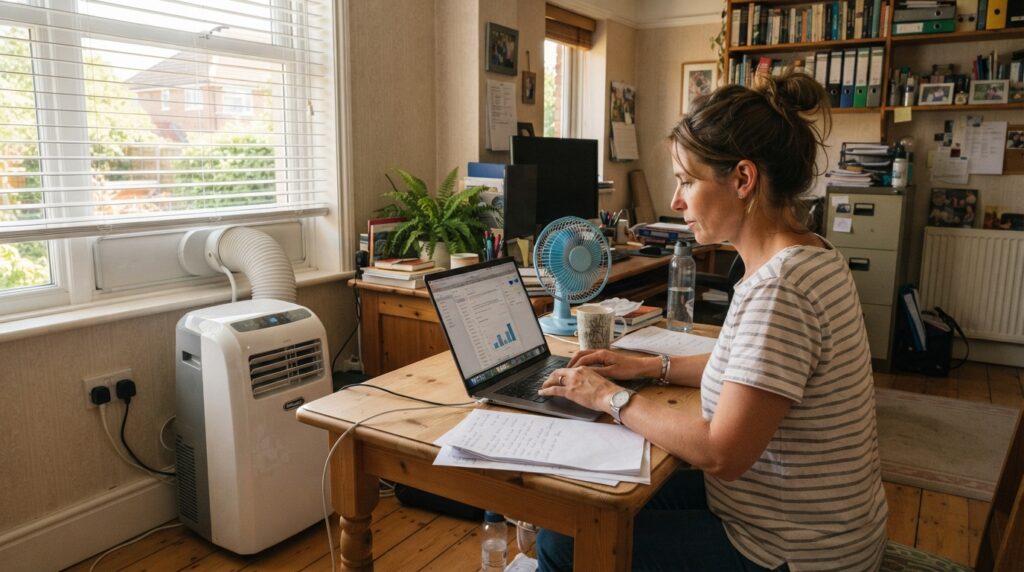
It depends heavily on three things: whether you’re a sole trader or working through a limited company, whether the item is genuinely used for business, and whether there’s private use — which for something in your house there almost always is. The general principle running through UK business expense rules is that costs must be incurred wholly and exclusively for the purposes of the trade. A machine cooling a room your family also uses isn’t that, which usually means apportionment rather than a full claim, if a claim is available at all.
This comes up a lot now that home working is normal, and the answers online are frequently wrong or out of date. Here’s how to think about it properly.
Your employment status changes everything
Start here, because the rules genuinely differ.
Employees working from home
If you’re employed and work from home, the rules on what you can claim are considerably tighter than most people expect — and generally tighter than they are for the self-employed.
There are provisions covering additional household costs for employees required to work from home, but eligibility conditions apply and they’ve changed in recent years. Equipment provided by your employer is treated differently again from equipment you buy yourself.
The practical first step: ask your employer. Many will provide or contribute toward equipment for a home workspace, particularly where there’s a health or safety dimension — and an employer has duties regarding your working environment under health and safety law. That’s a better route than a tax claim.
Sole traders
You’re running a business, so business expenses are deductible in calculating profit — subject to the “wholly and exclusively” test.
For a portable air conditioner used in a home office that’s also part of your home, you’re into apportionment: identifying the proportion of use that’s genuinely for the business. HMRC accepts apportionment on a reasonable basis for many household costs.
There’s also a simplified expenses regime for self-employed people working from home, using flat rates based on hours worked. It’s simpler, but it covers a defined set of costs — worth checking whether it would give you a better or worse outcome than apportioning actual costs, and whether you can switch.
Limited companies
More complex, and the area where people most often get it wrong.
If your company buys equipment that you then use personally, there are potential benefit in kind implications for you as an employee or director — which can create a personal tax charge and a National Insurance cost for the company. That can easily outweigh the corporation tax saving.
There are also considerations around whether the company has a formal agreement to use part of your home, and what that means for the property itself.
This is genuinely accountant territory. The interaction between company purchases, benefits in kind and personal use is not something to work out from a blog.
Capital versus revenue: the distinction that matters
A concept worth understanding before you speak to anyone, because it shapes the whole conversation.
- Revenue expenditure — day-to-day running costs. Electricity to run the unit would fall here.
- Capital expenditure — buying an asset that lasts. The air conditioner itself.
These are treated differently. Capital items may be dealt with through capital allowances rather than deducted as a straightforward expense, and the treatment differs again depending on whether you use cash basis or traditional accounting.
A fixed installation raises a further question, because something permanently installed in a building may be treated differently from a portable appliance you could carry out of the door. That’s another reason the portable-versus-fixed decision has consequences beyond comfort.
The questions to actually ask your accountant
Take this list. It’ll make the conversation efficient.
- Given how I’m structured, is this capital or revenue?
- What proportion of business use could I reasonably claim, and how should I evidence it?
- If I’m on simplified expenses, would apportioning actual costs be better, and can I switch?
- For a limited company: would this create a benefit in kind, and does the tax saving survive that?
- Does it change if the unit is in a dedicated office room used only for work?
- Am I registered for VAT, and if so what’s the position on input tax given private use?
- Would a fixed installation be treated differently from a portable unit?
- Does any of this affect Capital Gains Tax private residence relief if part of my home is used exclusively for business?
That last one catches people out. Using part of your home exclusively for business can affect the relief available when you sell. It’s a reason many advisers suggest ensuring rooms have some domestic use — which in turn affects the expense claim. The two pull against each other, which is exactly why it needs someone looking at your whole position.
Keep the records regardless
Whatever the answer, this costs you nothing and makes any claim defensible:
- Keep the invoice, showing date, supplier and amount.
- Note the business rationale at the time — for instance, that a room was unusable for work above a certain temperature.
- Record the basis of any apportionment you use, and be consistent year to year.
- Keep energy bills if you’re apportioning running costs.
- Note the room’s use — hours worked, and whether it has domestic use too.
HMRC’s expectation is that you can support what you’ve claimed. Contemporaneous notes are far more persuasive than a reconstruction two years later.
The practical side: is it worth it anyway?
Worth stepping back from the tax question.
Even at a full deduction, you’re recovering a fraction of the cost — you’re reducing taxable profit, not getting the money back. So the purchase needs to make sense on its own terms first.
On that: a home office that’s unusable in July is a genuine business problem. Cognitive performance falls in overheated rooms, and if you’re self-employed, hours you can’t work are income you don’t earn. That argument stands whether or not the tax treatment is favourable.
Our home office cooling guide covers specifying a unit for a working room — noise matters more than most people expect if you’re on calls, which our video calls guide covers in detail. And our winter home office guide covers the other half of the year.
If you’re an employee, try this first
Before any tax question:
- Ask your employer. Many have equipment budgets or will contribute, and an overheating workspace is a reasonable thing to raise.
- Raise it as a working environment issue if the room is genuinely unworkable. Employers have health and safety duties toward homeworkers, and HSE publishes guidance on this.
- Check whether your employer has a homeworking policy — many written since 2020 include equipment provisions people never read.
Frequently asked questions
Can I just claim the whole cost if it’s in my office room?
Not usually, unless the room and the equipment are used exclusively for business and there’s genuinely no private use — which is a high bar for something in your home. And exclusivity brings its own Capital Gains consequences. Take advice.
What about the electricity to run it?
Running costs are a different question from the purchase, and are generally handled either through simplified expenses flat rates or by apportioning actual household costs. Our running cost guide shows how to calculate what yours actually uses, which you’d need either way.
Does it matter if it’s portable or fixed?
Potentially yes, for both tax treatment and practicalities. A fixed installation is a more permanent alteration to the property, needs an F-Gas certified installer, and may need permissions — our installation law guide covers that side.
Where’s the authoritative guidance?
HMRC’s own pages, linked below. Their manuals are more detailed than the general guidance and are publicly available, though they’re written for professionals. For anything beyond the straightforward, an accountant is worth the fee — the cost of getting this wrong exceeds the cost of asking.
Compare current prices, stock and reviews on portable air conditioners at Amazon UK. Keep the invoice — you’ll want it whatever the tax treatment turns out to be.
Sources
- GOV.UK — Expenses if you’re self-employed
- GOV.UK — Simplified expenses if you’re self-employed
- GOV.UK — Capital allowances
- GOV.UK — Tax relief for employees: working at home
- GOV.UK — Expenses and benefits: homeworking (employers)
- HMRC — Business Income Manual (wholly and exclusively, apportionment)
- HSE — Protecting home workers
- ICAEW — Find a chartered accountant
Related reading: our home office cooling guide and running cost guide.