Cooling a Caravan, Motorhome or Campervan: What Actually Works
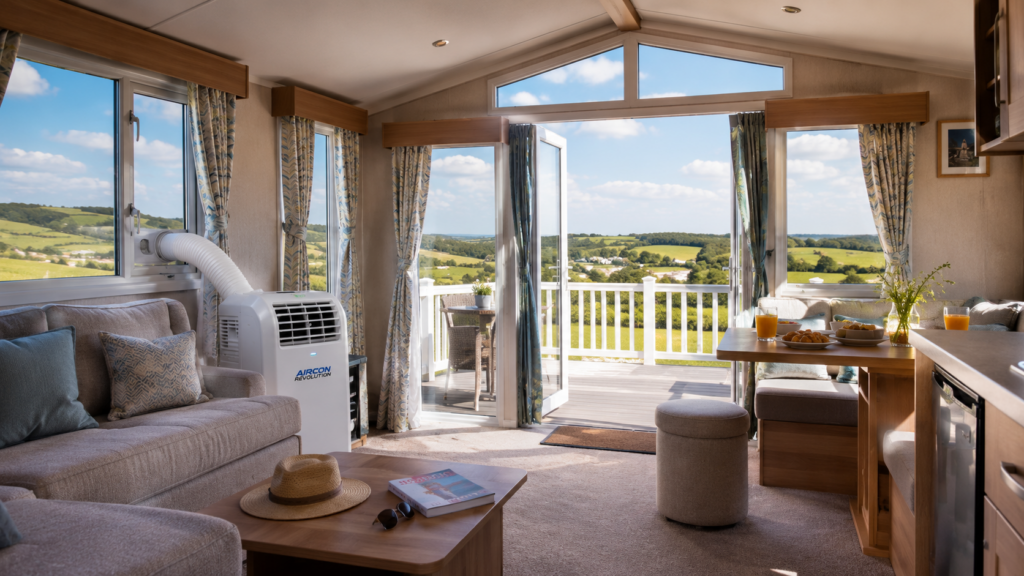
Everything here comes down to where the power is coming from, and that decision should come before any product decision. On a site with a 230V electric hook-up, a domestic portable unit or a rooftop system both work — but check the pitch’s amp limit first, because caravan hook-ups are frequently limited and a compressor will trip a low-rated bollard. Off-grid, air conditioning is genuinely demanding: compressors draw more than most leisure battery setups can sustain, and this is where honest expectations matter more than product choice. For many people, a 12V fan plus reflective window covers plus proper ventilation is the realistic answer, and it works better than people expect.
Vehicles heat up far faster than houses — thin walls, large windows, a metal or GRP roof and almost no thermal mass. Here’s how to think about it.
Start with the power question
This determines everything else, so settle it first.
230V hook-up on a site
The easiest situation, but not unlimited.
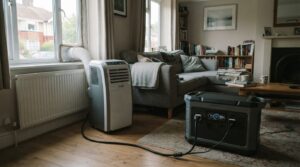
Off-grid on leisure batteries
Be realistic here, because this is where people spend money badly.
A compressor-based air conditioner is one of the most power-hungry things you can run. To work out what you’d get: take the unit’s running wattage, divide your usable battery capacity in watt-hours by it, and reduce by 10–15% for inverter losses. Most leisure setups give you an hour or two at best, and that assumes the battery started full.
You’d also need an inverter rated for both the continuous draw and the startup surge — the surge rating is the one people miss, and an inverter that handles the running load will still cut out when the compressor kicks in.
Our battery power guide works through the arithmetic in full.
Generator
The four approaches
1. A domestic portable unit
Works on hook-up, and it’s the cheapest route because you may already own one.
The practical problems in a vehicle: it’s heavy and takes floor space you don’t have, it needs the hose vented somewhere, and it produces condensate that has to drain. Venting through a window with a cut panel is usually the answer — our seal kits guide covers making one.
Also worth knowing: most portables specify a minimum room size, tied to the refrigerant charge. A small caravan interior may fall below it. Check the manual — our R290 guide explains why that figure exists and why it isn’t arbitrary.
And it must travel secured and, ideally, upright. Our moving guide covers why laying one down matters.
2. A rooftop air conditioner
The purpose-built option, fitted into a roof vent aperture. Frees floor space, vents properly, designed for the application.
What to check before committing — and these are questions for the manufacturer and an installer rather than a blog:
- Roof loading. These are heavy and sit high. Your vehicle has a payload limit and a roof loading limit, and exceeding either is both unsafe and potentially an insurance issue.
- Added height. It changes your overall height. Know your new figure and put it somewhere you’ll see it — low bridges and height barriers are unforgiving.
- Power requirement. Most rooftop units are 230V and need hook-up. Confirm the running and startup figures.
- Aperture compatibility with your existing roof vent.
- Warranty and insurance. Tell your insurer about any modification, and check whether a self-fit affects the vehicle warranty.
- Noise. On a quiet site at night, this matters to you and to your neighbours.
We’re not naming specific models here, because we can’t verify current specifications against manufacturer documentation to the standard we’d want on a purchase this significant. Speak to a caravan or motorhome dealer who fits these regularly — they’ll know what suits your vehicle and can tell you the real installed weight and power draw.
3. A 12V DC air conditioner
A genuinely different product category, designed for vehicles and boats rather than adapted from domestic use. Running on DC avoids inverter losses, which makes off-grid use more viable than with a domestic unit.
They’re typically installed rather than plugged in, and they’re a specialist purchase. If you’re serious about off-grid cooling, this is the category to investigate — with a supplier who knows vehicle electrical systems.
4. Fans and passive measures
The honest answer for a lot of people, and far more effective in a vehicle than in a house.
- Reflective window covers — external ones especially. A vehicle’s windows are a huge proportion of its surface, and stopping solar gain outside the glass beats removing heat afterwards. This is the single highest-value thing you can do.
- Park facing the right way and use available shade, remembering the sun moves.
- Roof vents open, with a low window or door open too — that combination drives a convection current. A powered roof vent fan draws a fraction of what a compressor does and can run all night on leisure batteries.
- 12V fans aimed at people, not at the space. Our fan explainer covers why that distinction matters.
- An awning, which shades the side of the vehicle as well as giving you somewhere cooler to sit.
- Cook outside. A hob in a small interior is a substantial heat source.
What about an evaporative cooler?
Better suited here than in a house, with a condition: it only works with good ventilation.
These cool by evaporating water, which adds humidity. In a sealed vehicle that builds up fast and makes things feel worse, as well as encouraging condensation and damp in a space that’s already prone to it. With the roof vent open and a window cracked, on a dry day, they do something useful and draw far less power than a compressor.
Our comparison covers the physics.
Reflective external window covers
Highest value per pound
Works off-grid
Stops gain outside
The thing we’d buy first for any vehicle. External covers stop solar energy before it passes through the glass, which is fundamentally more effective than any internal blind — once radiation is inside, an internal cover absorbs it and radiates that heat into the space. Look for covers made for your specific model where possible, since fit determines how well they work.
Good for: every situation, on-grid or off; keeping the interior usable during the day; and they work in winter too, reducing heat loss and condensation on the glass.
Less good for: convenience — external covers take a few minutes to fit and remove each time, they can be awkward in wind, and they block the view entirely. Internal thermal blinds are quicker but meaningfully less effective.
A 12V fan
Runs all night off-grid
No venting
Works anywhere
A 12V fan draws a tiny fraction of what a compressor does, so it will run overnight on leisure batteries without difficulty. It removes no heat, but moving air increases evaporation from your skin, so you feel cooler at the same temperature — and in a small space that’s often enough. Look for a stated current draw so you can work out runtime, and a secure mounting so it isn’t rolling around while you drive.
Good for: off-grid nights, wild camping, and anywhere hook-up isn’t available; pairing with an air conditioner on hook-up so you can set a warmer temperature.
Less good for: genuinely hot, still conditions. Evaporative cooling from moving air becomes less effective as air temperature approaches body temperature, and a vehicle interior can exceed that on a hot afternoon. In those conditions the answer is shade and ventilation, not a faster fan.
Static caravans and park homes are different
If it’s permanently sited with a proper mains supply, you’re much closer to a domestic situation — a standard portable unit vented through a window is usually straightforward. Our park home guide covers that case, including site rules and what the park operator may need to approve.
Safety in a small space
- Fit a CO alarm if there’s any fuel-burning appliance — a gas hob, a heater, or a generator anywhere nearby. Non-negotiable in a vehicle.
- Never block ventilation. Vehicles have fixed vents that are there for combustion safety and condensation control. Don’t tape them over to keep cool air in.
- Secure everything for travel. A 30kg unit loose in a motorhome during braking is a serious hazard.
- Check your hook-up lead is in good condition, correctly rated and fully unwound. A coiled cable reel under load overheats inside the drum.
- Watch condensate. Water pooling in a vehicle causes damp and rot, and vehicles are prone to it anyway.
Frequently asked questions
Can I run air conditioning off my leisure battery?
For a short period with a substantial battery bank and a suitably rated inverter, yes. For a full night, realistically no with most setups. Do the watt-hour arithmetic before buying rather than after — our battery guide covers it.
Will a rooftop unit affect my insurance?
Tell your insurer about any modification. It also changes your vehicle height and weight, both of which matter. Check the payload and roof loading figures before committing.
Are air conditioners allowed on campsites?
Usually, but noise rules and amp limits vary. Ask the site. Generators are frequently restricted or banned outright.
Why does my caravan get so much hotter than my house?
Thin walls, minimal insulation, a large glazed area relative to floor space, and almost no thermal mass to flatten the daily swing. It heats fast and cools fast, which is why shading and ventilation matter more than they do in a house.
Sources
- Electrical Safety First — Extension leads (cable reels under load)
- HSE — Carbon monoxide in the home
- GOV.UK — Fluorinated gases (F-gases): rules
- NHS — Heatwave: how to cope in hot weather
- Met Office — UK weather warnings
Related reading: our narrowboat guide and battery power guide.
Compare options at Amazon UK. Work out your power situation first — pitch amp rating, or battery capacity and inverter surge rating — before choosing anything.