Best Air Conditioner for a Park Home or Static Caravan UK
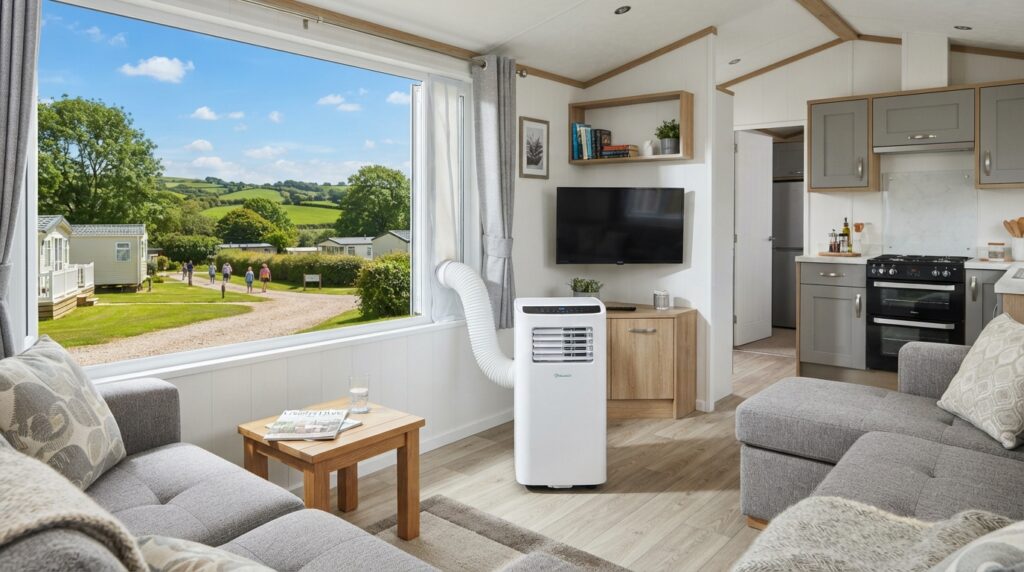
Park homes and static caravans heat up fast because they’re lightweight — the Centre for Sustainable Energy notes many park homes are built from thin plywood without much insulation, so they’re hard to heat in winter and keep cool in summer. That makes a unit that heats as well as cools the best value if you live in one year-round. Before buying, do two checks. First, your site rules and agreement: LEASE, the government-funded advice service, says you’ll often need the site owner’s consent for alterations, so a split system is out without permission. Second, your power supply: if you’re on a pitch hook-up, it may be limited to 16A or even 10A, so choose a unit with a modest power draw. A portable unit around 9,000 BTU with a heat mode, such as the MeacoCool MC Series Pro 9000 CH, suits most living areas.
If you live in a park home, summer heat isn’t an occasional inconvenience. A lightweight home on a sunny pitch can become the hottest place you spend time, and it cools down less at night than you’d hope. This guide is for people who live in a park home or spend long stays in a static caravan. If you’re touring, our caravan and motorhome cooling guide is the better fit.
Why they heat up faster than a house
A brick house has heavy walls that soak up heat during the day and release it slowly. A park home or static caravan doesn’t. The Centre for Sustainable Energy describes park homes as often made from thin plywood without much insulation, losing a lot of heat through the walls in winter and able to get hot in summer. The same lightweight structure that lets the sun heat the inside quickly also means there’s little to buffer it. The good news is the reverse is also true: once you start cooling, the space responds quickly.
Check the site rules before buying
This is the step that catches people out. According to LEASE’s park home advice, before making alterations or improvements to your pitch or the outside of your home you’ll often need the site owner’s consent, and you should check whether your agreement says you need their written permission. Doing work without permission could put you in breach of your agreement, even if the work seems minor. The site owner can’t impose a blanket ban on improvements, and you may also need planning permission for external alterations. The site rules for your park form part of your agreement too.
Residential park home or holiday static?
LEASE explains that a park home site must have a site licence allowing permanent residential living. Licences marked “holiday use only”, “seasonal occupation only” or “11-month occupancy only” mean the home isn’t meant to be lived in all year. It matters here because if you’re on a holiday site you may only use the caravan in the warmer months, and a cooling-only unit might be enough. If you live there year-round, a unit that also heats earns its keep for far more of the year.
Check your power supply
How much power you can draw depends on how your home is supplied. If it’s on a pitch hook-up of the kind used on caravan parks, the limits are tighter than most people expect. The Caravan and Motorhome Club says site supplies in the UK are usually 10 amps and sometimes 5 amps or less, and that a 16 amp supply suits a total load of about 3 kW. The Camping and Caravanning Club puts it bluntly: even 16 amps is barely more than a single household wall socket. At 230V, a 10 amp supply is only around 2.3 kW in total.
Going over the limit trips the breaker, and as the Caravan and Motorhome Club points out, that usually happens at the site’s supply point rather than inside your home. So add up what runs at the same time — an air conditioner, a kettle, a microwave — and pick a unit whose power draw leaves room for everything else. If you’re not sure what your supply is, ask the site owner. Our guides to an air conditioner tripping the power and extension leads cover the rest.
Sizing
Size for the room you actually want to cool, not the whole home. Check the manufacturer’s stated room size against your measured room: the two picks below cover 10–20 m² and 16–26 m² respectively. Because a lightweight home gains heat quickly on a sunny afternoon, lean towards the upper end of the range for your room size rather than the bottom. Our BTU calculator explains how glazing, orientation and insulation change the figure.
Why older residents need to take this seriously
The picks
MeacoCool MC Series Pro 9000 CH
Cools in summer, heats in winter
1,005W cool / 940W heat
52–54 dB
16–26 m²
Based on Meaco’s specifications, this single-duct unit cools at 9,000 BTU and heats at 8,100 BTU, drawing a rated 1,005W when cooling and 940W when heating. That’s a manageable load even on a restricted supply, provided you don’t run a kettle and microwave alongside it on a 10A pitch. It’s A-rated for both cooling and heating, uses R290 refrigerant, and has app control, a sleep mode and a 1–24 hour timer. For a park home that’s cold in winter and hot in summer, one appliance doing both jobs is the point.
Good for: living rooms and larger bedrooms; year-round use; restricted power supplies where every watt counts.
Less good for: very small rooms, where it’s more than you need. It’s single-duct, so seal the window gap well, and Meaco doesn’t state which setting its noise figure applies to.
Pro Breeze 7000 BTU 3-in-1
Lowest power draw for a bedroom
750W rated input
10–20 m²
Class A, R290
Pro Breeze lists this as a 7,000 BTU, Class A unit with cooling, dehumidifying and fan modes, a sleep mode and a timer. Its manual gives a rated cooling input of 750W and an applicable area of 10–20 m², which makes it a good fit for a static caravan bedroom where the power supply is tight. It doesn’t heat, so it suits holiday statics used in the warmer months, or a bedroom in a park home that’s heated another way.
Good for: small bedrooms; the tightest power supplies; summer-only static caravans.
Less good for: year-round living, as there’s no heat mode. Its manual lists 65 dB on high, so use low or sleep mode at night.
The passive measures that work unusually well here
Because a lightweight home responds so quickly to the sun, shading it makes a bigger difference than it would to a brick house.
- Shade the windows from outside where the site allows. Awnings and external blinds stop heat before it reaches the glass — check site rules first. See our external shading guide.
- Consider reflective window film on the sunniest windows. Our window film guide explains what it does and doesn’t achieve.
- Ventilate at the right times: closed and shaded during the day, opened up when it’s cooler outside in the evening.
- For the long term, ask about a heat pump. The Centre for Sustainable Energy suggests air-to-air heat pumps for park homes, since they provide heating in winter and cooling in summer. That’s a fixed installation, so it needs the site owner’s written consent and an F-gas qualified installer.
Frequently asked questions
Do I need permission to install air conditioning in a park home?
For anything fixed to the outside of the home or the pitch, very likely. LEASE says you’ll often need the site owner’s consent for alterations and should check whether your agreement requires written permission. A portable unit used inside is much less likely to need it, but check your site rules.
Will an air conditioner trip my pitch electricity?
It can if you run too much at once. The Caravan and Motorhome Club says UK site supplies are usually 10 amps, and a 16 amp supply suits about 3 kW in total. Choose a unit with a modest power draw and avoid running it alongside a kettle or microwave.
What’s the best air conditioner for living in a park home year-round?
A unit that heats as well as cools gives the best value, because park homes are often hard to keep warm in winter as well as cool in summer. For a fixed solution, the Centre for Sustainable Energy recommends air-to-air heat pumps.
Sources
- LEASE Park Homes — Alterations and improvements
- LEASE Park Homes — Site licences and conditions
- Centre for Sustainable Energy — Park homes
- Caravan and Motorhome Club — Mains electrical installation
- Camping and Caravanning Club — Electricity
- GOV.UK — Selling F gas or equipment
- UKHSA — Heat mortality monitoring report, England: 2025
- Meaco — MeacoCool MC Series Pro 9000 CH
Related reading: our caravan and motorhome cooling guide, portable versus split system guide and heat pump air conditioner guide.
Compare the MeacoCool MC Series Pro 9000 CH at Amazon UK.