Why Does Turning Off a Fan Make a Room Suddenly Feel So Much Hotter?
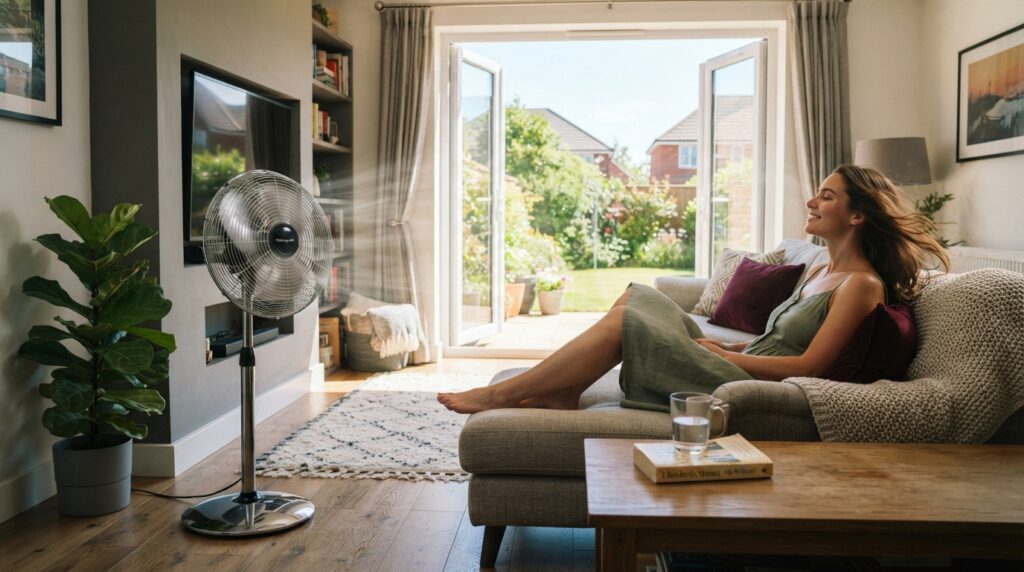
Because the fan never cooled the room in the first place — it cooled you. A fan moves air across your skin, sweeping away the thin layer of warm, damp air that sits against it and helping sweat evaporate. The room’s temperature barely changes. The moment you switch it off, that warm layer re-forms within seconds, evaporation slows, and you suddenly feel the room as it really is. That’s also why a fan has limits: it only helps while the air is cooler than your skin, which is normally around 32–34°C. UKHSA and the NHS both advise using fans when the air is below 35°C. An air conditioner is different: it removes heat and moisture from the room itself, so the room stays cooler after it stops.
Almost everyone has had this experience on a hot night: the fan’s been running for an hour, you turn it off to get some quiet, and within a minute the room feels stifling. It feels as though the room heated up instantly. It didn’t. What changed was how quickly your body was losing heat.
What a fan does, and doesn’t do, to a room
A fan is just a motor turning blades. It doesn’t remove any heat from the room — in fact the motor adds a small amount. What it does is move air. Moving air matters to your body for two reasons.
- It strips away the warm layer next to your skin. In still air, a thin layer of air sits against your skin, warmed by your body and dampened by sweat. It acts like a very light blanket. Moving air keeps replacing it with room air.
- It speeds up sweat evaporation. Evaporation is how your body loses heat when the air is warm. Moving air carries moisture away from the skin so more sweat can evaporate.
Neither of those changes the thermometer on the wall. They change how fast heat leaves you. That’s the key to everything else.
Why switching it off feels so abrupt
When the fan stops, the warm, humid layer against your skin rebuilds almost immediately, and evaporation drops sharply. Your body goes from losing heat quickly to losing it slowly, all at once. Your skin’s temperature sensors register that change as the room getting hotter, even though the air temperature is the same as it was a minute before.
The important limit: when a fan stops helping
If moving air cools you by carrying heat away, it only works while the air is cooler than you are. Once the air is hotter than your skin, blowing more of it at you starts to add heat rather than remove it, and the only cooling left is sweat evaporation.
Official UK guidance draws the line at 35°C. UKHSA’s “Beat the heat” advice says to use electric fans if the air temperature is below 35°C, and not to aim the fan directly at your body, as this can lead to dehydration. The NHS says the same: electric fans can help if the temperature is below 35 degrees.
The research is more nuanced than a single number. A 2021 modelling study by Morris and colleagues in The Lancet Planetary Health pointed out that health bodies discourage fans above 35°C despite little evidence, and estimated that the real upper limit depends heavily on humidity and on who’s using the fan — roughly 39°C for healthy young adults, 38°C for healthy older adults, and 37°C for older adults taking certain medications that reduce sweating. An earlier laboratory study by Jay and colleagues, published in JAMA in 2015, found that fans prevented heat-related rises in heart rate and core temperature in healthy volunteers at 36°C up to about 80% humidity, but only up to about 50% humidity at 42°C.
Why an air conditioner behaves differently
An air conditioner actually removes heat from the room and pumps it outside, and it removes moisture from the air at the same time. The room’s temperature genuinely falls. When you switch it off, the room warms back up gradually as heat leaks in from the walls, windows and the outside, rather than your comfort collapsing the moment the airflow stops. It’s also why an air conditioner keeps working when the room is above skin temperature, where a fan runs out of road. Our fan versus air conditioner guide goes through when a fan is enough and when it isn’t.
Making the most of a fan
- Pair it with cooler air. A fan is most useful when it moves cooler air in, not just the same hot air around. Run it with windows open once the outside air has cooled in the evening, using the timing in our window timing guide.
- Don’t point it straight at yourself all night. UKHSA warns this can dehydrate you. Oscillation or angling it slightly away works well.
- Use a timer instead of switching off abruptly. If the switch-off shock wakes you, a sleep timer or a lower speed for the last hour softens the change.
- Keep drinking water. A fan works partly by helping you sweat, and you need to replace that water.
- Watch the room temperature, not just how you feel. Once the room is heading past 35°C, a fan is the wrong tool.
It’s also cheap to run. As an example, a 40W fan at the October–December 2026 electricity price cap of 26.32p per kWh costs about 1.1p an hour, or around 8.4p for an eight-hour night. Check the wattage of your own fan and multiply the same way.
A pedestal or tower fan with a sleep timer
Softens the “switch-off shock” at night
Timer or sleep mode
Low running cost
The two features that matter most for this particular problem are oscillation, so you’re not sitting in a direct blast all night, and a timer or sleep mode, so the fan winds down rather than cutting out. Check the stated noise level and wattage on the listing, since both vary a lot between models. Our fan type guide compares pedestal, tower, desk and ceiling fans if you’re unsure which style suits your room.
Good for: bedrooms on warm nights; pairing with open windows in the evening; very low running costs.
Less good for: rooms above about 35°C, or vulnerable people in extreme heat, where the official guidance and the research both say a fan is not enough.
Frequently asked questions
Does a fan actually lower the temperature of a room?
No. A fan moves air, which helps your body lose heat, but it doesn’t remove heat from the room. The motor even adds a small amount of heat.
Why does the room feel hotter the moment I turn the fan off?
The fan was stripping away the warm, damp layer of air next to your skin and speeding up sweat evaporation. When it stops, that layer re-forms within seconds and you lose heat much more slowly, so the room feels hotter even though its temperature hasn’t changed.
Is it safe to use a fan above 35°C?
UKHSA and the NHS advise using fans when the air temperature is below 35°C. Research suggests the real limit depends on humidity and the person, and is lower for older adults, so in very high temperatures don’t rely on a fan alone.
How much does it cost to run a fan overnight?
At 26.32p per kWh, a 40W fan costs about 1.1p an hour, or roughly 8.4p for eight hours. Multiply your own fan’s wattage in kW by the hours and the unit rate to work out yours.
Sources
- UK Health Security Agency — Beat the heat: staying safe in hot weather
- NHS — Heatwave: how to cope in hot weather
- Morris et al., The Lancet Planetary Health (2021), via Monash University — Electric fan use for cooling during hot weather: a biophysical modelling study
- EurekAlert, reporting Jay et al., JAMA (2015) — Electric fans and extreme heat
- ScienceDirect Topics — Skin temperature
- Ofgem — Energy price cap, 1 October to 31 December 2026
Related reading: our ice in front of a fan guide, why 25°C feels hotter some days and heat-health alerts explained.
Compare current oscillating fans with sleep timers at Amazon UK.