Portable Air Conditioner Generator Power Requirements (UK)
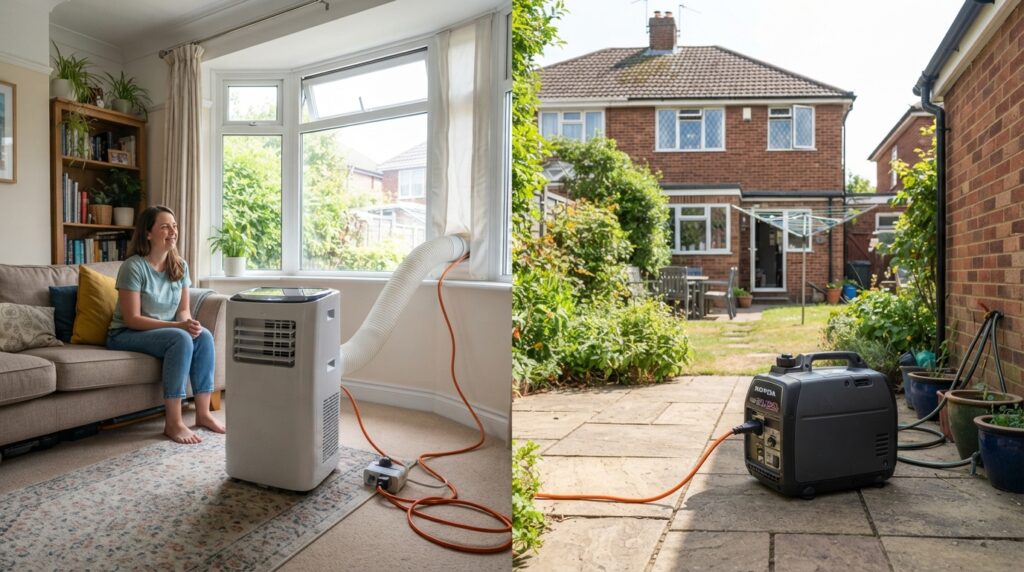
The number that catches people out isn’t the air conditioner’s running wattage — it’s the surge (starting) wattage. The compressor motor inside an air conditioner draws noticeably more power for a brief moment when it starts up than it does while running, and a generator has to handle that surge as well as the steady running load, plus whatever else is plugged in. Check the rating plate on the unit itself (or its spec sheet) for running watts/amps and, where listed, starting current — don’t estimate it from the BTU figure. Then choose a generator with genuine headroom above that, favour an inverter generator for cleaner power, and never run a generator indoors or in an enclosed space because of carbon monoxide.
Whether you’re planning for a power cut, running a cabin or static caravan off-grid, or cooling a room where there’s no mains supply, matching a generator to a portable air conditioner is mostly about respecting the startup surge and leaving headroom. Here’s how.
Running watts vs starting watts — the bit people miss
An air conditioner’s compressor is a motor, and motors draw considerably more current for a brief instant when they start than they do once they’re running steadily — this “surge” or “starting” current is a normal feature of how motors work, not a fault. A generator sized only to the unit’s running wattage can be overwhelmed by that brief starting spike, even though it would run the unit fine once it’s going. This is the single most common reason a generator that “should” be big enough trips out or stalls when the air conditioner switches its compressor on.
Leaving headroom
Beyond covering the starting surge, it’s sensible to choose a generator with some genuine headroom above the air conditioner’s running wattage — partly as a safety margin, and partly because you’ll likely want to run something else off the same generator at the same time (lighting, a fridge, a phone charger). Running a generator right at its stated maximum continuously also tends to shorten its working life and isn’t an efficient way to run it. A retailer or the generator’s own documentation can confirm what it can start and sustain — check both figures, not just the continuous running rating.
Why an inverter generator is usually the better match
An inverter generator
Cleaner power for sensitive electronics
Quieter running
Better suited to compressors and electronics
Inverter generators produce a more stable, cleaner electrical output than a conventional generator, which is kinder to sensitive electronics and to the compressor and control board inside an air conditioner. They also tend to run more quietly and adjust their engine speed to the load, which usually means better fuel efficiency when you’re not drawing full power. For running something like an air conditioner — which has both a motor and electronic controls — an inverter generator is generally the safer, more appropriate choice over a basic conventional model.
Good for: protecting the air conditioner’s electronics and compressor; quieter running; adjusting output to what’s actually needed.
Less good for: upfront cost — inverter generators typically cost more than a conventional generator of similar output.
Cables, sockets and safety
- Use an outdoor-rated extension lead if the air conditioner and generator aren’t right next to each other, and keep any cable runs off wet ground and away from where people walk.
- Don’t overload one socket or lead with multiple appliances beyond what it’s rated for.
- Keep the generator dry and on stable, level ground, away from anything flammable.
- Let the engine warm up before connecting a heavy load where the manufacturer recommends it — check the generator’s own instructions.
Fuel, runtime and noise — set realistic expectations
How long a tank of fuel lasts, and exactly how loud a generator is, varies enormously by model, load and how hard it’s working — we won’t invent a figure here, because it genuinely depends on your specific generator and how much you’re drawing from it. Check the manufacturer’s own runtime and noise figures for the exact model you’re considering, and factor in that an air conditioner’s compressor cycling on and off means the load — and therefore the fuel use — isn’t constant.
When this matters most
This comes up in a few common situations: a genuine power cut where you want to keep one room cool (our power cut cooling guide covers the wider picture, including when a generator isn’t the right answer at all), an off-grid cabin, shed or static caravan with no mains supply, or a campsite or event where mains power isn’t available. In every case, the same principle holds: size to the starting surge, not just the running figure, and never run the generator anywhere enclosed.
Frequently asked questions
Can I run a portable air conditioner off any generator?
Only if the generator can handle both the unit’s running wattage and its brief starting surge, with some headroom left over. Check the air conditioner’s rating plate for its actual figures rather than guessing from its cooling capacity.
Why did my generator trip when the air conditioner switched on?
Almost certainly the compressor’s starting surge, which draws more power for a moment than the running wattage alone. A generator sized only to the running figure, with no headroom, is the most common cause of this.
Do I need an inverter generator specifically?
Not strictly, but it’s generally the better choice — inverter generators produce cleaner, more stable power that’s kinder to a compressor and any electronic controls, and they tend to run quieter too.
Is it safe to run a generator near an open window?
No — carbon monoxide from the exhaust can still enter the building. Run a generator well away from windows, doors and vents, in the open air, regardless of how it might seem to be ventilated.
Sources
- Health and Safety Executive — Carbon monoxide dangers from generators and engines
- Electrical Safety First — Electrical safety and generators
- RoSPA — Carbon monoxide safety
Related reading: our power cut cooling guide and buying guide.
Compare current inverter generator options at Amazon UK — check the AC unit’s own rating plate first.