10 Winter Energy Myths That Are Costing You Money
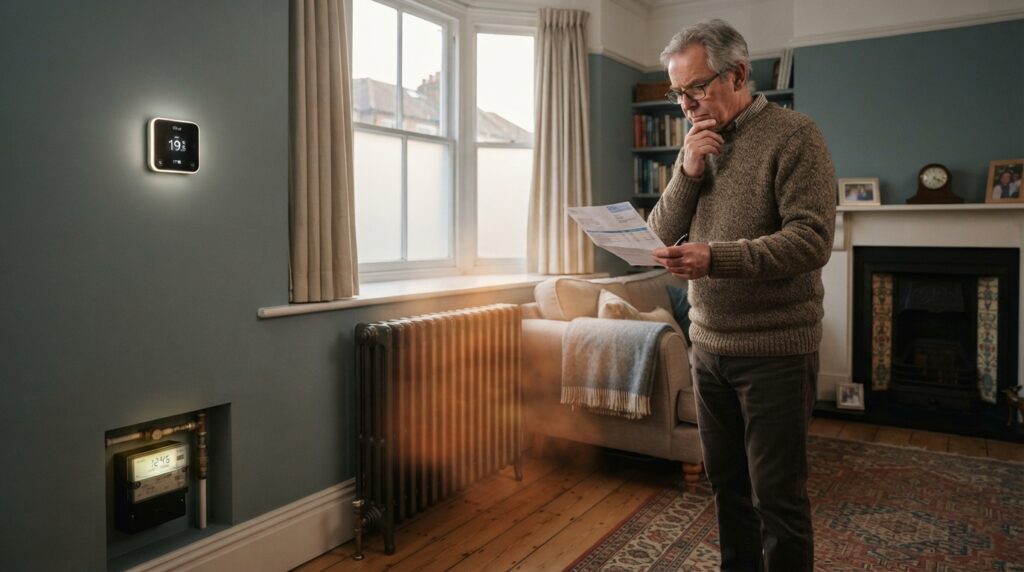
Some of these are outright false — plug-in “energy saving” boxes don’t reduce a domestic bill, and no electric heater is cheaper than another at the same wattage. Some are half-true in a way that misleads: leaving the heating on low all day generally costs more, but switching unused rooms fully off causes mould. And one is true but useless — turning the thermostat up doesn’t heat your house any faster.
Most of these persist because they sound plausible. Here’s what’s actually going on with each.
Myth 1: “It’s cheaper to leave the heating on low all day”
Generally false.
A house loses heat continuously, at a rate roughly proportional to how much warmer it is inside than outside. Keep it warm for twenty-four hours and you lose heat for twenty-four hours. Heat it for six and you lose considerably less.
Heat when you need it, using a schedule. The Energy Saving Trust’s guidance is consistent on this.
The important caveat, which is why this myth persists: a modest overnight setback beats switching off entirely, because it protects against frozen pipes and stops surfaces getting cold enough to condense on. “Down, not off” is the accurate version. Our overnight heating guide covers the nuance.
Myth 2: “Turning the thermostat up heats the house faster”
False.
A boiler and radiators put out heat at their rate. The thermostat is a target, not an accelerator. Setting 25°C when you want 20°C doesn’t get you to 20°C sooner — it just means the system keeps going past 20°C and overshoots, costing you money and leaving the house too warm.
Exactly the same applies to air conditioners in the opposite direction, as covered in our cooling temperature guide.
Myth 3: “Some electric heaters are cheaper to run than others”
False, at the same wattage.
Every resistive electric heater — fan heater, oil-filled radiator, halogen, panel heater, convector — converts electricity to heat at essentially 100%. A 2kW heater of any type costs the same per hour as any other 2kW heater. Marketing that implies otherwise is describing how the heat is distributed, not how much it costs.
Distribution does matter for comfort. An oil-filled radiator holds heat and warms a room gently; a halogen heater warms you directly and quickly. Choose on that basis, not on claimed efficiency.
The one real exception is a heat pump, which moves heat rather than generating it and can therefore deliver more heat energy than the electricity it consumes. Our running costs comparison covers the difference properly.
Myth 4: “Plug-in energy saving boxes cut your bill”
False for domestic customers.
These devices are sold with claims of reducing household electricity use by a percentage, usually via “power factor correction”. Domestic customers are billed on real power, not reactive power, so correcting power factor doesn’t reduce a household bill in the way advertised.
Treat any device promising percentage savings without changing anything about your home or behaviour with strong scepticism. If a claim seems too good to be true in the energy sector, it generally is — and misleading pricing and savings claims are exactly what the CMA gained direct enforcement powers over under the Digital Markets, Competition and Consumers Act.
Myth 5: “Radiator foil works everywhere”
Half-true.
Reflector panels help on radiators against uninsulated external walls, by bouncing heat back into the room rather than into the masonry.
On an internal wall they do essentially nothing — heat going into that wall ends up in another room of your own house. On a well-insulated cavity wall the benefit is much smaller.
Fit them selectively. And use proper foil-faced panels rather than kitchen foil, which crumples and tarnishes. Our cheap upgrades guide covers where they earn their money.
Myth 6: “Closing off unused rooms saves money”
True, with a serious caveat.
Closing the door and turning down the TRV does save — that’s sound. But turning the radiator fully off leaves a cold room, and moisture from the rest of the house condenses on its cold surfaces. That’s why the closed-off spare room is so reliably the one with mould behind the wardrobe.
Damp and mould are a health issue, and remediation costs far more than the low background heating would have. Turn down, don’t turn off. Our closed doors guide and damp guide cover it.
Myth 7: “Draught-proofing causes damp”
False if done correctly — true if done wrong.
Proper draught-proofing raises internal surface temperatures, which reduces condensation risk. The problem arises when people don’t distinguish between draughts and ventilation.
Seal: gaps around doors and windows, letterboxes, keyholes, floorboard gaps, unused chimneys.
Never block: airbricks, trickle vents, extractor fans, vents serving a suspended floor, and any ventilation serving a gas appliance, wood burner or open fire — that last one is a carbon monoxide risk, not just a damp one.
Our draught-proofing guide covers the boundary in detail.
Myth 8: “Standby power is trivial”
False.
The Energy Saving Trust puts the saving from switching devices off standby at somewhere in the region of £45–£55 a year for a typical household, and up to around £70. The Powering the Nation research found that a meaningful share of domestic electricity goes to appliances that aren’t actively being used.
Individual devices are small; the aggregate across a modern household isn’t. Our standby guide covers which devices are worth targeting — and note that in summer, standby draw is also heat being dumped into your rooms.
Sensible exceptions: don’t switch off anything that needs to stay on — fridges, freezers, alarms, medical equipment, routers you rely on, and anything with a clock or schedule you’d have to reset daily.
Myth 9: “Modern insulation means you don’t need to worry about summer”
False, and increasingly so.
Insulation slows heat transfer in both directions. Well-insulated, airtight modern homes are excellent at retaining winter heat — and equally good at retaining summer heat once it gets in. Overheating in new builds is a recognised problem, which is why our explainer on UK housing exists.
The measures that work in both directions are shading and ventilation strategy, not insulation alone.
Myth 10: “You need a professional to fix a cold radiator”
Often false.
Two of the most common causes are free and take five minutes:
- A seized TRV. Pull off the plastic head and check the pin underneath moves freely. If it’s stuck down, gently free it. This is the single most common cause of a room that won’t heat.
- Air in the radiator. Cold at the top, warm at the bottom means it needs bleeding — our bleeding guide covers the method and the order.
When you do need someone: cold at the bottom (sludge), pressure that keeps dropping (a leak), anything involving gas, and anything involving a refrigerant circuit, which legally requires F-Gas certification.
The things that genuinely work
Since this article is mostly about what doesn’t:
- Draught-proofing. Cheapest meaningful improvement available to most households.
- Loft insulation to current guidance — around 270mm of mineral wool. Many homes have far less.
- Working TRVs, used properly. Often free.
- A sensible heating schedule rather than heating an empty house.
- Thermal curtains, closed at dusk. Works in summer too.
- One degree lower on the thermostat — try it for a fortnight before deciding.
- Checking what support you’re entitled to. Several schemes go widely unclaimed; Citizens Advice can run a check.
Frequently asked questions
Is it worth turning the boiler flow temperature down?
Often yes on a combi serving radiators — condensing boilers are more efficient when return water is cool enough for the flue gases to condense, and many are set higher than necessary. The trade-off is slower warm-up. Check the Energy Saving Trust’s current guidance and ask your engineer at the next service.
Do smart thermostats save money?
Depends entirely on your starting point. Going from no room thermostat to proper control is a real improvement; going from a well-used programmable thermostat to a smart one is mostly convenience. Our smart controls guide covers how to judge it.
Does closing curtains actually help?
Yes, genuinely — glass is the weakest thermal element in most rooms, and a lined curtain adds a layer of still air against it. Close at dusk, and make sure they aren’t hanging over a radiator, which sends the heat up the window.
Sources
- Energy Saving Trust — Thermostats and heating controls
- Energy Saving Trust — Draught-proofing
- Energy Saving Trust — Roof and loft insulation
- Energy Saving Trust — Quick tips to save energy (standby savings)
- Energy Saving Trust — Air source heat pumps
- CMA — Digital Markets, Competition and Consumers Act (misleading claims enforcement)
- GOV.UK — Damp and mould: health risks
- Citizens Advice — Grants and benefits to help pay energy bills
Related reading: our cheap upgrades guide and things making your house colder list.
Related guides



Compare current prices, stock and reviews on portable air conditioners at Amazon UK. Prices and stock move fast in a heatwave, so it is worth checking before you commit.
Browse air conditioners →