Air Conditioner Winter Maintenance You Can Do in 20 Minutes
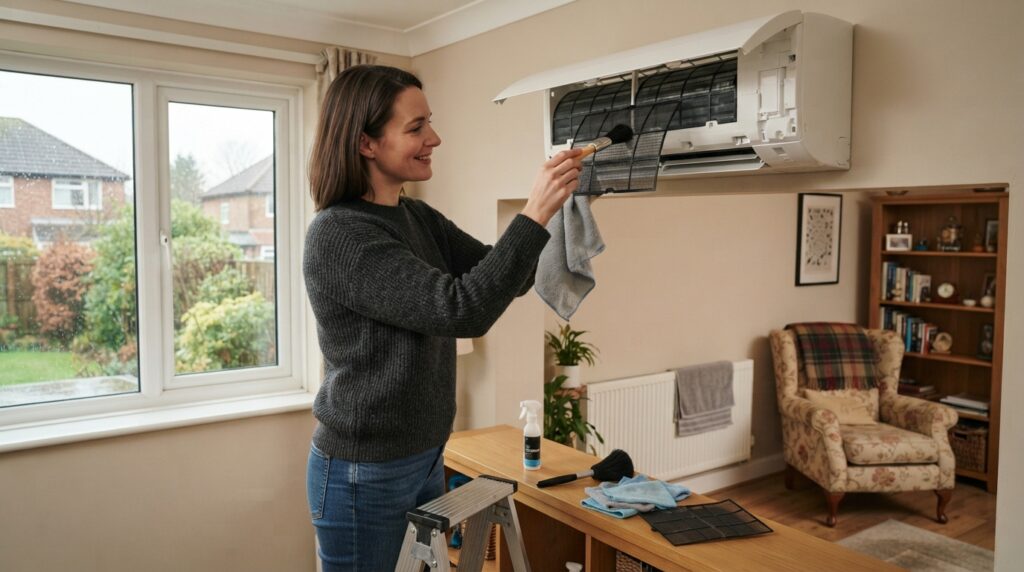
Twenty minutes on a winter afternoon, and next summer’s unit works properly instead of smelling of mould. The list: check it’s stored upright and dry, inspect the filter, uncoil the hose if you folded it tightly, check the seals and window kit are intact, and find the manual. None of it involves running the unit — which you shouldn’t do in a cold room anyway.
Most air conditioner problems people discover in July were created the previous October. This is the winter check that prevents them, and it genuinely takes twenty minutes.
Before you start: don’t run it
The instinct is to switch it on and check it works. Resist that.
Most portable air conditioners have a minimum operating temperature — commonly somewhere around 16–18°C, though check your manual. Running the compressor below that can ice the evaporator coil and strains the system. You’d be creating a problem to check for one.
Fan-only mode is fine at any temperature, since it doesn’t engage the compressor. That’s the mode used for drying the unit out. But there’s no benefit to running it periodically through winter — our winter running guide covers why that advice belongs to fixed split systems rather than portables.
Minute 1–3: Check where and how it’s stored
Three things:
- Is it upright? Most manufacturers specify upright storage so refrigerant and compressor oil settle correctly. A unit that’s been on its side needs to stand upright for several hours before use.
- Is it dry? A garage or shed that swings between wet and frozen is a poor choice. A spare room, a dry loft, or a heated utility space is better.
- Is anything stacked on it? Boxes on top of the casing can distort vents and grilles.
Our storage guide covers the full autumn routine.
Minute 4–8: The filter
The single highest-value item on this list.
- Take it out and look at it. If it’s dusty, wash it in lukewarm water with a little mild detergent.
- Let it dry completely — genuinely completely, over several hours, not “mostly dry”. A damp filter refitted into a sealed unit is the number one cause of the musty smell people meet next June. Our smell guide covers the mechanism.
- Check it for damage — tears, distortion, a warped frame. Order a replacement now if needed rather than in a heatwave when everyone else wants one.
- Refit it. Don’t store the unit with the filter out; the aperture is a dust trap.
If yours has a carbon or HEPA-type element as well as the mesh, note that those are typically replaced rather than washed — check the manual for the interval.
Minute 9–12: The exhaust hose
The part most likely to have been put away badly.
- If you folded it tightly, uncoil it now. Left creased for eight months, the accordion material takes a permanent set and the crease restricts airflow forever after. Store it loosely coiled or extended.
- Check for splits, particularly at the ends where it fits the couplings. A split hose leaks hot air back into the room.
- Check the couplings haven’t cracked. These are usually plastic and they’re the first thing to fail.
- Check the inside for anything that’s got in — spiders and dust are common.
Minute 13–16: The window kit and seals
Frequently the weakest link in the whole setup, as covered in our hacks list — a poorly sealed kit undoes a large share of the unit’s work.
- Find it. It’s often the bit that goes missing between seasons.
- Check the slider panels for cracks and the adjustment mechanism for stiffness.
- Check any foam or brush seal hasn’t perished, compressed or gone brittle.
- Check any zip or hook-and-loop on a fabric kit still functions.
- Note what you’ll need to improve it next summer — foam tape, draught strip, or a cut board for an awkward window. Buying it now is cheaper and easier than in June.
Our window seal kits guide covers the options if yours needs replacing.
Minute 17–19: Drainage and casing
- Check the tank is empty and dry. Water left standing all winter grows things.
- Check the drain plug and any continuous drainage port are clear and the caps present.
- Wipe the casing and grilles — a dry cloth over the intake and outlet vents.
- Check the castors turn. They seize, and a heavy unit with a seized castor is awkward to move.
- Check the power cable for damage, and the plug for scorching or a loose fit. Any damage to a mains cable means don’t use it until it’s repaired or replaced.
Minute 20: The manual, and the diary
Two admin jobs that pay off later.
Find the manual, or download a PDF and save it somewhere you’ll find it. You want the minimum operating temperature, the filter cleaning interval, the continuous drainage instructions and the model number for ordering parts.
Put a reminder in your calendar for late March or April to do the spring reset — our spring checklist covers bringing it back into service. Finding a fault in April means you have options. Finding it in a July heatwave means competing with everyone else for stock, and with the El Niño-driven outlook covered in our summer 2027 guide, that’s not a queue you want to join.
If yours is a reverse-cycle heat pump unit
Different situation — you’re using it through winter rather than storing it, so this becomes in-season maintenance instead:
- Clean the filter more often, not less. It’s working continuously.
- Keep the window kit fitted and well sealed. Heating mode still exhausts outside, and a leaky kit undermines heating exactly as it undermines cooling.
- Watch for reduced output, which usually means a dirty filter or restricted airflow.
- Check the condensate arrangements — heating mode produces condensate too, sometimes in different volumes.
Our heating mode guide covers running one properly through the cold months.
What needs a professional
Everything above is user maintenance. These aren’t:
- Anything involving the refrigerant circuit. Work on refrigerant legally requires F-Gas certification — there’s no householder exemption. Our installation law guide covers this.
- Opening the sealed casing beyond removable panels the manual identifies.
- Electrical repairs beyond replacing a fuse in a plug.
- Fixed split systems, which have their own servicing requirements and an outdoor unit to check.
ElectriQ Eco Silent 12000
If yours is past it
53 dB
A-rated
Heat pump
Worth considering if this winter’s check turns up a unit that’s genuinely worn out. The reverse-cycle heat pump function means it earns its keep in winter as well as summer rather than sitting in a cupboard for eight months — which changes the value calculation considerably. Covers up to around 28m².
Frequently asked questions
Should I run it briefly to check it still works?
Not in cooling mode in a cold room — the minimum operating temperature makes that counterproductive. Fan-only mode is harmless if you want reassurance the electrics work. Save the real test for a mild day in spring.
How often should I do this over winter?
Once is enough for a properly stored unit. The autumn storage routine does the real work; this is a mid-winter check that everything’s still as you left it.
My unit already smells musty. Can I fix it now?
Yes, and now is better than June. Clean the filter thoroughly, and follow the cleaning routine in our smell guide. You may need to move it somewhere warm enough to run fan mode to dry it fully.
Is it worth buying a cover?
A loose cover or sheet against dust is fine, provided the unit went into storage completely dry. Don’t seal a damp unit under a cover — that’s the mould scenario.
Compare current prices, stock and reviews on portable air conditioners at Amazon UK. Winter is the sensible time to buy — normal prices, full availability.
Sources
- GOV.UK — Fluorinated gases (F-gases): rules
- Energy Saving Trust — Home appliances and energy use
- Electrical Safety First — Electrical safety around the home
- NOAA Climate Prediction Center — ENSO Diagnostic Discussion
Related reading: our full maintenance guide and winter storage guide.