Buying a Second-Hand Air Conditioner: What to Check Before You Pay
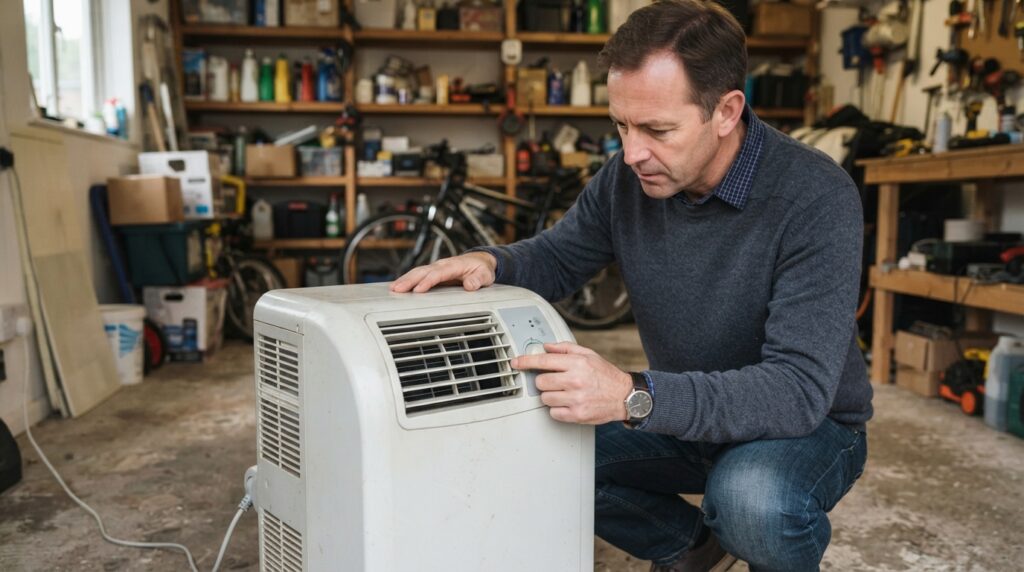
Two non-negotiables: see it running before you hand over money, and confirm the window kit and exhaust hose are both included. A unit without its kit is often effectively unusable, and replacements are expensive or unavailable. Beyond that, check for a musty smell (poor storage), listen for rattles, and be aware your consumer rights are minimal buying privately. Best hunting season is September, when the summer’s impulse buyers are clearing space.
There’s a genuine second-hand market for portable air conditioners, and prices can be a fraction of new. There are also specific ways to get stung that don’t apply to most appliances.
When to look
September and October are the sweet spot. People who bought in a heatwave panic have discovered they’ve nowhere to store a 30kg appliance, and listings appear. Prices are lowest when demand is lowest.
June and July are the worst time — everyone wants one, sellers know it, and you’re competing.
Also worth watching: house moves and clearances year-round, and university towns in June when students leave. Our buying timing guide covers the wider calendar, including whether new is actually cheaper than you assume out of season.
The two things that matter most
1. See it running
Non-negotiable. Ask the seller to have it plugged in and running when you arrive.
What you’re checking:
- It powers up and the display works.
- The compressor engages. You’ll hear it kick in after the fan — a distinct change in sound, usually within a minute or two of switching to cooling mode.
- Air from the outlet is genuinely cold, not just moving. Hold your hand there after a few minutes.
- The exhaust hose gets hot. This confirms it’s actually rejecting heat rather than just blowing air about.
If the seller says it’s packed away, or there’s no power where it’s stored, or they’d rather not — walk away. That’s the single most common way people buy a broken unit.
2. Confirm the window kit and hose
This catches people constantly. The window kit and exhaust hose are easy to lose during a house move, and without them the unit doesn’t work.
Replacement hoses and kits are model-specific, often expensive, and for discontinued models sometimes unavailable at any price. A cheap unit that needs a £40 hose you can’t source is not a bargain.
Ask for a photo of the kit before you travel. Our window seal kits guide covers what a complete kit should include.
The other checks
- Smell it. A musty or mildewy smell means it was stored damp without being dried out — the problem covered in our storage guide. It’s fixable, per our smell guide, but it tells you how the unit was looked after generally.
- Pull the filter out. Filthy and matted means neglected. Missing entirely is a warning sign, since running without one lets debris reach the coil.
- Listen for rattles or grinding. Some noise is normal; a rattle or grinding suggests loose components or a failing fan bearing. Our noise guide covers what’s normal.
- Check the castors and handle. Broken castors on a 30kg unit make it genuinely difficult to live with.
- Look underneath and around the base for water staining, which suggests a drainage or seal problem — see our leaking guide.
- Check the power cable along its whole length for damage, and the plug for scorching.
- Ask its age. Most portable units last around 8–12 years with reasonable care — our lifespan guide covers this. Something a decade old at a low price may still be fine, but budget for it not lasting.
- Get the model number and look up its BTU rating, noise level and running cost before you go. Sellers routinely misremember specifications.
Buy the right size, not the available size
The classic second-hand mistake. A cheap unit that’s undersized for your room runs continuously without ever reaching a comfortable temperature, costing more in electricity while performing worse.
Work out what you actually need using our BTU calculator guide before you start looking, and hold to it. A bargain in the wrong capacity isn’t a bargain.
Equally, avoid a much-oversized unit: it draws more power and cycles inefficiently in a small room.
Your consumer rights are limited
Worth understanding before you hand over cash.
Buying privately — Facebook Marketplace, Gumtree, a neighbour — gives you very little protection. The main requirement is that goods match their description. There’s no right to expect satisfactory quality the way there is from a trader, and returns are entirely at the seller’s discretion. Effectively: what you see is what you get, which is why seeing it run matters so much.
Buying from a business — a second-hand shop, a refurbisher, an eBay business seller — gives you considerably more. Goods must be of satisfactory quality, fit for purpose and as described, and you have rights if they’re not. Business sellers on marketplaces must identify themselves as such.
Our refurbished and ex-display guide covers the middle ground, which often offers better protection than a private sale for not much more money.
What to do once you’ve bought it
- Clean the filter thoroughly before first use, and let it dry completely — our maintenance guide covers the routine.
- Stand it upright for a few hours before switching on, especially if it was transported lying down. Refrigerant and compressor oil need to settle.
- Check the coil behind the filter for dust or fur matting, and clean if needed — our coil cleaning guide covers it.
- Run a fan-only cycle for an hour or two to dry out anything damp inside.
- Test the window kit fit on your actual window before you need it.
- Download the manual — almost always available as a PDF from the manufacturer, even for discontinued models.
When new is actually the better buy
Being honest about this. Second-hand makes sense when you find a well-maintained recent unit, complete with kit, at a genuine discount.
It makes less sense when:
- You’re buying out of season anyway. New prices in autumn and winter are considerably better than in summer — the gap to second-hand narrows a lot. Our Black Friday guide and January sales guide cover those windows.
- You want a heat pump model. These are less common second-hand, and the year-round value case is strong enough to justify new — see our heating mode guide.
- You need a specific size. Second-hand means taking what’s available.
- You want a warranty. Private sales come with none.
Pro Breeze 7000 BTU
The new-price benchmark
53 dB
~£296
~19p/hr
Worth knowing what new costs before you agree a second-hand price — this is our budget benchmark, and out of season it’s often closer to used prices than people expect. It’s also the cheapest of our picks to run, which matters more over years than the purchase price does.
Frequently asked questions
What’s a fair second-hand price?
Depends heavily on age, condition and completeness. Start by checking what the model costs new right now — out of season that figure may be lower than you expect, which strengthens your position. A unit missing its kit should be priced as effectively broken.
Can I buy a second-hand split system?
Not practically. Removing and reinstalling a split system requires F-Gas certified engineers at both ends, which usually costs more than the unit is worth second-hand. Our installation law guide covers why.
Is a unit with no manual a problem?
Not really — manufacturers almost always host PDFs, including for discontinued models. Get the exact model number and check it’s available before buying.
The seller says it works but it’s in the loft. Should I risk it?
No. This is the single most common way people end up with a broken unit. If it can’t be demonstrated running, treat the price as what you’d pay for something faulty — which is usually nothing.
Compare current new prices on portable air conditioners at Amazon UK — useful as a benchmark before agreeing a second-hand price.
Sources
- Citizens Advice — If you bought something from a private seller (limited rights on private sales)
- Citizens Advice — Consumer rights when buying goods
- GOV.UK — Accepting returns and giving refunds: the law
- Legislation.gov.uk — Consumer Rights Act 2015
- Electrical Safety First — Buying second-hand electrical goods
Related reading: our refurbished and ex-display guide and lifespan guide.