Refurbished and Ex-Display Air Conditioners: Worth the Risk?
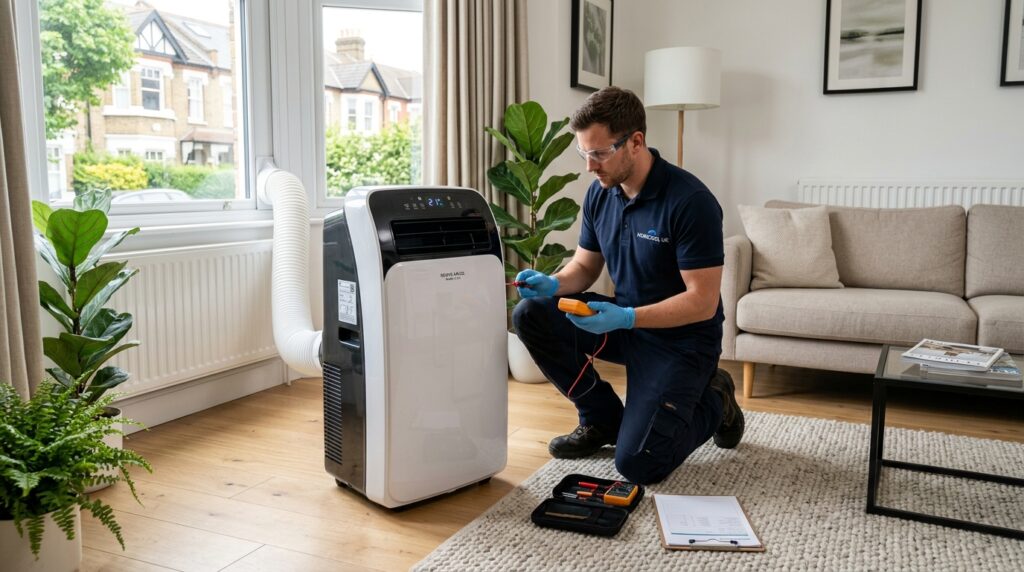
Often yes — and the reason is one people miss: buying from a retailer means the Consumer Rights Act applies, even to refurbished goods. Goods must be of satisfactory quality, fit for purpose and as described, judged against what you were told — so a unit sold as “refurbished, light cosmetic marks” must still work properly. That protection is exactly what you don’t get buying privately. The three grades are not equivalent: ex-display has usually only been switched on, open-box is typically a return, and refurbished means something was wrong and was fixed. Ask which one you’re buying.
This is one of the better ways to save money on cooling, provided you understand what you’re buying and from whom.
The three categories
Retailers use these loosely, so ask rather than assume.
Ex-display
A unit that stood in a showroom. Usually switched on to demonstrate, sometimes never run properly. Cosmetic marks are likely; mechanical wear is minimal.
Usually the best value of the three — close to new condition, at a reduced price, with the risk mostly cosmetic.
Worth checking: whether the window kit, hose, remote and manual are all present. Display units lose accessories, and a missing window kit is a genuine nuisance to replace.
Open-box or returned
Bought, opened, returned. Could be a change of mind, could be a fault the previous buyer found.
The question to ask: was it tested before resale? A retailer that tests and states so is offering something meaningfully different from one that repackages returns unchecked.
Refurbished
Something was wrong and has been repaired. That isn’t automatically bad — a professionally repaired unit with a warranty can be a sound buy — but you should know:
- What was the fault?
- Who did the repair — the manufacturer, an authorised agent, or the retailer?
- What warranty applies to the repair and to the rest of the unit?
Manufacturer-refurbished is generally the strongest, since the manufacturer has the parts, the specifications and a reputation at stake.
Your rights — the part that makes this worth doing
This is the substantive difference between a refurbished unit from a retailer and a used one from a private seller, and it’s worth knowing properly.
Under the Consumer Rights Act 2015, goods bought from a trader must be:
- Of satisfactory quality — judged by what a reasonable person would expect, taking into account the description and price. A unit sold as refurbished with cosmetic marks is judged against that description, not against new.
- Fit for purpose — it must cool.
- As described — if the listing says “tested, full working order” and it isn’t, that’s a breach regardless of grade.
The remedies, in broad terms:
- A short-term right to reject for a full refund applies within 30 days of purchase
- After that, you’re generally entitled to a repair or replacement first
- If that fails, a price reduction or a final right to reject may apply
- Within the first six months, a fault is generally presumed to have been present at purchase unless the trader proves otherwise — a meaningful advantage
Time limits for bringing a claim are six years in England, Wales and Northern Ireland, and five years in Scotland. That’s the limit for court action, not a guarantee the goods will last that long.
What to check before buying
- Which grade is it? Ex-display, open-box or refurbished — ask explicitly.
- What warranty is offered, and by whom? Retailer or manufacturer, and for how long. Get it in writing.
- Are all accessories included? Window kit, hose, remote, manual, drain plug. Sourcing a replacement window kit for a specific model is harder than it sounds.
- Has it been tested? And is that stated in the listing, so it forms part of the description?
- What’s the return policy? Distance selling rules generally give a cancellation period for online purchases, but check the terms.
- What’s the actual saving? Compare against the current new price, not the original RRP.
- Is it a current model? Parts and filters for discontinued models get harder to find.
- What’s the energy rating? A cheap, inefficient unit costs more over a few summers. Our running cost guide covers it.
What to check on arrival
Do this within the 30-day window, and don’t wait for the first heatwave to find a problem.
- Run it properly for an hour. Confirm the compressor engages — a low hum distinct from the fan — and that the air is genuinely cold, not just moving.
- Check for unusual noises. Our noise guide covers what’s normal and what isn’t.
- Smell it. Musty means moisture got in during storage. Anything acrid or burning means unplug it and return it.
- Inspect the cable and plug for damage.
- Check the hose for splits and permanent creases.
- Look for damage to the casing near the refrigerant circuit. A unit that’s been dropped is a different proposition — see the safety note below.
- Check the rating plate matches what you ordered, including the refrigerant type and stated minimum room size.
Where to buy
Better: manufacturer outlet stores, major retailers’ clearance and refurbished sections, and established online retailers with a published returns policy. All are traders, so the Consumer Rights Act applies in full.
Be more careful with: marketplace sellers where it isn’t clear whether you’re buying from a trader or an individual. That distinction decides which rights you have, and it isn’t always obvious from a listing.
Different territory entirely: private sales. Buying from an individual on a classified site means goods must match their description, but the satisfactory-quality and fit-for-purpose protections don’t apply as they do with a trader. Our second-hand guide covers that case.
When to skip it
- The saving is small. If refurbished is within a little of new, take new with a full warranty.
- No warranty at all is offered. On an appliance with a compressor, that’s a meaningful gamble.
- The grade is vague and the seller won’t clarify.
- It’s a discontinued model and you can’t establish parts availability.
- Accessories are missing.
- You need it this week. Refurbished stock and returns take longer to resolve if something’s wrong.
Frequently asked questions
Does a refurbished unit come with a warranty?
Often, but shorter than new — and it varies a great deal. Get the length and the provider in writing before buying. Your statutory rights apply regardless of what warranty is offered.
Can a retailer refuse a refund on clearance items?
Not for faulty goods. Statutory rights can’t be contracted out of by labelling something clearance or refurbished. “Sold as seen” has no effect on a trader’s obligations for faults you weren’t told about.
Is ex-display better than refurbished?
Usually, yes. Ex-display has typically been switched on rather than used, so the risk is cosmetic. Refurbished means something was wrong — which can be fine if a manufacturer fixed it and warrants it, but it’s a bigger question.
How much should I expect to save?
We don’t quote figures, since they move constantly and depend on grade and model. Compare against the current new price rather than the original RRP — that’s the comparison that tells you whether the saving is real.
Sources
- Citizens Advice — Problems with something you’ve bought
- Legislation.gov.uk — Consumer Rights Act 2015
- Citizens Advice — If you paid by card (section 75)
- CMA — Competition and Markets Authority
- BESA — Rise of propane sparks safety fears (R290 classification)
- Electrical Safety First — Electrical safety around the home
Related reading: our second-hand guide and extended warranties guide.
Compare refurbished and new at Amazon UK. Check the grade, the warranty and whether all accessories are included before ordering.