Air Conditioning in a Home With Pets: Fur, Filters and Safety
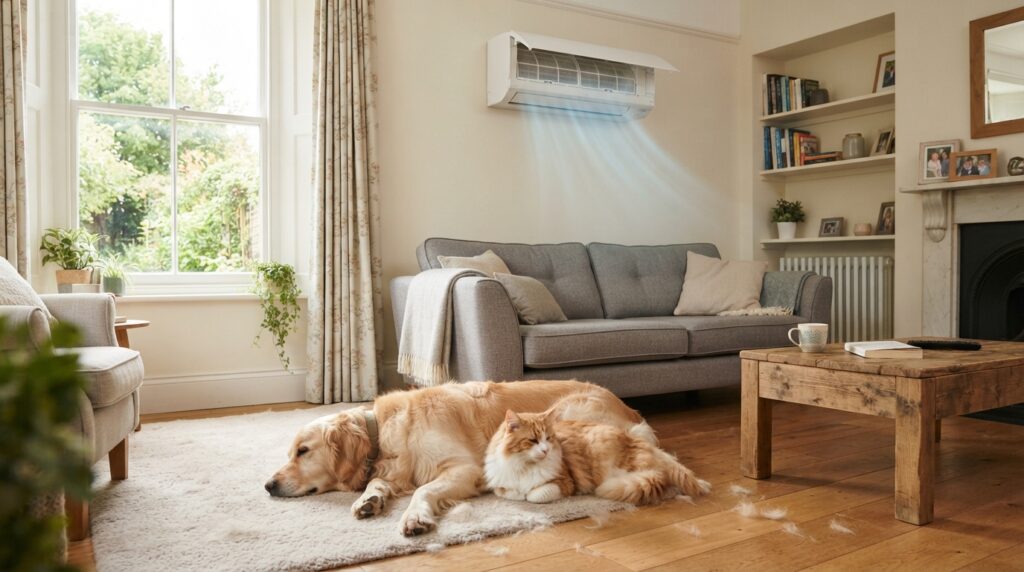
Three practical differences. Filters clog far faster — expect to clean weekly during moulting season rather than fortnightly, because a blocked filter costs cooling performance and electricity. The exhaust hose is a chew and trip hazard, and a dislodged hose means the unit pumps hot air back into the room. And don’t aim cold air directly at a sleeping animal — cool the room, not the pet. Cats will find the coolest spot themselves; the job is making sure one exists.
We cover keeping pets cool separately. This is the other side: what changes about running and maintaining an air conditioner when there are animals in the house.
Filters clog dramatically faster
The mesh pre-filter in a portable air conditioner exists to protect the evaporator coil from dust and debris. In a home with a shedding dog or cat it does that job much harder.
Why it matters beyond housekeeping: a clogged filter restricts airflow across the coil, which means less heat removed per minute, which means the compressor runs longer for the same result. That shows up directly on your bill — our running cost guide covers the figures.
Severe restriction can also cause the coil to ice up, which stops cooling entirely. Our frozen coils guide covers that failure mode, and pet hair is one of the more common causes of it.
Practical schedule: check weekly during moulting season, fortnightly otherwise. It takes two minutes.
Cleaning a fur-loaded filter properly
- Switch off and unplug first.
- Vacuum the worst of it off before you go near water. Wet fur turns into a mat that’s genuinely hard to remove.
- Rinse from the clean side outward, pushing debris back the way it came rather than further into the mesh.
- Let it dry completely before refitting. Refitting a damp filter is the most common cause of the musty smell covered in our smell guide.
- Check the coil behind it occasionally. If fur has got past the filter and matted onto the fins, that needs the deeper clean covered in our coil cleaning guide.
Our washable filter guide covers filter types — for a pet household, a straightforward mesh-only design you can clean endlessly is genuinely preferable to one with consumable layers you’ll be replacing constantly.
The hose and cable问题
Both are hazards, in both directions.
- Chewing. Puppies, rabbits and some cats will chew a power cable. That’s a genuine electrocution and fire risk, not a theoretical one. Route cables behind furniture, use cable protectors, or restrict access to the room when you’re out.
- Dislodged hose. A dog knocking the exhaust hose off its window kit means the unit is pumping hot air straight back into the room — it’ll seem to have stopped working, and it’ll run continuously getting nowhere. Check the connection is properly locked, and consider a bracket or tie.
- Trip hazard. For you as much as them, particularly with a hose crossing a room in the dark.
- Knocking the unit over. A large dog can shift a portable unit. Most manufacturers specify upright operation and storage; if it’s tipped, stand it upright for a few hours before running it again.
Don’t point it at the animal
The instinct is to aim cold air at an overheating dog. Resist it.
Cool the room and let the animal choose where to lie. Pets are genuinely good at thermoregulating by position — the job is making sure a cool spot exists, not deciding where it should be.
Direct airflow onto a sleeping animal for hours isn’t dangerous exactly, but it isn’t what they’d choose, and they can’t move a fan aimed at them the way you’d shift your chair.
Leave a route out. If you’re cooling one room, don’t shut a pet in it with no alternative. Being able to move between a cool room and a warmer one is how animals self-regulate.
Running it while you’re out
A common reason pet owners buy one at all. A few points:
- Use a timer or smart plug rather than leaving it running all day — our smart plugs guide covers the options, and app control lets you check it’s actually running.
- Make sure water is available in the room, and ideally more than one bowl.
- Check the unit’s behaviour if power is interrupted. Some units restart in their previous mode after a power cut; others don’t restart at all. Worth knowing which yours does before relying on it.
- Don’t rely on a single point of failure. Shade, ventilation and water matter as much as the appliance — our keeping pets cool guide covers the wider picture.
Noise and animals
Some pets are genuinely bothered by a compressor cycling on and off, particularly noise-sensitive dogs. Others settle better with consistent background sound.
If yours is anxious, a quieter unit and a steady low fan setting is worth prioritising over raw capacity. Introduce it gradually rather than switching it on at full speed next to their bed.
The picks
Pro Breeze 7000 BTU
Quiet, easy filter access
53 dB
~£296
~19p/hr
Quietest and cheapest to run of our picks, which matters if you’re running it through the day while you’re out. Straightforward slide-out washable filter, which you’ll be grateful for when you’re cleaning it weekly through moulting season. Suits rooms up to around 20m².
MeacoCool MC Series 9000
Check on it remotely
51–55 dB
~£349
App control
The app control genuinely earns its place for pet owners — being able to confirm from work that the unit is still running, and adjust it if the day gets hotter than forecast, is exactly the reassurance you want. More capacity for a larger living room or open-plan space up to around 25m².
A note on allergies
If someone in the household is allergic to the pet, don’t expect the air conditioner to help much. Its mesh filter catches visible hair, not the fine dander that actually causes reactions.
What it does do is let you keep windows closed comfortably, and it reduces humidity, which helps with dust mites. For actual dander filtration you want a dedicated HEPA purifier — our air purification guide explains why “air purifying” claims on air conditioner listings usually describe a standard mesh screen.
Frequently asked questions
How often should I really clean the filter with a shedding dog?
Weekly during moulting season, fortnightly otherwise. Check it rather than following a schedule blindly — if it looks furred over, clean it regardless of when you last did.
Is air conditioning safe for pets generally?
Yes — a comfortably cooled room is considerably safer for an animal than an overheating one, and heatstroke is a genuine emergency. The practical points are the ones above: don’t aim it directly at them, leave a route to a different room, and keep water available.
My cat sits in front of the unit. Is that a problem?
Not for the cat, but it can be for the unit if it blocks the intake — restricted airflow degrades performance the same way a clogged filter does. Keep the intake and outlet clear.
What temperature should I leave it at for a dog at home alone?
Aim for a comfortable room rather than a cold one — somewhere in the low twenties is generally sensible. Your vet is the right source for advice on a specific animal, particularly a flat-faced breed, an older dog or one with a health condition.
Compare current prices, stock and reviews on portable air conditioners at Amazon UK.
Sources
- PDSA — Heatstroke in dogs (signs, emergency response, risk factors)
- RSPCA — Keeping pets safe in hot weather
- Blue Cross — Heatstroke in dogs
- Electrical Safety First — Electrical safety around the home (cable damage risks)
- Energy Saving Trust — Home appliances and energy use
Related reading: our keeping pets cool guide and maintenance guide.